
TDR and Cable Length Testers: Locating Faults by Distance
Time-domain reflectometers that measure cable length and locate faults by distance, on fiber and on copper.
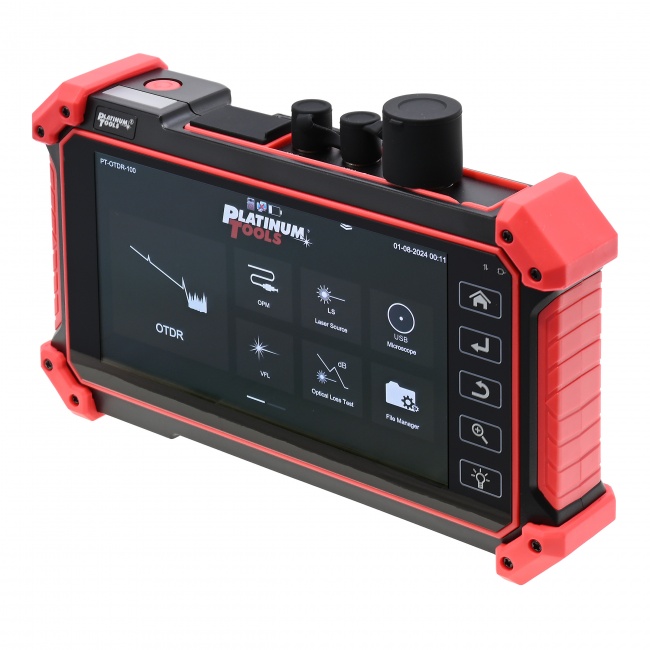
A time-domain reflectometer measures how far along a cable a fault sits, so you can open one ceiling tile instead of twenty. Our catalog includes the Platinum Tools PT-OTDR-100 ($931.78), a handheld that works as an OTDR on fiber (3 m to 105 km at 1310 and 1550 nm, 26/28 dB dynamic range) and as a TDR on copper, returning length and distance-to-fault on twisted pair. Traces export as .SOR files or PDF reports for as-built documentation.
Every other tester on this site answers a yes/no question: is the cable wired correctly, does it pass to a standard, is there power on the pair. A time-domain reflectometer answers a different question, and it is usually the expensive one: where is the problem.
A TDR sends a pulse down the cable and times the reflections that come back. Because signal velocity through a given cable type is known, the time delay converts directly into distance. An impedance change, a break, a poor splice, or an open all reflect differently, so the instrument reports both the type of event and how many feet or meters away it sits. The optical version of the same technique is called an OTDR and works identically on glass with a laser pulse instead of an electrical one.
The Platinum Tools PT-OTDR-100 ($931.78) is both instruments in one housing. On fiber it traces a span from 3 meters out to 105 km at 1310 nm and 1550 nm with 26/28 dB of dynamic range, and auto-maps each event on the link. On copper it acts as a TDR for length and distance-to-fault on twisted pair. It also carries an integrated optical power meter, laser source, and visual fault locator.
That matters for a contractor whose work is mostly copper with a fiber backbone. Buying a dedicated OTDR and a separate copper length meter means two instruments, two calibrations, and two sets of reports. One reflectometer covering both sides keeps the documentation in one place and the toolbag lighter. Our fiber vs copper test cost comparison works through where that tradeoff lands.
For background on the technique and how to read a trace, see how to perform a TDR cable test, how to measure cable length with a tester, and how to find a cable fault fast. If you are testing fiber end to end for the first time, start with our fiber testing walkthrough.
Frequently Asked Questions
What is the difference between a TDR and an OTDR?
They use the same technique on different media. A TDR (time-domain reflectometer) sends an electrical pulse down a copper cable and times the reflections to locate impedance changes, opens, and shorts by distance. An OTDR (optical time-domain reflectometer) sends a laser pulse down a fiber and times the backscatter and reflections to locate splices, connectors, bends, and breaks. The PT-OTDR-100 performs both.
Does a TDR replace a cable tester or a certifier?
No, it answers a different question. A cable tester confirms the cable is wired correctly. A certifier proves it meets a TIA-568 performance standard and produces the pass/fail report a warranty program requires. A TDR tells you how far away a fault is so you can physically find it. Most installers own a tester first and add a reflectometer when troubleshooting time, not test coverage, becomes the expensive part of the job.
How accurate is distance-to-fault on a TDR?
Distance accuracy depends on entering the correct nominal velocity of propagation (NVP) for the cable under test, because the instrument converts time to distance using that figure. An NVP that is off by a few percent shifts the reported distance by the same few percent, which on a 300 ft run is a matter of feet. Check the cable manufacturer datasheet for NVP before relying on a reading to open a wall.
Can one instrument really test both fiber and copper?
Yes, when it carries both a laser transmitter for the optical side and an electrical pulse generator for the copper side. The PT-OTDR-100 does, and it adds an optical power meter, laser source, and visual fault locator. It is aimed at contractors running a fiber backbone into copper horizontal cabling, where carrying two separate reflectometers is hard to justify.