
Visual Fault Locators: Fiber Faults You Can See
Visible red laser tools for fiber continuity checks, strand identification, and finding breaks and bends by eye.
A visual fault locator is a visible red laser you connect to one end of a fiber so faults show up as a glow you can see with your eyes rather than a trace you have to interpret. Our catalog includes the Platinum Tools TVFL100 ($140.94), a 10 mW pocket unit with solid and flashing beam modes, a 2.5 mm interface with a 1.25 mm adapter, and 20+ hours of runtime on two AA batteries. It is the fastest first check on a dead fiber link and the standard way to identify which strand is which at a patch panel.
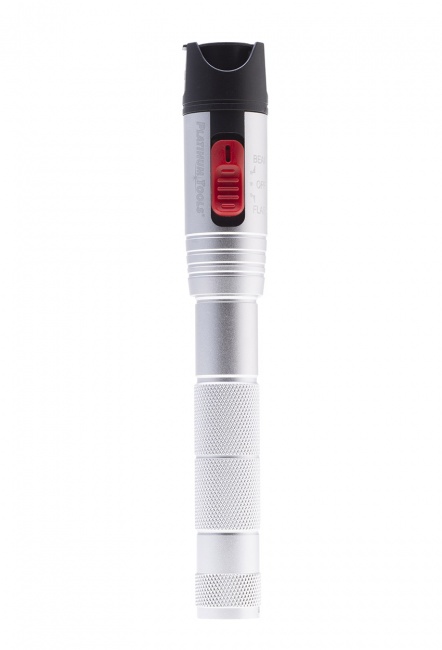
A visual fault locator is the simplest instrument in fiber testing and often the first one you should reach for. It couples a visible red laser into the fiber. Light escapes wherever the glass is broken, cracked, badly spliced, or bent too tightly, and because the wavelength is visible, that escape shows as a red glow through the jacket. No trace, no dead zone, no interpretation.
The Platinum Tools TVFL100 ($140.94) is a 10 mW unit in an aluminum body, with solid and flashing beam modes, a 2.5 mm connector interface plus a 1.25 mm adapter, and more than 20 hours of runtime on two AA batteries.
Three jobs a VFL does that an OTDR cannot
Near-end faults. Every OTDR has a dead zone: a stretch at the start of the trace, typically the first several meters, where the reflection from the launch connector saturates the detector and hides anything behind it. That is exactly where connector and patch-panel faults tend to live. A VFL has no dead zone, so it finds them.
Strand identification. In a splice tray or a densely loaded patch panel, telling one strand from another is a physical problem, not a measurement problem. Light one end and look for the glow at the other. The flashing mode makes it obvious in a bundle of lit fibers.
Speed. Confirming that a link is continuous end to end takes seconds and costs nothing in setup. Bringing out a reflectometer to discover the fiber was simply broken is time you do not get back.
A VFL does not measure loss and does not tell you how far away a fault is. When you need distance, that is reflectometer work: see the TDR and cable length testers category. For the full sequence on a new fiber run, read how to test fiber optic end to end and our roundup of the best fiber testers.
Frequently Asked Questions
What does a visual fault locator actually detect?
Breaks, cracks, poorly seated or dirty connectors, bad mechanical splices, and macrobends (bends tighter than the fiber allows). All of these let visible light escape the glass, so they appear as a red glow through the jacket or at the connector. A VFL confirms continuity and locates a visible escape point. It does not measure optical loss and does not report distance.
Do I still need an OTDR if I have a visual fault locator?
For anything longer than a patch cord, yes. A VFL is limited by how far the visible light carries and by your ability to physically walk the run and look at it, so it is a short-range, line-of-sight tool. An OTDR characterises a full span, measures loss at each event, and reports the distance to a fault on cable you cannot see. The two are complementary: VFL first for the fast check and the near end, OTDR when you need distance and loss numbers.
Will a visual fault locator work through the cable jacket?
On most standard jacketed patch cords and distribution cable, yes, the glow is visible at a break or a tight bend. It is far less visible through heavily armored, dark, or thick outdoor-plant jackets, and it will not be visible at all inside conduit or a wall. Work in low ambient light where you can, which makes a marginal glow much easier to spot.
Is a 10 mW visual fault locator safe to look at?
Never look directly into the output of a VFL or into the end of a fiber connected to one, and never point it at anyone. The output is a laser. The safe way to use it is to look at the side of the fiber for escaping light, or at a connector ferrule from an angle, not down the axis of the beam. Follow the manufacturer safety instructions supplied with the unit.