Why Length Measurement Matters
The TIA-568 standard limits a permanent link to 90 meters of installed cable, with up to 5 meters of patch cord at each end for a total channel length of 100 meters. This is not an arbitrary number. Insertion loss in a copper twisted pair scales linearly with length, and at 10GBASE-T frequencies a cable that is 10% too long can lose enough signal margin to fail certification — even if every other parameter is fine.
Length problems are also one of the easiest faults to misdiagnose. A run that "should" be 60 meters based on the floor plan often turns out to be 95 meters because of the actual path the cable takes through the ceiling, around obstacles, down the riser, and through the conduit. Without measurement, you are guessing.
How TDR Length Measurement Works
Time Domain Reflectometry has been used in the telephone industry since the 1930s. The principle is identical for modern cable testers.
The pulse
The tester sends a sharp electrical pulse — a step or a fast rise edge — onto one pair of the cable. The pulse travels down the conductor at a speed determined by the dielectric properties of the cable insulation.
The reflection
When the pulse encounters any change in cable impedance, some of its energy reflects back toward the tester. Major impedance changes occur at the far end of the cable (open or short circuit) and at any defect along the way (broken conductor, water damage, kinked section).
The math
The tester precisely measures the round-trip time between sending the pulse and receiving the reflection. Length is calculated as:
Length = (Round-Trip Time / 2) × (Speed of Light × NVP)
The "/2" accounts for the round trip — the pulse travels the full cable length twice before being measured. NVP is the cable-specific speed factor.
What gets reported
The tester displays length per pair (most testers measure all four pairs and report the average, longest, and shortest). It also flags any intermediate impedance discontinuities as faults with their distance from the tester.
NVP Calibration: The Step Most Techs Skip
Nominal Velocity of Propagation is how fast electricity travels through your specific cable. Different cable manufacturers, different cable categories, even different lots from the same manufacturer can have slightly different NVP values. Most testers default to a generic NVP that gets you within 5-10% of correct length. For tighter accuracy, calibrate.
How to calibrate NVP
- Cut a known length of the same cable you will be testing — 100 feet (30 m) is the practical minimum, longer is better.
- Connect this reference cable to your tester.
- Enter the actual measured length into the tester's NVP calibration menu.
- The tester will adjust its internal NVP value so that the measured TDR length matches the entered length.
- Save the NVP value as a custom cable profile and select it for all subsequent tests on that cable type.
When NVP calibration matters most
For verification work where you just need to know the cable is under 100 meters, the default NVP is fine. For certification where the test report goes to a customer, or for forensic troubleshooting where you need to locate a fault precisely, calibrate. The Fluke DSX series, Softing WireXpert, and most professional certifiers store NVP profiles by cable manufacturer and part number for one-click selection.
Free Cable Length & NVP Field Reference Card (PDF)
A printable one-pager for the truck: default NVP values by cable category, the 5-step NVP calibration procedure, TIA-568 length limits (permanent link vs. channel), and the distance-to-fault conversion workflow. Everything on this page, condensed to one card.
Step-by-Step: Measuring Length in the Field
1. Confirm wiremap first
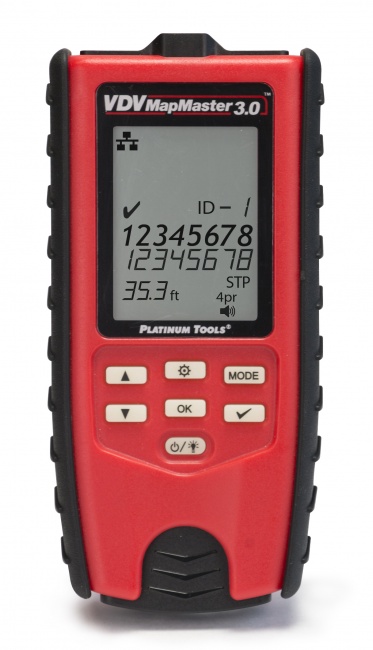
A cable with an open conductor will return a length measurement that is the distance to the open, not the cable's actual length. Always run wiremap before length measurement to know what you are looking at. Tools like the VDV MapMaster 3.0 do both in a single test.
2. Open or terminate the far end
Most testers measure length using the natural impedance change at the far end of the cable when it is unterminated. Plug a remote unit at the far end if your tester requires it (some do, some do not — check the manual). For TDR-only length, an open or shorted far end both work; the tester recognizes either.
3. Select the correct cable type
Pick Cat5e, Cat6, Cat6A, or coax in the tester menu. This selects the appropriate default NVP. If you have a custom NVP profile from calibration, select that instead.
4. Run the test
One button press. Length displays for each pair within seconds.
5. Read the result correctly
Look at the longest pair, not the average. The longest pair determines the channel's worst-case insertion loss. If the longest pair exceeds 90 meters for a permanent link or 100 meters for a channel, the run is out of spec.
6. Investigate large length skew
Different pairs in the same cable should report lengths within 6 inches (15 cm) of each other. A larger spread suggests the cable was damaged at one or more points, was incorrectly punched down (one pair is making a longer path through the keystone), or has a manufacturing defect.
Using Distance-to-Fault to Locate Breaks
When a cable has an open or short, TDR length measurement reports the distance from the tester to the fault. This is your roadmap to finding the problem.
Convert distance to physical location
Take the reported distance from the tester end. Walk the cable path with a tape measure, accounting for slack at both ends, drops down through walls, runs across ceilings. The fault location is usually within a few feet of the calculated point — accurate enough to find the staple driven through the cable, the spot where it was crushed under a pallet, or the moisture damage above a leaky window.
If both ends report different distances
Test from each end of the cable. If the fault is at 47 meters from end A and 53 meters from end B on a 100-meter cable, the math checks out. If the numbers do not add up to the cable's full length, you have multiple faults.
Soft faults vs hard faults
A complete open or short produces a sharp TDR reflection that is easy to locate. A "soft" fault — water-damaged insulation, partial conductor break, slightly kinked section — produces a smaller reflection that may be invisible to entry-level testers but visible on professional certifiers. A failed cable that wiremaps clean and reads full length but won't pass certification often has a soft fault that only a high-quality TDR will reveal.
Length Accuracy by Tester Tier
| Tester Tier | Method | Accuracy (calibrated) | Distance-to-Fault | Example |
|---|---|---|---|---|
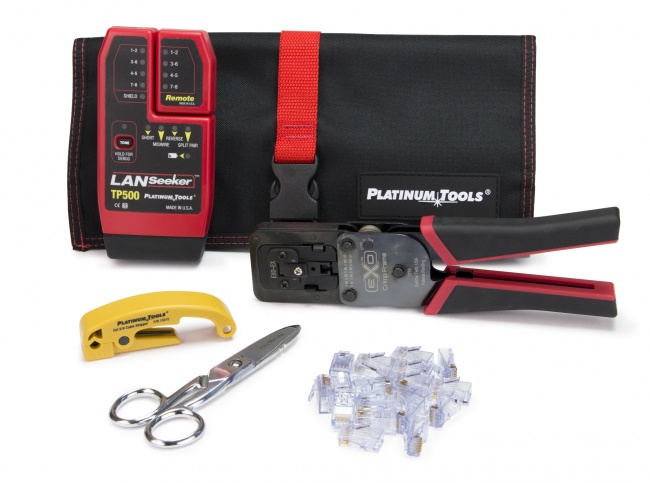
| Basic verifier | None | N/A | No | LanSeeker |
| Qualifier | TDR pulse | +/- 2-5% | Yes | VDV MapMaster 3.0 |
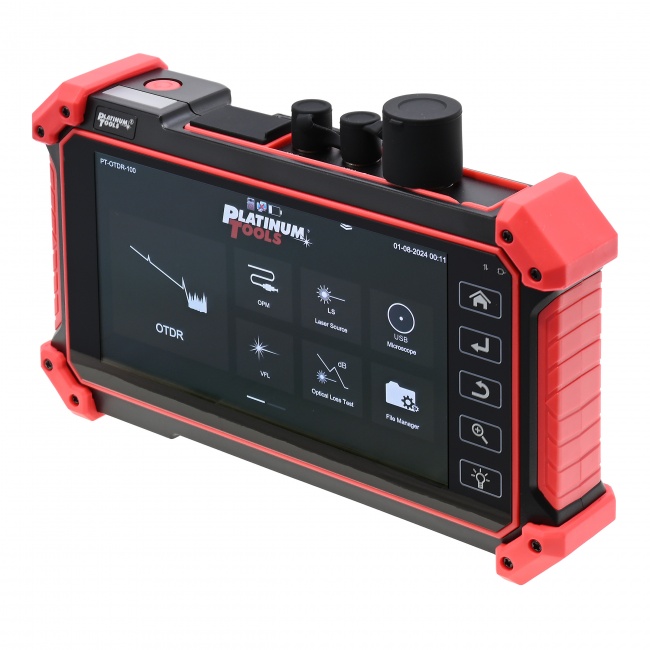
| Network analyzer | TDR + speed test | +/- 2-3% | Yes, with hard fault | None in our catalog |
| Full certifier | Calibrated TDR | +/- 1-2% | Yes, soft and hard faults | Fluke DSX, Softing WireXpert |
Common Mistakes That Skew Length Measurement
Wrong cable category selected
Default NVP varies by category. A Cat6 setting on Cat5e cable will report length 3-5% off. Always select the correct cable type before running the test.
Running TDR through a coupler
Each in-line connector (coupler, patch panel, keystone) introduces an impedance bump that shows up on the TDR trace. Length measurement may stop at the coupler, treating it as the end of the cable. Always test the permanent link with the proper test cords, not through field couplers.
Confusing patch cord length
If you connect a 5-meter patch cord between the tester and the cable under test, the result includes the patch cord length. Set the tester to use channel-mode adapters (which subtract the patch cord) or do the math manually.
Forgetting one end is unterminated
Some testers require the far end open, others require a remote unit. Get this wrong and you may get no result, the wrong result, or the distance to a coupler instead of the cable end. Read the manual for your specific tester.
Frequently Asked Questions
How does a cable tester measure length?
Time Domain Reflectometry. The tester sends a pulse down the cable and times how long it takes for the reflection to return. Multiplying round-trip time by signal velocity (NVP times speed of light) and dividing by two gives the length.
How accurate is cable tester length measurement?
With correct NVP, professional testers are accurate to within 2-5% — about 1-3 meters on a 100-meter run. Without NVP calibration, accuracy can drift 10-15%. Full certifiers are most accurate; qualifiers and entry testers are slightly less precise but still within acceptable installation tolerance.
What is NVP and why does it matter for length measurement?
Nominal Velocity of Propagation — the speed of an electrical signal in the cable, as a fraction of the speed of light. Typical values are 65-72%. NVP varies by cable manufacturer and category, so calibrating against a known length sample improves accuracy. See how to perform a TDR cable test for the full TDR workflow.
Can a cable tester find the location of a break?
Yes — distance-to-fault is the same TDR measurement applied to a defect rather than the far end. With correct NVP, fault location is accurate within a meter or two, turning "this cable is broken" into "the break is 47 meters from the IDF."
What is the maximum cable length for Ethernet?
TIA-568 specifies 90 meters for the permanent link (in-wall) and 100 meters for the channel (with 5 m patch cords at each end). This applies to Cat5e, Cat6, and Cat6A. Beyond 100 meters, insertion loss degrades performance — particularly for 10GBASE-T.
Get the Cable Length & NVP Field Reference Card
The same printable card linked above — NVP defaults by category, the calibration steps, TIA length limits, and the distance-to-fault workflow. Drop your email and we'll send the PDF.
Related Guides
- How to Perform a TDR Cable Test — the full TDR workflow beyond length measurement.
- How to Find a Cable Fault Fast — the troubleshooting sequence when distance-to-fault is step one.
- Best TDR Cable Length Meters — our tested picks by accuracy tier and budget.
- Cable Tester vs. Certifier — which accuracy tier your work actually requires.
Ready to Measure Length and Locate Faults on Every Job?
Tell us the accuracy you need — quick under-100-meter checks, customer-facing certification reports, or forensic fault location — and we'll point you to the right TDR tester instead of the most expensive one.