The Short Version
The Real Cost of Inadequate Testing
The argument against cable testers is always "I do good work, I don't need a tester." The argument falls apart on contact with reality: every install has a non-zero defect rate even when the work is done by experienced technicians. The question is whether you catch the defects during install (cheap) or after the client calls you back (expensive).
Per-callback cost breakdown
- Drive time -- Round trip to site. Average 1-2 hours @ $75/hour fully loaded labor cost = $75-$150
- Diagnostic time -- Identifying the bad cable in a finished install. Without a tester, this can take 30-90 minutes per cable = $40-$110
- Repair time -- Re-terminating or re-pulling the cable. 30-60 min if accessible, 2-4 hours if walls or ceilings need to be opened = $40-$300
- Lost productive time -- The time you spend on a callback is time not spent on a billable job. Opportunity cost runs $50-$200 per visit
- Equipment and materials -- Patch cords, connectors, cable replacement = $5-$50
Total typical callback cost: $200-$500. Worst case (walls/ceilings reopened): $800-$1,500.
The non-financial cost
Beyond the dollars: every callback erodes client confidence. A client who calls you back twice wonders why they hired you. A client who never calls you back referrals you to other clients. Testing is how you make sure clients fall in the second category.
Tier 1: $160 Verification Tester ROI
Equipment: VDV MapMaster 3.0 at $168.14. Tests wiremap, length, split pairs, cable ID.
What it prevents
The MapMaster 3.0 catches every wiring defect that would cause a cable to fail in service: opens, shorts, miswires, reversed pairs, and split pairs. It also identifies cables in a bundle, eliminating the time spent tracing unlabeled runs.
Payback math
Industry-typical residential and small commercial install defect rate: 2-5%. On a 30-drop install, that means 1-2 defects. Without testing, you find these defects when the client calls back -- average cost $300 each. The MapMaster 3.0 catches these during install at zero additional cost.
Payback: 1 callback prevented. Most contractors hit ROI on their first project.
Tier 2: Speed Qualification, and Why It Is Now a Rental Line Item
Equipment: a speed qualifier, rented or subcontracted. Tests actual Ethernet throughput up to 1 Gb/s with PDF reports. CableTestShop does not currently stock one; the Platinum Tools unit that filled this tier has been discontinued by the manufacturer.
What it prevents
Cables that pass wiremap but fail at speed. The most common cause of "the network is slow" complaints in modern installations -- a cable passes continuity but cannot carry error-free traffic at the rated speed because of marginal crosstalk or noise that a basic tester cannot see. A qualifier at this tier also generates per-drop reports for client documentation, which is often the reason to run one at all.
Payback math (200 drops/month contractor)
Pre-test callback rate: 3% means about 6 callbacks a month, each one unbillable labor plus a return trip. Catching those at handover with throughput testing is where the tier pays. Run the numbers on your own callback cost rather than ours: the rate is yours, and a rental price is quoted per job.
Payback: under 2 months.
Bonus revenue
"Speed Certified" as a line item on your bid provides differentiation. Contractors report 5-15% higher win rate when bids include documented speed certification compared to no testing documentation.
Tier 3: $12,000 Full TIA Certifier ROI
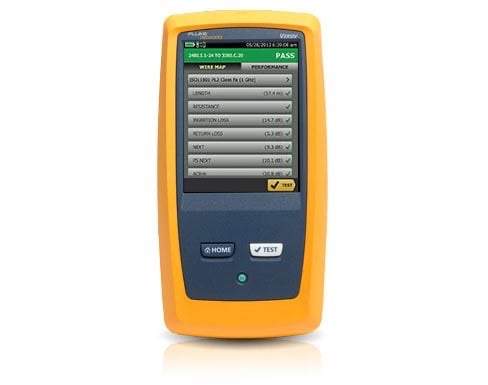
Equipment: Fluke DSX2-5000 or Softing WireXpert 500 at $9,000-$15,000. Performs full TIA-568 / ISO 11801 certification with native reports.
What it enables
Bids on commercial projects that require TIA certification (typical for healthcare, education, government, large enterprise). Manufacturer system warranty registration (Belden, Panduit, CommScope, etc.). Higher-margin work with documented compliance.
Payback math (outsourced cert replacement)
Contractor outsourcing certification at $25/drop, 500 drops/year = $12,500/year outsourced cost. Add: travel coordination, scheduling delays waiting for the cert subcontractor, and lost margin on outsourced work.
Payback: 12-15 months. Continued savings of $12,500/year for the next 5-7 years of certifier life.
Payback math (new contract revenue)
Each commercial project that requires certification typically delivers $5,000-$25,000 in revenue at higher-than-average margins. Winning two such projects per year that you would have lost without certification capability covers the certifier purchase. See our pro tester guide for ISP-tier equipment recommendations.
ROI Summary by Tester Tier
| Tier | Investment | Annual Savings | Payback Period |
|---|---|---|---|
| Verification (MapMaster 3.0) | $160 | $1,200-$3,600 (4-12 callbacks) | 1-2 projects |
| Speed qualification (rented) | Rental or subcontract | $15,000-$25,000 (200 drops/mo contractor) | 2-5 months |
| Full TIA cert (DSX2-5000) | $12,000 | $12,500+ (replacing outsourced cert) + new contracts | 12-15 months |
| Combined kit (all tiers) | ~$13,000 | $30,000-$50,000 combined | 4-6 months |
Hidden ROI Most Contractors Miss
The callback-prevention math is straightforward, but several other ROI drivers are often overlooked:
Faster troubleshooting on existing installs
Even when testing your own new work, the same tester accelerates troubleshooting on inherited installations. A LanSeeker identifies which cable is which in a 96-port patch panel in minutes vs hours of trial-and-error. Service call billable time stays consistent while non-billable diagnostic time disappears.
Junior tech enablement
A clear pass/fail tester lets a junior technician verify their own work without the senior tech needing to inspect every termination. This frees the senior tech for higher-value work and accelerates junior tech ramp-up.
Insurance and liability
Documented test results reduce insurance claims when a network failure is alleged to be installation-related. Some E&O insurers offer reduced premiums for contractors with documented testing protocols.
Resale value of equipment
Quality testers retain 30-50% of value at the 5-year mark. A $12,000 certifier sold after 5 years for $4,000 means the actual cost of ownership is $8,000 over 5 years -- $1,600/year for capability that generates $12,500+ in annual returns.
Frequently Asked Questions
How much does a callback cost a low-voltage contractor?
Typical callback: $200-$500 in unbillable labor (drive time, diagnostics, repair, re-test). Worst case with walls or ceilings reopened: $800-$1,500. Plus the relationship damage and lost referrals.
Does throughput testing pay for itself?
For a 200 drops/month contractor with a 3% post-install failure rate, throughput testing usually pays back inside a season on prevented callbacks alone, plus the bid differentiation value of "speed certified" documentation. Price it as a per-job rental: we do not currently stock a qualifier.
When does a $12,000 full TIA certifier make financial sense?
When you need manufacturer warranty registration, you are losing bids requiring TIA certification, or you currently outsource certification at $20-$40 per drop and exceed 400-500 drops/year. See our rental vs buy analysis for the borderline cases.
Should I buy used or rent before investing in a certifier?
Rent if uncertain about volume or under 10-15 days/year of certification work. Used certifiers can save 40-60% but require recent calibration certificate, included channel adapters and reference cords, and current firmware. Refurbished units from authorized resellers are safer than private sales.
Find the Right Tester for Your Volume
Match your investment level to the work you do today. Upgrade as your business grows.