What a Ground Loop Actually Is
A ground loop is a closed conductive circuit formed when two pieces of equipment are connected to ground at different physical points and also connected to each other through a signal cable. The signal cable closes the loop. If the two ground points sit at different electrical potentials -- which they almost always do in any real building -- current flows around the loop, driven by the potential difference.
This is not the cable's fault. Buildings are full of small ground potential differences caused by current flowing through grounding conductors, neutral-to-ground bonding at the service entrance, induced voltages from large nearby equipment, and the simple fact that copper grounding conductors have non-zero resistance over distance. The cable just happens to be the path that closes the loop.
For Ethernet, the loop typically completes through one of two paths: the shield of a shielded cable, or the chassis-to-chassis path through Ethernet's transformer-coupled signal. Unshielded twisted pair Ethernet is much less susceptible to ground loops than shielded cable because the magnetics in every Ethernet port provide isolation. Shielded cable, by design, intentionally bonds the shield to the equipment chassis at every connection point and so creates a direct conductive path that completes the loop.
Why Ground Loops Happen in Real Buildings
Multiple grounding points are normal
NEC requires that any building electrical service has a grounding electrode bonded to the system neutral. Larger buildings have separately derived systems (transformers feeding subpanels) each with their own grounding electrodes. Equipment chassis ground throughout the building is bonded to whatever local panel it is fed from. All of these grounds are bonded together by design, but the bonding paths have resistance and carry currents from normal building loads.
Ground potential between bonding points is not zero
Current flowing through grounding conductors creates voltage drops along those conductors. A 200A load drawing through a building's main service ground can produce 1-2 volts across the building's ground bus over the length of the building. Every chassis bonded to that ground sits at the local potential of its bonding point, not at the same potential as every other chassis.
The network cable closes the loop
When you run a shielded network cable between two locations and ground the shield at both ends, you have created a low-impedance path between two ground points that may sit at different potentials. Current flows. The cable carries this current along with the data signal. Noise, intermittent errors, and in severe cases damage follow.
Building-to-building runs are the worst
Two buildings on the same campus typically have separate service entrances and separate grounding electrodes. Even when bonded by an underground grounding conductor, the two buildings' grounds can sit at significantly different potentials, especially during thunderstorms or large equipment switching events. Copper Ethernet between two buildings is almost always a ground loop waiting to happen, which is why the standards strongly recommend fiber for inter-building runs.
Ground Loop Symptoms
| Symptom | What Is Happening | Severity |
|---|---|---|
| Intermittent CRC errors | Ground loop noise corrupting signal at receiver | Mild to moderate |
| Speed downshift to lower Ethernet rate | Cable cannot maintain higher modulation | Moderate |
| Buzz on connected analog audio | 60 Hz hum from ground loop on shared shielded cable | Moderate |
| Switch port shutdowns / errdisable | Switch protection reacting to abnormal port voltage | Moderate to severe |
| Equipment damage after thunderstorm | Lightning-induced ground potential difference exceeded port tolerance | Severe |
| Repeated PHY failures on one port | Sustained low-level current degrading PHY over time | Severe |
| Drain wire warm to touch | Significant continuous current through shield | Severe |
How to Detect a Ground Loop
Step 1: Measure ground potential difference
Disconnect the network cable at the device end. With a multimeter set to AC volts, measure between the device chassis ground (or the cable shield's drain wire at the disconnected end) and the chassis ground at the switch end. Any reading above a few millivolts AC indicates a potential difference that could drive ground loop current.
Repeat with the meter set to DC volts. DC offsets indicate static potential differences from grounding system imbalances. AC readings indicate dynamic differences from current flowing through the grounding system.
Step 2: Measure shield current
Reconnect the cable. With the cable shield's drain wire passing through a clamp current meter, measure the current flowing through the shield. Any sustained current above a few milliamps DC or AC indicates an active ground loop. Currents above 100 mA suggest serious bonding problems requiring electrician attention.
Step 3: Correlate with environmental factors
Ground loops often vary with building load. Currents and potentials change as HVAC systems start, large equipment cycles, or building electrical load changes throughout the day. Take measurements at different times to characterize the worst case.
Step 4: Check the bonding system
Verify that grounding electrodes are properly bonded together per NEC. A building with separately derived systems whose grounds are not properly inter-bonded will have larger ground potential differences than a properly bonded system. This is electrical contractor work but is sometimes the actual root cause.
Ground Loop Fixes
Fix 1: Use unshielded cable
If the installation does not require shielding for EMI rejection, unshielded twisted pair (UTP) eliminates the most common ground loop path. Ethernet's transformer coupling provides isolation between the two ends, so signal-conductor ground loops on UTP are rare. This is why most commercial UTP installations have no ground loop issues.
Fix 2: Single-end shield grounding (controversial)
If you are using shielded cable, grounding the shield at only one end breaks the loop. This violates the strict TIA-568 recommendation of bonding the shield throughout the channel, but it eliminates the loop. The disadvantage is reduced EMI rejection compared to fully bonded shielding. Use this fix when the EMI environment is mild and the ground loop is severe.
Fix 3: Properly bond all building grounds
The "fix it right" answer: ensure that grounding electrodes are properly bonded together with low-impedance conductors per NEC. Reduces ground potential differences across the building. Requires electrical contractor and may not be feasible in older buildings.
Fix 4: Use a fiber link
Fiber optic cable carries no electrical signal, so it cannot complete a ground loop. For inter-building runs, runs to outdoor equipment, or runs in environments where ground potential differences are uncontrolled, fiber is the right answer. Use copper-to-fiber media converters at each end if the equipment has only copper interfaces.
Fix 5: Use an isolation transformer or galvanic isolator
For specialized situations where copper is required but ground loops persist, isolation devices break the conductive path between the two ends. This is more common in industrial controls and audio than in standard data networking, but the option exists.
Fix 6: Surge protection at both ends
For ground loops driven by intermittent transient events (lightning, large motor switching), Type 3 surge protection on each end of the network cable diverts the transient before it damages the network equipment. Surge protection does not eliminate the underlying ground loop but limits the damage from extreme events.
When to Call an Electrician
Some ground loop problems are cabling problems and some are electrical system problems. Recognize the difference.
Cabling contractor scope
- Choose unshielded vs shielded cable correctly for the environment
- Ground shielded cable shields per the standard at patch panels and equipment
- Recommend fiber for inter-building runs
- Install surge protection on outdoor or exposed runs
Electrical contractor scope
- Verify grounding electrode system meets NEC requirements
- Bond separately derived systems properly
- Address neutral-to-ground bonding errors
- Resolve building load imbalances causing excessive ground currents
If your measurements show ground potential differences over 1V AC or sustained currents over 50 mA in shield drain wires, the underlying cause is electrical, not cabling. Loop in the customer's electrician for the root-cause fix. For more on shielded cable handling see our guide on how to test shielded cable grounding.
Tools for Ground Loop Diagnosis
True-RMS multimeter
Required for accurate AC voltage measurements between ground points. A standard multimeter that cannot measure True-RMS will give misleading readings on the non-sinusoidal waveforms typical of ground loop voltages.
Clamp current meter (low-current)
Required for measuring current through cable shield drain wires. Look for meters with at least 1 mA resolution; standard high-amp clamps cannot resolve the small ground loop currents.
Wiremap tester
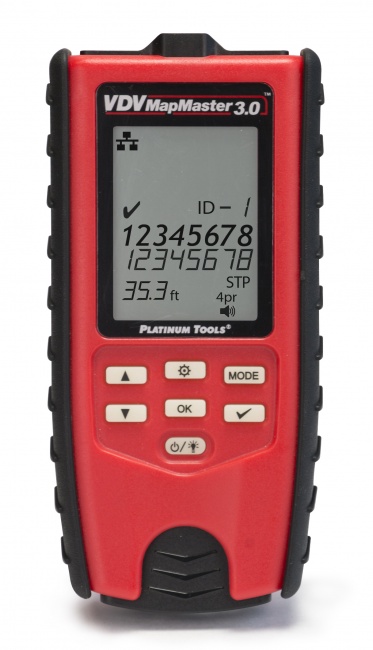
Use a VDV MapMaster 3.0 to confirm the cable itself is healthy. Ground loops cause performance issues without changing the cable's basic test results, so a clean wiremap here is evidence for the ground loop rather than against it.
Frequently Asked Questions
What is a ground loop on a network cable?
A ground loop is a closed conductive circuit formed when two pieces of grounded equipment are connected by a network cable, with the two ground points sitting at different electrical potentials. The potential difference drives current through the cable, causing noise and signal degradation.
Why do ground loops happen?
Buildings have multiple grounding points that sit at slightly different potentials due to current flow through the building's grounding system. Network equipment connected at two different ground reference points can complete a loop through the network cable.
How do I detect a ground loop?
Measure the AC voltage between the chassis ground of the two endpoints. Any reading above a few millivolts indicates potential for a ground loop. On shielded cable, measure current through the shield drain with a clamp meter.
Can a ground loop damage network equipment?
Yes, in severe cases. Lightning, large motor switching, or other transient events can drive significant currents through network cable, damaging Ethernet PHY chips, switch ports, and PoE circuitry. Use fiber for inter-building runs to eliminate the risk.
Tools for Diagnosing Ground Loop Problems
Wiremap, qualification, and shielded-cable testing tools that help you isolate ground loops from other failure modes.