The Short Answer
Why Shield Grounding Matters
The shield around a twisted pair has one job: intercept electromagnetic interference before it can couple onto the signal conductors. To do that, the shield needs a low-impedance path to ground so any captured noise drains away rather than building up as a voltage on the shield.
If the shield is not grounded at all, it captures noise and holds it -- the captured energy then radiates onto the signal pairs from a few millimeters away, the worst possible coupling distance. The shield becomes part of the problem.
If the shield is grounded at both ends and there is any potential difference between those two grounds (which there always is in a real building), current flows through the shield to equalize the potentials. That current is noise on the shield, and again it couples onto the signal pairs.
The middle ground -- the only configuration that works in real buildings -- is single-point grounding: bond at one end, float at the other. The bonded end gives noise a path to drain. The floating end prevents ground-loop currents from circulating. The shield does its job and stays out of trouble.
Shielded Cable Types and What to Test
| Designation | Overall Shield | Pair Shielding | Drain Wire | Typical Use |
|---|---|---|---|---|
| U/UTP | None | None | No | Standard Cat5e/6, no shielding |
| F/UTP | Foil | None | Yes | Cat6/6A in moderate EMI environments |
| U/FTP | None | Foil per pair | Yes (per pair) | Cat6A/7 with alien crosstalk concerns |
| S/FTP | Braid | Foil per pair | Yes (per pair) | Cat7/7A high-EMI industrial |
| SF/UTP | Braid + foil | None | Yes | Heavy-duty Cat6A in industrial settings |
For grounding tests, what matters is the drain wire and the overall shield path. F/UTP has a single drain wire and a single foil. S/FTP has a drain wire per pair plus an overall braid. Each shielding layer must be properly terminated for the cable to deliver its rated EMI immunity.
Step-by-Step Shield Test Procedure
Step 1: Verify shield continuity end-to-end
Disconnect both ends of the cable from any equipment. Set a multimeter to the lowest resistance range (200 ohms). Probe the shield contact at one end (the metal frame of the keystone jack, the drain wire of an unterminated cable, or the metal shell of a shielded RJ45) against the shield contact at the other end.
Expected reading: under a few ohms for a 30-meter run, scaling roughly proportional to length. A 100-meter F/UTP run typically reads 5-15 ohms shield-to-shield. S/FTP reads 2-8 ohms.
An infinite (open) reading means the shield is broken somewhere in the run, or that the drain wire is not making contact at one or both terminations. The most common cause is a shielded jack installed without bonding the drain wire properly. Re-terminate.
Step 2: Verify shield-to-conductor isolation
With both ends still disconnected, probe the shield against each of the 8 signal conductors at the same end. No beep, infinite resistance. If the shield rings against any conductor, you have a short between shield and that conductor -- usually at a damaged termination where stripped copper bridges the gap.
Step 3: Identify the intended ground bond point
Per TIA-568 and ISO/IEC 11801 best practice, the shield is bonded at the patch panel or telecommunications grounding busbar (TGB) end, and floated at the workstation outlet end. Verify the design intent before testing -- some specs deliberately ground at both ends, some use isolated ground systems, and the test pass criteria differ.
Step 4: Measure ground bond resistance at the bonded end
At the bonded end, measure resistance between the shield and the grounding busbar or building ground. Expected reading: under 1 ohm. A good bond reads close to zero.
A reading higher than a few ohms indicates a poor connection somewhere in the bonding path -- a corroded ring lug, a loose hex screw on the busbar, a paint-thickness primer between the rack and the building ground rod. The shield cannot drain noise effectively through a high-resistance bond.
Step 5: Measure isolation at the floating end
At the floating end (typically the workstation outlet), measure resistance between the shield and the local ground (the receptacle ground pin, the metal device frame). Expected reading: very high resistance (megohms or open).
A low reading at the floating end indicates an unintended ground bond -- often a metal jack housing in metal contact with a metal box that is bonded to the building ground. This creates a ground loop. Either insulate the jack from the box (insulating bezels are sold for this purpose) or accept that the shield will be grounded at both ends and design accordingly.
Step 6: Measure ground-loop voltage
Disconnect the shield bond at the floating end (if it was unintentionally bonded). Set the multimeter to AC voltage. Measure between the shield (now disconnected) and the local ground at the floating end.
Expected reading: under 0.5 VAC, ideally closer to zero. A reading above 0.5 VAC indicates a meaningful potential difference between the two ground references. Bonding the shield at both ends in this scenario will drive an AC current through the shield (V / R_shield), which becomes noise on the cable.
Step 7: Measure shield current under operation (advanced)
If the cable is in service and you suspect a ground loop is causing problems, use a clamp ammeter on the cable itself near the patch panel end. A working shielded cable carries near-zero current. A cable in a ground loop carries milliamps to amps of AC ground-loop current. The clamp meter reading is a direct measure of the loop current and how serious the problem is.
Common Shield Grounding Faults
Drain wire not landed
The single most common shield termination error. The drain wire must contact the shield bonding pad inside a shielded keystone jack or RJ45 plug. If the drain wire is folded back, cut short, or tucked under the cable jacket, the shield is electrically open.
Shielded jack in non-shielded box
The shielded jack expects to bond to a grounded metal yoke or box. Installing a shielded jack in a plastic box leaves the shield ungrounded at that end -- which may be the intent (single-point grounding at the panel) or may be an installation error.
Unintentional bond at the workstation
A metal jack housing in metal contact with a metal box bonded to building ground creates an unintended bond at the workstation end. Use insulated bezels or non-conductive boxes when single-point grounding at the panel is the design.
Loose busbar bond
The bond from rack to TGB to building ground is critical. Loose hex screws, paint between mating surfaces, or corroded lugs all increase bond resistance and reduce shield effectiveness.
Multiple grounding conductors of different lengths
If the rack is bonded to ground via two paths of different lengths, AC ground current can flow in a loop within those bonds. Use a single bond conductor between the rack and the TGB.
Ground loop through coax
A common scenario: the network shielded cable is grounded at the panel, the workstation has a coax CATV connection grounded at the demarc, and both grounds are at different potentials. The loop closes through the workstation chassis. See our coax network testing guide for the parallel test procedure on the coax side.
Shield Test Pass / Fail Reference
| Test | Pass | Fail |
|---|---|---|
| Shield continuity end-to-end | Under 15 ohms (per 100 m) | Open or over 50 ohms |
| Shield-to-conductor isolation | Open / megohms | Continuity to any conductor |
| Ground bond resistance (bonded end) | Under 1 ohm | Over 5 ohms |
| Isolation at floating end | Over 1 megohm | Under 100 ohms |
| AC voltage shield-to-local-ground (floating end) | Under 0.5 VAC | Over 1 VAC |
| Shield current in service | Under 10 mA AC | Over 100 mA AC |
Equipment for Shield Testing
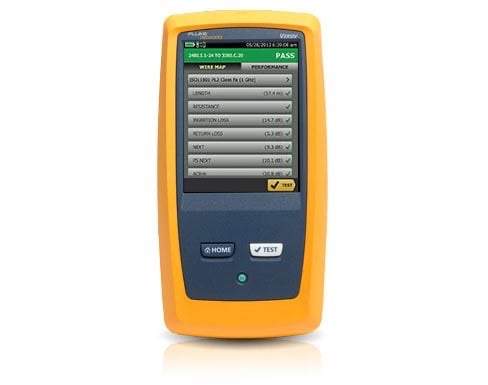
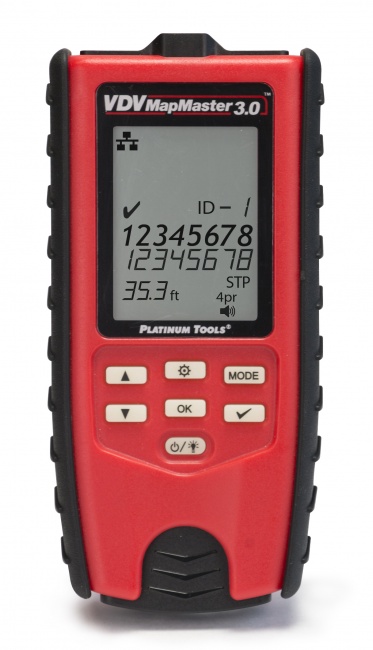
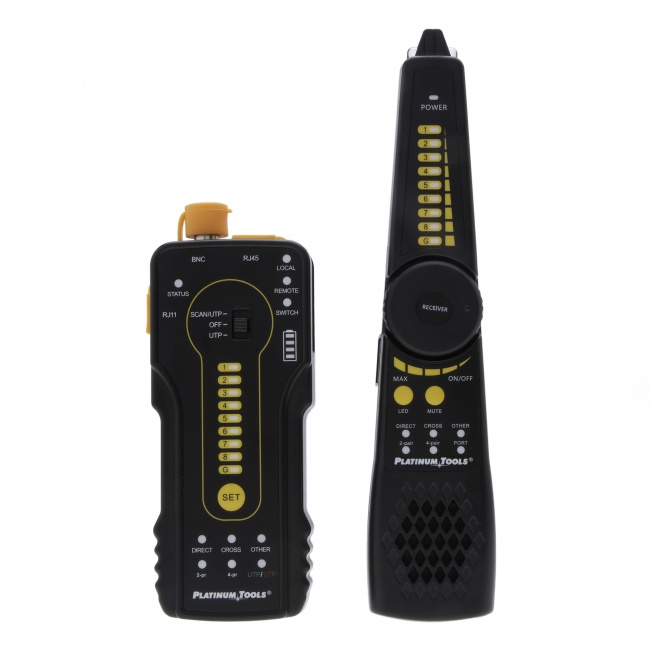
A digital multimeter with continuity, low-range resistance, and AC voltage modes covers the basic procedure. A clamp ammeter is required for shield current measurement under operation. For full shield testing alongside category certification, a TIA-compliant certifier reports shield continuity as part of the autotest. Browse our cable testers and cable certifiers for options.
For broader context, see our guides on cable tester vs. certifier and testing Cat6A cable -- much of the Cat6A discussion applies to shielded F/UTP and S/FTP installations.
Frequently Asked Questions
How do I test if a shielded cable is properly grounded?
Measure resistance between shield and ground at the bonded end (under 1 ohm pass), confirm isolation at the floating end (megohms), and verify shield-to-shield continuity end-to-end (under 15 ohms per 100 m).
Should a shielded cable be grounded at both ends?
Generally no. Single-point grounding at one end (typically the patch panel) prevents ground-loop currents while still allowing the shield to drain noise. Both-end grounding is only used in specific designs and requires equipotential bonding between the two grounds.
What is a ground loop and how does it affect data cables?
A ground loop is a closed conductive path between two unequal-potential grounds. Current flows through the loop, and on shielded cable that current rides the shield, coupling noise onto the data pairs. Symptoms: intermittent errors, hum, throughput degradation.
Can I test ground loop voltage on a shielded cable?
Yes. Disconnect the shield bond at one end. Measure AC voltage between the disconnected shield and local ground. Above 0.5 VAC indicates a problematic potential difference.
What resistance should the shield have end to end?
About 5-15 ohms per 100 m for F/UTP, 2-8 ohms per 100 m for S/FTP. Readings dramatically higher indicate poor termination or damaged shield.
Get Shield Termination Right
Shielded cable only delivers EMI immunity when the shield is correctly bonded. The right tester confirms continuity, bond integrity, and absence of ground loops in one pass.