The Short Answer
Three Levels of Cable Testing
The test and measurement industry breaks cable testing into three distinct levels. Each level answers a different question about the cable, and each requires a different class of tool.
Level 1: Verification (Cable Tester)
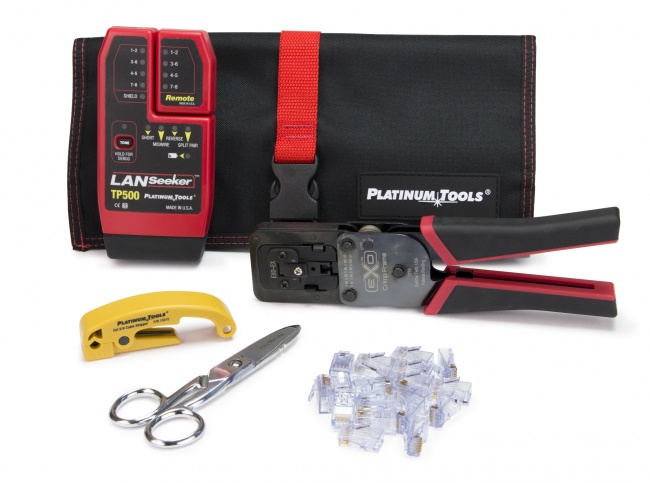
A verification tester checks the physical connections in the cable. It answers the question: "Is every pin connected to the correct pin on the other end?" This means testing for wiremap (correct pin-to-pin wiring), continuity (no open conductors), shorts (no pins shorted together), and sometimes cable identification (which cable is which in a bundle).
Verification testers range from $25 LED units that show pass/fail lights to $150 devices like the VDV MapMaster 3.0 that display detailed wiremap results, detect split pairs, and identify cable runs by number.
What a verification tester does NOT tell you: whether the cable can actually carry data at the rated speed. A cable can pass a wiremap test perfectly and still fail to support Gigabit Ethernet because of crosstalk, return loss, or insertion loss problems caused by poor cable quality, excessive untwist at terminations, or tight bend radius violations.
Level 2: Qualification
A qualification tester goes beyond wiremap to assess whether the cable can support a specific application. It answers the question: "Can this cable carry Gigabit Ethernet?" or "Can this cable support 2.5GBASE-T?" Qualification testers measure cable length, detect PoE, and may test actual data throughput or bandwidth capability.
A qualification-level tool validates actual network performance up to 1 Gb/s and provides a clear pass/fail result for the application you specify. It does not perform the full frequency sweep of a certifier, but it proves the cable can do the job. CableTestShop does not list a tester at this level: the qualifier that filled the tier has been discontinued by Platinum Tools and we have not replaced it.
Level 3: Certification (Cable Certifier)
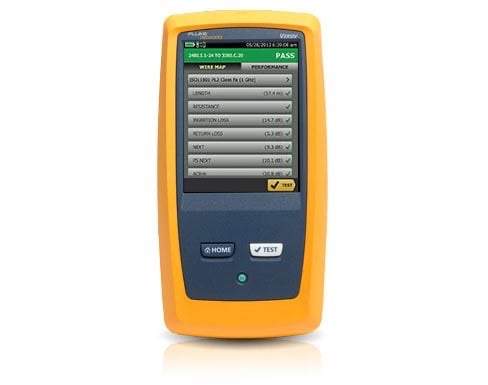
A certifier performs a complete frequency sweep across the cable's rated bandwidth and measures dozens of parameters against TIA-568 or ISO 11801 standards. It answers the question: "Does this cable meet the published specification for Cat5e, Cat6, or Cat6A?" Certifiers measure NEXT (Near-End Crosstalk), PS-NEXT, ACR-F, return loss, insertion loss, propagation delay, delay skew, and more.
Certification is required when the cable manufacturer's extended warranty depends on certified test results, when the project specification calls for TIA or ISO compliance, or when the building inspector or general contractor requires certification documentation before sign-off.
Certifiers start at approximately $5,000 and can exceed $15,000 for top-tier units. The cost reflects the precision RF measurement hardware required to test at 500 MHz (Cat6A) or 2,000 MHz (Cat8).
Side-by-Side Comparison
| Capability | Verification Tester | Qualification Tester | Certifier |
|---|---|---|---|
| Wiremap | Yes | Yes | Yes |
| Continuity / shorts | Yes | Yes | Yes |
| Split pair detection | Some models | Yes | Yes |
| Cable length | No | Yes | Yes |
| Distance to fault | No | Some models | Yes |
| PoE detection | No | Yes | Some models |
| Throughput validation | No | Yes | No (frequency-based) |
| NEXT / crosstalk | No | No | Yes |
| Return loss | No | No | Yes |
| Insertion loss | No | No | Yes |
| TIA/ISO pass/fail | No | No | Yes |
| PDF test reports | No | Some models | Yes |
| Typical cost | $25 - $150 | $300 - $1,500 | $5,000 - $15,000+ |
When You Need Which
Use a cable tester when:
- You are troubleshooting a cable that stopped working and need to find opens, shorts, or miswires
- You are verifying your own terminations during installation (quality check before the walls close up)
- You are doing residential or small-office work where no certification documentation is required
- You need to identify and map cables in a bundle using tone generation or cable ID numbers
- Budget is limited and you need basic confidence that the cable is wired correctly
Use a qualification tester when:
- You need to verify the cable can support a specific application (Gigabit, 2.5G, 5G, 10G)
- You want actual throughput validation -- not just theory, but measured data transfer speed
- You need PoE detection alongside cable testing in one device
- You need cable length measurements for documentation or billing purposes
- The job does not require formal TIA/ISO certification but the customer wants proof of performance
Use a cable certifier when:
- The project specification explicitly requires TIA-568 or ISO 11801 certification
- The cable manufacturer's extended warranty requires certified test results
- The building inspector or general contractor requires certification reports for occupancy sign-off
- You are bidding on commercial or government projects where certification is a contractual requirement
- You are installing Cat6A for 10GBASE-T and need to prove the channel meets the 500 MHz spec
The Practical Middle Ground
Most low-voltage contractors do not need a certifier for every job. The reality is that full certification is required on a fraction of installations -- typically large commercial projects, government contracts, and healthcare or education facilities with strict IT specifications.
For the majority of work, the combination of a quality verification tester and a qualification tester covers your needs. Use the VDV MapMaster 3.0 to verify every termination as you work, then bring in a qualifier to validate throughput on the finished run. That gives you wiremap confidence plus actual performance proof at a fraction of the certifier cost. The verifier is a tool to own; the qualifier is one to rent.
When a job does require full certification, you have options: rent a certifier for the project, subcontract the certification to a testing service, or invest in your own unit if the volume of certification work justifies the cost.
Frequently Asked Questions
What is the difference between a cable tester and a cable certifier?
A cable tester performs basic checks like wiremap, continuity, and cable identification. It tells you whether the cable is wired correctly. A cable certifier performs a full frequency sweep up to the rated bandwidth of the cable category (250 MHz for Cat6, 500 MHz for Cat6A) and measures parameters like NEXT, return loss, and insertion loss against TIA or ISO standards. A certifier tells you whether the cable meets the performance specification.
Do I need a cable certifier for residential work?
For most residential work, a cable tester that provides wiremap and continuity testing is sufficient. Certifiers are primarily required for commercial installations where the cable manufacturer's warranty requires certified test results, or where the customer's specifications mandate TIA or ISO compliance documentation.
Can a cable tester detect split pairs?
Basic LED wiremap testers cannot detect split pairs because the wiremap shows correct pin-to-pin connections even when pairs are split. More advanced testers like the VDV MapMaster 3.0 can detect split pairs by measuring the relationship between conductors within each pair.
What does a qualification tester do?
A qualification tester sits between a basic cable tester and a full certifier. It performs wiremap, measures cable length, identifies PoE presence, and may test basic bandwidth capability. It does not perform a full frequency sweep against TIA/ISO standards, so it cannot produce a formal certification report. A qualification-level tool of this kind also validates actual data throughput, which a basic tester cannot.
Find the Right Testing Tool
From basic wiremap testers to speed certifiers. Find the testing level that matches your work.