Why Cat6A Testing Is Different
Cat6A cable is rated to 500 MHz -- double the 250 MHz bandwidth of Cat6. That higher frequency support is what enables 10GBASE-T (10-Gigabit Ethernet) over the full 100-meter distance. But operating at those frequencies means every component in the channel is under tighter scrutiny: the cable itself, the terminations, the patch panels, the patch cords, and even the physical proximity to adjacent cables.
Cat5e and Cat6 installations can often get away with sloppy terminations or tight bends because the performance margins at their rated frequencies are generous. Cat6A has less room for error. A cable that passes Cat6 testing at 250 MHz can fail Cat6A testing at 500 MHz because performance problems that are invisible at lower frequencies become show-stoppers at higher ones.
What to Test on a Cat6A Installation
A complete Cat6A test validates the entire channel from patch panel to outlet (or patch panel to patch panel, depending on the topology). Here are the parameters that matter.
Wiremap
The foundation. Verify all 8 conductors are connected to the correct pins at both ends, with no opens, shorts, crossed pairs, or split pairs. Every cable tester can do this. Do it first -- there is no point running a 500 MHz frequency sweep on a cable with a wiring fault.
Insertion Loss (Attenuation)
How much signal strength the cable absorbs over the length of the run. Measured in decibels (dB) at each frequency up to 500 MHz. Insertion loss increases with frequency and cable length. Cat6A allows a maximum of 35.9 dB of insertion loss at 500 MHz for a 100-meter permanent link. A marginal insertion loss result often points to excessive cable length, damaged cable, or poor connector contact.
NEXT (Near-End Crosstalk)
The amount of signal that leaks from one pair to another within the same cable, measured at the near end (the end where the signal is injected). NEXT is the single most critical parameter for Cat6A performance. It is measured in dB at each frequency point, and higher numbers are better (more isolation between pairs). Cat6A's tighter NEXT limits at 500 MHz are what distinguish it from Cat6.
PS-NEXT (Power Sum NEXT)
The combined crosstalk effect from all other pairs onto one pair, measured simultaneously. PS-NEXT accounts for the cumulative interference that a single pair experiences from all three of its neighbors transmitting at once. This is more representative of real-world conditions than individual pair-to-pair NEXT.
ACR-F (Attenuation-to-Crosstalk Ratio, Far End)
Formerly called ELFEXT (Equal Level Far End Crosstalk). This measures the crosstalk at the far end of the cable relative to the signal loss. ACR-F tells you whether the signal at the receiving end is strong enough relative to the crosstalk noise to be decoded correctly.
Return Loss
The amount of signal reflected back toward the transmitter due to impedance mismatches in the channel. Impedance mismatches occur at every connection point -- patch panel, outlet, patch cord plugs -- and at any point where the cable geometry changes (kinks, tight bends, compression). High return loss means a lot of reflected energy, which wastes signal strength and can cause bit errors.
Propagation Delay and Delay Skew
The time it takes for a signal to travel from one end of the cable to the other (propagation delay), and the difference in delay between the fastest and slowest pair (delay skew). Delay skew matters because data is split across all four pairs simultaneously -- if one pair delivers its data significantly later than the others, the receiving equipment cannot reconstruct the signal correctly.
Equipment Needed
The level of testing equipment depends on your project requirements.
Basic Verification
For wiremap, continuity, and cable identification. Catches wiring errors before they become expensive problems.
VDV MapMaster 3.0 -- wiremap, split pair detection, tone generation. ~$150.
Speed Qualification
For verifying actual gigabit throughput on finished Cat6A runs. Confirms the link carries traffic, but does not prove 10GBASE-T performance.
This is a gigabit speed qualifier's job. We do not currently list one, so it is a rental or subcontract step.
Full Certification
For generating TIA/ISO-compliant certification reports. Required when the project spec or manufacturer warranty demands it.
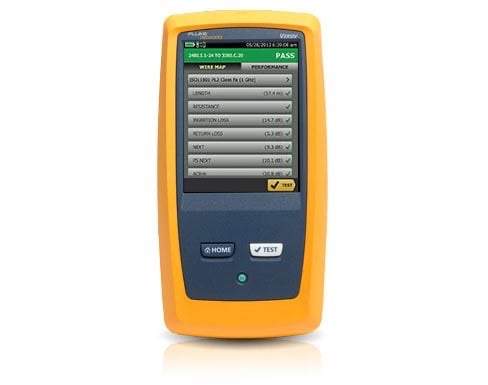
Fluke DSX-8000, VIAVI CertiFiber, or equivalent. $8,000-$15,000+. Consider renting if certification jobs are infrequent.
Step-by-Step Testing Process
1. Test each run as you terminate
Do not wait until all cables are terminated to test. Test each run immediately after terminating both ends. If there is a wiring fault, you want to find it while you still have access to the termination points. Re-terminating a connector at a patch panel is trivial. Doing it after the ceiling tiles are back up and the rack is populated is a different story.
2. Run wiremap first
Plug your wiremap tester into both ends and verify all 8 pins. Check for opens, shorts, crossed pairs, split pairs, and reversed pairs. Fix any faults before proceeding. A wiremap failure means the cable cannot pass any higher-level test.
3. Measure cable length
Verify the permanent link length does not exceed 90 meters (the TIA-568 limit for a permanent link, which allows 10 meters total for patch cords). If you are testing the full channel (including patch cords at both ends), the limit is 100 meters. Excessive length increases insertion loss and can push borderline parameters over the failure threshold at 500 MHz.
4. Run the frequency sweep (if certifying)
If the project requires certification, connect your certifier's permanent link adapters and run the autotest for Cat6A. The certifier will sweep all frequencies from 1 MHz to 500 MHz and compare every parameter against the TIA-568.2-D Cat6A limits. Review the test report for any marginal results (pass but close to the limit). Marginal results at installation time tend to become failures as connectors age.
5. Validate throughput (if qualifying)
If certification is not required, use a qualification tester to verify the link negotiates at gigabit speed and data transfers at the expected rate. This is a practical real-world test, but it qualifies the link at 1 Gb/s -- it does not prove 10GBASE-T performance.
6. Document results
Save test results for every cable run. This documentation serves as your baseline for future troubleshooting, proves the installation was correct at the time of completion, and satisfies warranty and compliance requirements. Most certifiers store results internally and export to PDF or cloud platforms. Qualifiers store exportable results too, which is worth confirming before you rent one.
Common Cat6A Test Failures and Fixes
NEXT failure at the near end
Almost always a termination problem. Excessive untwist at the connector or patch panel insert is the most common cause. Cat6A requires minimal untwist -- keep the pairs twisted as close to the termination point as physically possible. Re-terminate and retest.
Return loss failure
Usually caused by an impedance mismatch at a connection point. Check for damaged connectors, loose patch panel inserts, or mismatched patch cord quality. Patch cords are a frequent culprit -- a cheap Cat5e patch cord in a Cat6A channel can cause return loss failures even if the permanent link is perfect.
Insertion loss failure
Check cable length first. If the run is under 90 meters, check for cable damage (crimps, tight bends, staples through the jacket). Also verify you are using Cat6A-rated cable -- some installers inadvertently pull Cat6 from a box marked Cat6A due to inventory mix-ups.
Marginal pass on all parameters
If every parameter passes but sits within 1-2 dB of the limit, the channel is at risk of failing over time as connectors oxidize and cable properties change with temperature. Investigate the worst parameter and try to improve it through re-termination. A solid pass today should have margin to spare for the 15-25 year life of the cabling infrastructure.
Frequently Asked Questions
What frequency does Cat6A need to be tested at?
Cat6A is rated to 500 MHz. A full certification test sweeps all parameters from 1 MHz to 500 MHz. Cat6 is rated to 250 MHz and Cat5e to 100 MHz. The higher the frequency, the more sensitive the test is to termination quality, cable geometry, and component performance.
Can I use a Cat6 tester for Cat6A cable?
A Cat6 certifier tests up to 250 MHz. It cannot certify Cat6A, which requires testing to 500 MHz. You can run a Cat6 test on Cat6A cable -- the cable will pass Cat6 requirements -- but you have not proven it meets Cat6A specs. For Cat6A certification, you need a certifier rated to at least 500 MHz.
What is alien crosstalk and do I need to test for it?
Alien crosstalk (AXT) is electromagnetic interference between adjacent cables. Unlike NEXT, which measures crosstalk between pairs inside the same cable, AXT measures interference from other cables running alongside. Cat6A's improved shielding and tighter twist rates are designed to minimize AXT. In practice, alien crosstalk testing is rarely required in the field because it involves testing multiple cables simultaneously. Most Cat6A certification focuses on within-cable parameters.
Test Cat6A with Confidence
From wiremap verification to speed qualification, get the right testing tools for Cat6A installations.