Why PoE Testing Matters
A cable that passes data perfectly can fail to deliver power. A switch that provides PoE on 23 ports can run out of power budget on port 24. A device that works on a 10-meter patch cable can brown out on a 90-meter run. PoE failures are some of the most frustrating problems in low-voltage work because they can be intermittent, load-dependent, and invisible to standard cable testers.
A dedicated PoE tester eliminates guesswork. Instead of swapping cables, swapping switch ports, and swapping devices until something changes, you measure exactly what the switch is delivering and compare it to what the device needs. Diagnosis that took hours with trial-and-error takes minutes with the right measurement tool.
PoE Standards at a Glance
Before testing, you need to know what you are testing against. The IEEE 802.3 standard defines four PoE power levels.
| Standard | Common Name | PSE Power | PD Power | Voltage | Pairs |
|---|---|---|---|---|---|
| 802.3af | PoE | 15.4W | 12.95W | 44-57V DC | 2 |
| 802.3at | PoE+ | 30W | 25.5W | 50-57V DC | 2 |
| 802.3bt Type 3 | PoE++ | 60W | 51W | 50-57V DC | 4 |
| 802.3bt Type 4 | PoE++ | 90W | 71W | 52-57V DC | 4 |
The gap between PSE (switch) output and PD (device) received power is lost to DC resistance in the cable. On long runs with thin-gauge cable, this power loss is substantial. A camera rated at 25W needs a PoE+ source -- but if the cable wastes 6W in resistance, the 12.95W delivered by basic PoE is nowhere near enough.
What to Measure
Voltage
Measure voltage at the switch port and at the device end. Standard PoE operates at 44-57V DC. Voltage below 44V at the device indicates excessive cable resistance, a failing switch port, or an overloaded power supply. The difference between near-end and far-end voltage is your voltage drop -- it quantifies how much power the cable is wasting as heat.
Wattage
Your PoE tester should show the power in watts being delivered. Compare this to the endpoint device's power requirement. If the device needs 25W and the tester shows 13W available, the switch port is only providing 802.3af (PoE) when the device needs 802.3at (PoE+).
PoE Type Identification
Verify which 802.3 standard the switch port is providing. Some switches offer configurable per-port PoE settings -- a port may be limited to 802.3af even though the switch hardware supports 802.3at. Identifying the negotiated standard tells you whether the switch is providing what the device needs.
Active Pairs
Check which pairs are carrying power. For 802.3af and 802.3at, power runs on 2 pairs (Mode A: pins 1-2/3-6, or Mode B: pins 4-5/7-8). For 802.3bt, all 4 pairs carry power. If a pair that should be carrying power shows zero, there is a conductor fault on that pair.
Common PoE Problems and Solutions
Device does not power on
- Check the switch's total PoE power budget -- it may be exhausted across all ports
- Verify PoE is enabled on the specific switch port (some may be data-only by default)
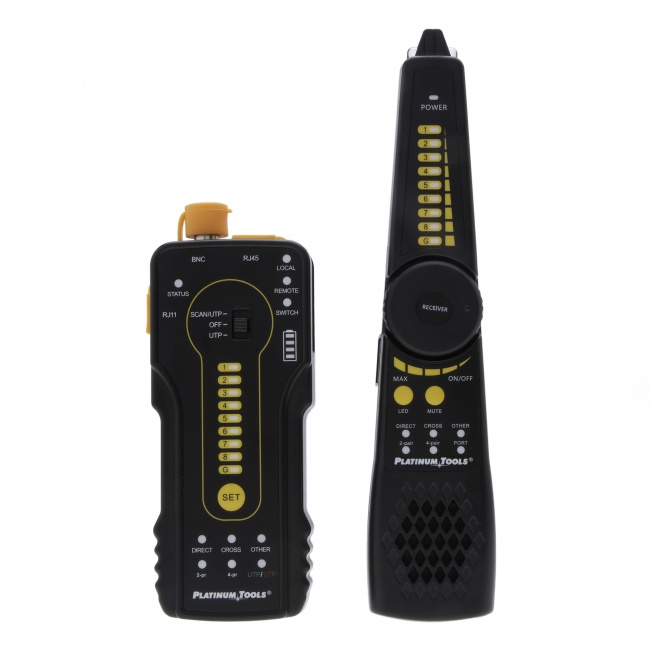
- Test for cable faults on the power-carrying pairs using a wiremap tester
- Confirm the device supports the PoE standard the switch is providing
- Try a known-good short patch cable to isolate cable vs switch vs device issues
Device powers on but reboots or drops
- Measure voltage at the device end under load -- brownouts during high-power events (PTZ movement, IR illumination) indicate insufficient power delivery
- Check cable length -- runs over 80-90 meters may have marginal voltage at the device end
- Inspect terminations for high-resistance contacts, especially at patch panels and keystones
- Check for cable damage -- a crushed cable may carry data but restrict power
PoE switch power budget exhaustion
- Add up the total power draw of all PoE devices on the switch and compare to the switch's total PoE budget
- Some switches prioritize ports -- higher-numbered ports may be shut down first when the budget is exceeded
- Solution: upgrade to a higher-budget switch, add a midspan injector for additional devices, or redistribute devices across multiple switches
PoE works on short cable but not on installed run
- The permanent run has excessive DC resistance -- measure cable length and check for damage
- Re-terminate connectors at both ends and retest to eliminate high-resistance terminations
- Verify cable is solid copper, not CCA -- CCA cable causes significantly more voltage drop over distance
PoE Testing Tools
Dedicated PoE Tester
Identifies 802.3af/at/bt standards, displays voltage, current, and wattage on each pair, and fits in a pocket. The single-purpose tool that answers the power question fastest.
Multi-Function Tester with PoE
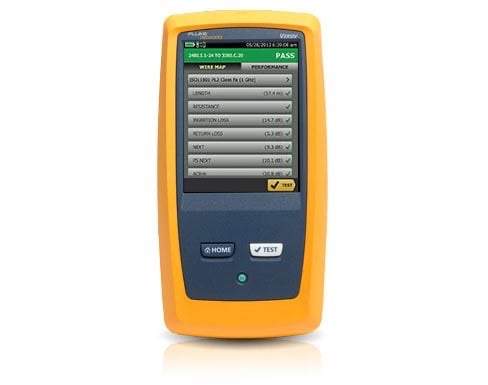
Combines cable testing, network diagnostics, and PoE detection in one device: wiremap, cable length, PoE voltage, DHCP and DNS verification, and link speed. The tier to look at when you are diagnosing the cable and the network in the same visit.
Speed Certifier with PoE
Proving the cable carries data at rate is a gigabit speed qualifier's job. We do not currently list one, so it is a rental or subcontract step.
Cable Requirements for PoE
Not all Ethernet cable handles power equally. Several cable characteristics directly affect PoE delivery.
Conductor gauge
Thicker conductors (lower AWG number) have lower DC resistance. Cat5e uses 24 AWG, Cat6 uses 23 AWG, and Cat6A often uses 22-23 AWG. For long PoE runs, the difference in DC resistance between 24 AWG and 23 AWG cable can be the margin between reliable power delivery and brownouts.
Solid copper vs CCA
Copper-clad aluminum (CCA) cable has approximately 50% higher DC resistance than solid copper at the same gauge. On a 90-meter run, this means significantly more voltage drop and power loss. CCA cable is non-compliant with TIA standards and should never be used for PoE installations. If you find CCA cable on a PoE troubleshooting call, replacing the cable is often the fastest path to resolution.
Bundle derating
When many PoE cables run in the same pathway, the power dissipated as heat raises the bundle temperature. Higher temperature increases DC resistance, which increases voltage drop, which generates more heat. For high-power 802.3bt installations, derate cable fill rates in conduit and cable trays to prevent thermal runaway.
Frequently Asked Questions
Can I test PoE with a regular multimeter?
You can measure the DC voltage on the cable pairs with a multimeter, but you cannot safely identify the PoE standard, measure wattage under load, or determine which pairs are carrying power. A dedicated PoE tester participates in the PoE negotiation handshake and provides all of this information automatically. Using a multimeter also risks shorting the power-carrying pairs if you probe incorrectly.
Will a PoE tester damage a switch port?
No. A proper PoE tester is designed to safely negotiate with the PSE (switch) and accept power without damage. It presents itself as a valid Powered Device during the PoE handshake. Do not connect equipment that is not rated for PoE voltage (44-57V DC) to a live PoE port.
What is the maximum distance for PoE?
The IEEE 802.3 standard specifies 100 meters maximum channel length for both data and PoE. However, PoE performance degrades with distance due to DC resistance. For high-power 802.3bt devices on 24 AWG cable, practical reliability often drops off around 80-90 meters. Thicker gauge cable or shorter runs improve PoE reliability.
What We Sell for PoE Work
We sell neither a PoE tester nor a network analyzer. Our catalog covers the cable the power travels on: wiremap, continuity, length, and distance to fault, with certifiers available by quote. Buy the PoE instrument from a supplier who stocks one, and prove the run first, because most of the faults described above are wiring faults wearing a power symptom.