The Quick Summary
Why TIA-568 Gets Revised
TIA-568 is a living standard that evolves to match changes in network technology, installation practices, and field experience. Revisions happen approximately every 5-7 years as new Ethernet variants are standardized, new cable categories are developed, and field issues identify gaps in the prior revision.
The current revision history of the twisted-pair component standard:
- TIA-568-A (1995): Original commercial building cabling standard. Defined Cat3, Cat4, Cat5.
- TIA-568-B (2001): Split into multiple parts. Added Cat5e and refined Cat5 testing. Introduced ELFEXT and the channel test configuration.
- TIA-568-C (2009): Added Cat6A category supporting 10GBASE-T to 100 meters. Introduced alien crosstalk parameters.
- TIA-568.2-D (2018): Added Cat8 categories supporting 25/40GBASE-T. Refined alien crosstalk. Added MPTL configuration. Renamed ELFEXT to ACR-F. Expanded shielded cabling guidance.
Each revision built on the prior one with new categories, refined methodologies, and clarifications based on field experience. Most installations meeting an older revision continue to meet the newer revision because the standard tries to maintain backward compatibility for performance limits.
Major Change 1: Cat8.1 and Cat8.2 Categories
The most visible addition in TIA-568.2-D is Category 8 in two variants:
- Cat8.1: F/UTP or U/FTP shielded cable with RJ45 connectors, supporting 25GBASE-T and 40GBASE-T at up to approximately 30 meters channel length
- Cat8.2: S/FTP cable with non-RJ45 connectors (GG45 or TERA), supporting 25/40GBASE-T at 30 meters with greater EMC margins
Both categories require a Level 2G TIA-1152 certifier capable of testing across 1 MHz to 2 GHz. The 30-meter channel limit makes Cat8 a data center technology rather than an enterprise horizontal cabling technology. Its primary application is top-of-rack switch to in-rack server connections where copper has cost and operational advantages over fiber.
For deeper background see Cat8 Certification: ISO Class I and II Explained. Cat8 corresponds to ISO Class I and Class II in the parallel ISO 11801 standard.
Major Change 2: Refined Alien Crosstalk Requirements
Alien crosstalk -- electromagnetic coupling between adjacent cables in the same bundle -- was first introduced as a Cat6A parameter in TIA-568-C. Field experience identified several gaps in the original requirement:
- The original limit calculation methodology produced inconsistent results between certifier brands
- The "disturber" cable selection process was not fully specified
- The test setup for measuring with multiple disturber cables was operationally complex
TIA-568.2-D refined the methodology with clearer disturber cable selection criteria, updated limit calculations, and clarified test setup requirements. The result is more reproducible alien crosstalk results across different certifier brands.
The substantive change for installers: alien crosstalk testing in the field is now a more defined process. Most projects still rely on cable manufacturer pre-qualification documentation rather than field testing every cable, but when field testing is required, the methodology is clearer.
Major Change 3: Modular Plug Terminated Link (MPTL)
Traditional permanent link testing assumes the cable terminates in a fixed jack at both ends -- a patch panel jack at one end and a wall jack at the other. MPTL recognizes that some installations terminate in a field-terminated modular plug at the device end, used for connecting devices with integrated RJ45 ports directly:
- IP security cameras with built-in PoE ports
- Wireless access points with PoE
- VoIP phones in some installations
- IoT devices with integrated network ports
For these devices, installing a wall jack and patch cord is unnecessary -- the cable terminates directly in a plug that connects to the device. MPTL gives this configuration a defined test method and pass/fail criteria.
How MPTL testing works
The certifier uses an MPTL adapter at the device end that accepts the field-terminated plug. The patch panel end uses a standard permanent link adapter. The certifier applies MPTL-specific limit values that account for the additional connector at the device end.
MPTL limits are similar to standard permanent link limits with small adjustments. A cable that passes standard permanent link will usually pass MPTL on the same cable, but the configurations are not interchangeable for compliance purposes.
When to use MPTL
Use MPTL when the installation specification calls for it or when the as-built configuration matches the MPTL boundaries. Document the test configuration on each report. MPTL is becoming increasingly common as PoE-powered devices proliferate.
Major Change 4: Terminology Harmonization with ISO
TIA-568.2-D adopted ISO 11801 terminology for several parameters to reduce confusion when working across both standards. The key renamings:
| Old Name (TIA-568-C and earlier) | New Name (TIA-568.2-D) | What It Measures |
|---|---|---|
| ELFEXT | ACR-F | Far-end crosstalk relative to attenuation |
| PSELFEXT | PS-ACR-F | Power sum far-end crosstalk to attenuation |
| Reference Link | Permanent Link | Fixed installed cable plant test |
The measurements themselves are identical -- only the names changed. Older test reports use the older terminology; newer reports use ACR-F and PS-ACR-F. Both refer to the same measurements with the same limit values.
For the parameter set in detail see Cat6A Test Parameters Explained.
Major Change 5: Expanded Shielded Cabling Guidance
TIA-568.2-D expanded guidance on shielded cabling installation, bonding, grounding, and field verification. The changes align with TSB-184 (Shielded Cabling) and integrate shielded-specific requirements into the main standard rather than requiring separate reference to TSB-184.
Specific updates:
- Clarified shield bonding requirements at terminations -- the shield must be electrically continuous from the cable's drain wire through the connector body
- Added requirements for verifying shield continuity in the field as part of certification testing (automatic on modern certifiers with shielded adapters)
- Provided guidance on telecommunications grounding bar (TGB) connection requirements per TIA-607
- Addressed mixing of shielded and unshielded components (generally not permitted in a single link)
For deeper guidance on shielded cabling certification see TSB-184 Shielded Cabling Certification.
What Stayed the Same
Despite the additions and refinements, much of TIA-568.2-D is the same as prior revisions. Existing Cat5e, Cat6, and Cat6A installations remain compliant without re-test in most cases.
Performance limits for Cat5e, Cat6, and Cat6A
The pass/fail limit tables for these categories are essentially unchanged. A cable that measured a clean Pass under TIA-568-C will measure a clean Pass under TIA-568.2-D using the same data.
Permanent link and channel configurations
The test boundaries for permanent link (90 m max, patch panel to wall jack) and channel (100 m max, equipment to equipment including cords) are unchanged.
Required test parameters
The required parameter set (wiremap, length, insertion loss, NEXT, PS-NEXT, ACR-F, PS-ACR-F, return loss, propagation delay, delay skew) is unchanged. ACR-F and PS-ACR-F are the new names for ELFEXT and PSELFEXT but the measurements are identical.
Certifier requirements
Cat5e still requires Level III, Cat6 requires Level V or higher, Cat6A requires Level VI. TIA-1152 accuracy levels are unchanged. The new addition is Level 2G for Cat8 certification.
Practical Impact for Installers
Update certifier firmware
Modern certifiers receive firmware updates that incorporate TIA-568.2-D limit tables and methodology refinements. Verify your certifier is running current firmware before testing on new projects. The manufacturer's web site lists current firmware and TIA standard support.
Update reports terminology
If you generate reports in custom formats (rare -- most use the certifier's native report format), update the parameter names from ELFEXT/PSELFEXT to ACR-F/PS-ACR-F. The certifier's native reports already use the new names.
Address MPTL projects explicitly
If your project includes direct device terminations (cameras, APs, IoT), discuss MPTL testing with the consultant or specifier. The MPTL test configuration must be agreed upfront because it requires specific adapters and produces reports with MPTL-labeled results.
Verify Cat8 capability before bidding Cat8 work
Cat8 certification requires Level 2G certifiers (Fluke DSX-8000 or equivalent). If you bid Cat8 work, verify your equipment supports it before mobilization. Renting a Cat8 certifier per project is an option but adds cost and logistical complexity.
For background on standards see ISO/IEC 11801 Requirements and TIA-1152 Accuracy Levels.
Frequently Asked Questions
What are the major changes from TIA-568.2-C to TIA-568.2-D?
Cat8.1 and Cat8.2 categories supporting 25/40GBASE-T at 30 meters; refined alien crosstalk requirements; Modular Plug Terminated Link (MPTL) configuration for direct device terminations; expanded shielded cabling guidance; and ELFEXT renamed to ACR-F (PSELFEXT to PS-ACR-F) to align with ISO terminology. Cat5e, Cat6, and Cat6A performance limits largely unchanged.
Do I need to retest existing Cat6A installations against TIA-568.2-D?
Generally no. Cat6A performance limits in TIA-568.2-D are essentially unchanged from prior revisions. An installation that passed Cat6A under TIA-568-C will still pass under TIA-568.2-D. Exception: 568.2-D refines alien crosstalk methodology; if your project specifically requires 568.2-D alien crosstalk verification, prior testing may not satisfy the requirement.
What is a Modular Plug Terminated Link (MPTL)?
A permanent link configuration where one end terminates in a field-terminated modular plug rather than a wall jack. Used for connecting devices with integrated RJ45 ports (security cameras, APs, IoT). TIA-568.2-D added MPTL as a recognized configuration with its own field test method and adapter. Limits are similar to standard permanent link with adjustments for the additional device-end connector.
Did TIA-568.2-D change Cat6A test parameters?
The core parameters and limits are essentially unchanged. ELFEXT was renamed to ACR-F and PSELFEXT to PS-ACR-F, but the measurements are identical. Some alien crosstalk limit calculations were refined. Modern certifiers handle the renaming and methodology updates automatically through firmware updates.
Is TIA-568.2-D the current standard?
Yes. ANSI/TIA-568.2-D published in 2018 (with subsequent addenda) is the current revision of the balanced twisted-pair component standard. The full TIA-568 family includes 568.0-E, 568.1-E, 568.2-D, 568.3-D, 568.4-D, and 568.5. Project specs referencing "TIA-568" without a part designation usually mean 568.1 (commercial cabling) which references 568.2-D for twisted-pair.
Certifiers Aligned with TIA-568.2-D
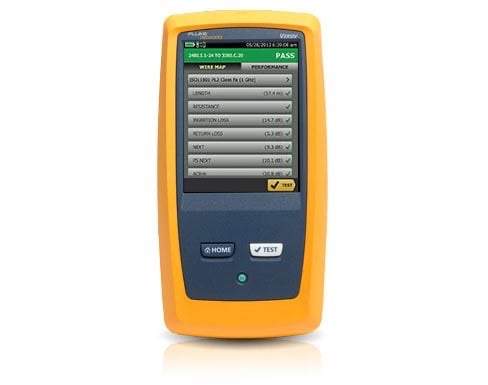
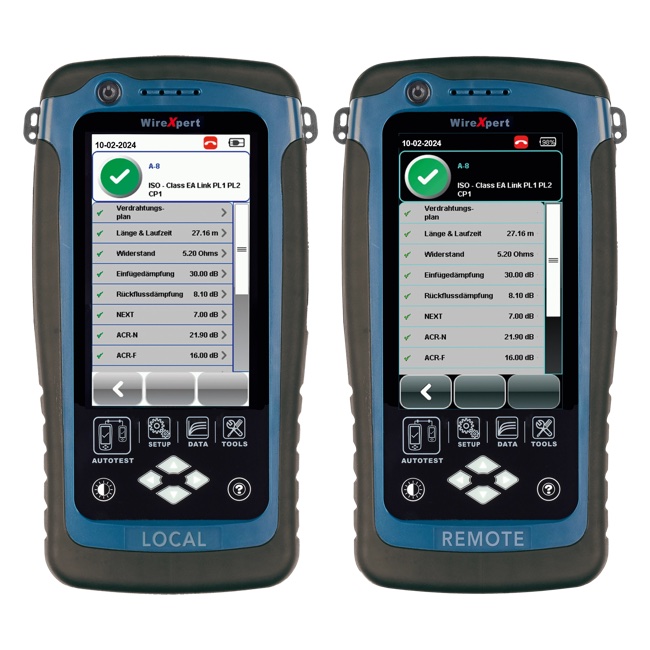
The certifiers in our catalog support current TIA-568.2-D limit tables and methodology through manufacturer firmware. They are quote-only, so send the configuration you need and we will confirm what it covers before anything is ordered.