The Quick Answer
What TSB-184 Is and Why It Exists
TSB-184 (Telecommunications Systems Bulletin 184) is a TIA document that addresses gaps in the standard TIA-568.2 certification process when shielded cabling is involved. The bulletin is not a standalone standard -- it is a supplement that provides guidance on additional verification steps for shielded systems.
The motivation is simple. TIA-568.2 specifies electrical performance limits for balanced cabling: insertion loss, NEXT, return loss, ACR-F, propagation delay, delay skew. These parameters define how the cable performs as a balanced transmission line. They do not measure how effectively the shield isolates the signal from external interference or contains the signal from radiating out.
For unshielded cable (UTP), this is fine -- there is no shield to verify. For shielded cable (F/UTP, U/FTP, S/FTP, etc.), passing TIA-568.2 only proves the balanced electrical properties. The shield's effectiveness is a separate question that TSB-184 addresses.
TSB-184 became important as Cat6A, Cat7, and Cat8 deployments grew. These categories are increasingly deployed as shielded systems for EMC reasons -- 10GBASE-T and faster protocols are noise-sensitive enough that EMC margins matter, and shielded cable provides those margins. Certification needs to prove the shield is actually functional.
Shielded Cable Types and Naming Conventions
Shielded cable comes in several configurations, each with different shielding strategies and EMC characteristics. The TIA naming convention is X/YTP where X describes the overall shield and Y describes per-pair shielding.
| Designation | Overall Shield | Per-Pair Shield | Typical Use |
|---|---|---|---|
| U/UTP | None | None | Standard Cat5e, Cat6, unshielded Cat6A |
| F/UTP | Foil | None | Most Cat6A shielded; budget Cat7 |
| U/FTP | None | Foil per pair | Some Cat6A, Cat7 |
| S/FTP | Braid | Foil per pair | Cat7, Cat7A, Cat8.2 |
| F/FTP | Foil | Foil per pair | Cat6A, Cat8.1 |
| SF/FTP | Braid + foil | Foil per pair | Premium Cat7A, Cat8 |
More shielding generally means better EMC performance but greater cost and termination complexity. The shield must be properly bonded to the connector at both ends -- a poorly terminated shield can be worse than no shield because it acts as an antenna rather than a barrier.
The TSB-184 Parameter Set
Shield Continuity (DC Resistance)
Shield continuity verifies that a low-resistance path exists through the shield from one end of the cable to the other, including the connector grounding. This is the simplest TSB-184 parameter to measure in the field and is the one always tested.
The certifier sends a small current through the shield and measures the resistance from the near-end ground reference to the far-end ground reference. A pass typically means resistance below 5 ohms for a 100-meter run. Higher resistance indicates a poor connection somewhere -- typically at the connector where the shield is bonded to the metal shroud.
Shield continuity failures are common and almost always caused by termination errors: the shield drain wire not bonded to the connector, the foil shield not making good contact with the connector body, or the metal shroud screws not torqued properly. Re-termination with attention to shield bonding usually resolves the failure.
Coupling Attenuation
Coupling attenuation measures the shield's effectiveness at preventing electromagnetic coupling between the internal signal pairs and the external environment. It is expressed in dB across a frequency range -- typically 30 MHz to 1 GHz for Cat6A shielded systems, extending to 2 GHz for Cat8.
Higher coupling attenuation means better shielding. A well-designed F/UTP cable might show 80-100 dB of coupling attenuation across most of its frequency range. A poorly designed or damaged shield might show only 40-50 dB, meaning the shield is letting through 30-50 dB more interference than it should.
Coupling attenuation is difficult to measure in the field because it requires controlled electromagnetic test conditions. Cable manufacturers measure it in laboratories using anechoic chambers and calibrated antennas. Field certifiers do not have the equipment to measure coupling attenuation directly. TSB-184 acknowledges this and accepts manufacturer pre-qualification documentation as the primary verification, with field measurements only when troubleshooting EMC issues.
Transfer Impedance
Transfer impedance characterizes how efficiently external electromagnetic fields couple onto the shield and onto the internal signal conductors. Lower transfer impedance is better -- it means the shield is more effective at isolating internal signals.
Like coupling attenuation, transfer impedance is a laboratory measurement. It requires injection of controlled currents onto the shield and precise measurement of the voltage induced on internal pairs. Field measurement is impractical. Manufacturer-supplied values are the standard.
Bonding and Grounding Verification
TSB-184 includes guidance on verifying that shielded cabling is properly bonded and grounded according to the bonding and grounding requirements in TIA-607 and the applicable electrical code (NEC in the US). The shield must be electrically continuous from the cable's drain wire through the connector to the rack ground bar to the building ground reference. A break anywhere in this path defeats the shield's effectiveness.
Field Testing Workflow for TSB-184 Compliance
Step 1: Pre-installation cable verification
Before installation, obtain the cable manufacturer's data sheet showing TSB-184 compliance: coupling attenuation, transfer impedance, and any other shield-specific parameters. This documentation establishes that the cable design meets the requirements; it is the foundation that field testing builds on.
Step 2: Shielded permanent link or channel adapter setup
For shielded cabling, use the certifier's shielded test adapters. These adapters include shield contact points that engage with the connector shroud and route shield resistance through the certifier's measurement circuit. Standard unshielded adapters do not measure shield continuity -- they pass through but do not test the shield.
Step 3: Standard TIA-568.2 certification
Run the standard certification test: wiremap, length, insertion loss, NEXT, return loss, ACR-F, propagation delay, delay skew. The shielded cable must pass all standard parameters in addition to the shield-specific tests.
Step 4: Shield continuity verification
The certifier automatically measures shield continuity as part of the test sequence when shielded adapters are connected. The result appears on the report alongside the standard parameters. Verify it shows Pass.
Step 5: Visual and documentation review
For any installation requiring stricter TSB-184 compliance, supplement field testing with visual inspection of shield bonding at terminations and a documented review of the cable's manufacturer-supplied coupling attenuation and transfer impedance data.
Step 6: EMC troubleshooting (if needed)
If the installation exhibits EMI symptoms (network errors correlating with nearby equipment, RF emissions failures), investigate beyond standard certification. Possibilities include: shield damage along the run, poor shield bonding at one or more connectors, ground loops between rack ground and building ground, or unshielded patch cords used in a shielded installation.
Common Shielded Installation Failures
Shield not bonded to drain wire
The cable's foil or braid shield must be electrically connected to the drain wire (a bare or tinned conductor running alongside the shield). If the drain wire is not in contact with the shield (separated during cable jacket stripping, for example), the shield has no path to the connector ground. Shield continuity fails. Re-strip the cable with attention to keeping the drain wire in contact with the shield.
Drain wire not bonded to connector shroud
Even with a good shield-to-drain connection, the drain wire must be bonded to the connector's metal shroud or shielded jack body. If the drain wire is cut short, terminated to a non-shield contact, or wedged behind the dielectric, the shield path is broken at the connector. Re-terminate with the drain wire properly secured to the shield contact point.
Mixed shielded and unshielded components
Using a shielded cable with an unshielded jack defeats the shield. The connector path becomes the weak link. Verify that all components in a shielded installation are themselves shielded: cable, jacks, patch panels, and patch cords.
Improper grounding at the rack
The rack ground must connect to the telecommunications grounding bar and ultimately to the building ground reference. If the rack is not properly grounded, the shield has no useful ground reference and the shielding effectiveness collapses regardless of the cable's quality.
Damaged shield along the run
Severely kinked or crushed cable can fracture the foil shield even when the cable still works electrically. The damage is often invisible from outside the jacket. Symptoms include intermittent EMI issues that shift with cable position. Replacement is the only fix.
For background on certification fundamentals see Understanding Network Certification Reports and ISO/IEC 11801 Requirements.
Frequently Asked Questions
What is TSB-184 and how does it differ from TIA-568.2?
TSB-184 is a TIA Telecommunications Systems Bulletin that supplements TIA-568.2 with measurements specific to shielded cabling: shield continuity, coupling attenuation, and transfer impedance. TIA-568.2 covers the standard balanced electrical parameters that all categories must meet. TSB-184 adds the parameters that prove a shield is actually functional.
Is shield continuity a TIA-568 requirement?
Required for any shielded installation. TSB-184 makes it a measured parameter automatically tested by modern certifiers when shielded adapters are connected. Failure indicates poor shield bonding at one or more terminations, almost always fixable by re-termination with attention to drain wire and shield contact.
What is coupling attenuation and why does it matter?
Coupling attenuation measures how effectively the shield isolates internal pairs from external EMI (and contains internal signals). Expressed in dB; higher is better. The entire purpose of shielded cabling is electromagnetic isolation; if coupling attenuation is poor, the shield is mechanically present but not functionally shielding. Verified by manufacturer laboratory testing.
Do I need TSB-184 testing for every shielded installation?
No. Most shielded installations are certified with standard TIA-568.2 parameters plus shield continuity. Full TSB-184 testing is uncommon in the field because coupling attenuation and transfer impedance require lab equipment. Reserved for projects with strict EMC requirements (medical imaging, secure facilities) or troubleshooting EMI issues.
What is the difference between F/UTP, U/FTP, S/FTP, and F/FTP?
X/YTP designates shield types: X is overall shield (F=foil, S=braid, U=none), Y is per-pair shield. F/UTP has overall foil and unshielded pairs (typical Cat6A shielded). U/FTP has no overall shield but per-pair foil. S/FTP has overall braid plus per-pair foil. F/FTP has overall foil plus per-pair foil. More shielding means better EMC but greater cost and termination complexity.
Certifiers for Shielded Installations
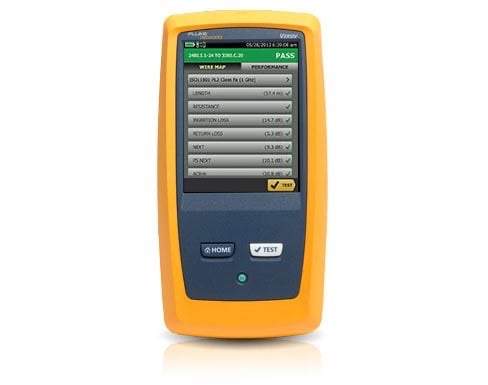
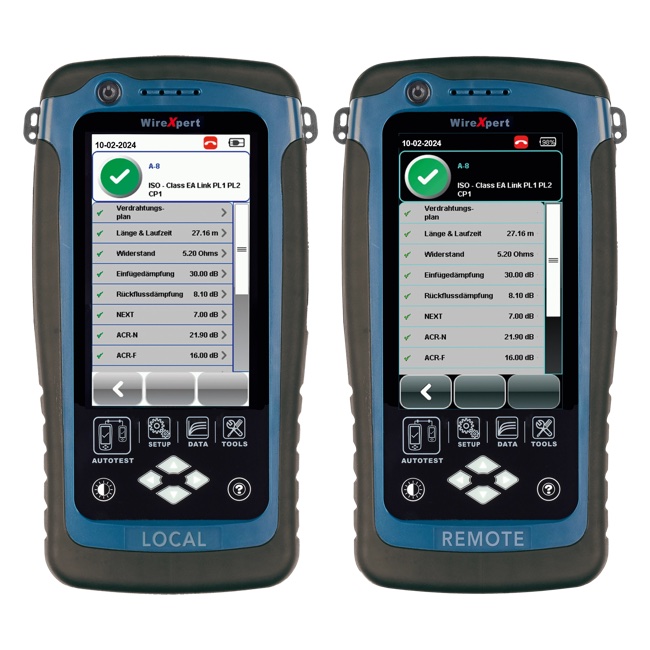
The certifiers in our catalog verify shield continuity automatically when shielded adapters are connected. They are quote-only, and shielded adapters are a per-order configuration choice rather than an assumption.