The Quick Overview
What ISO/IEC 11801 Is and Who Publishes It
ISO/IEC 11801 is the international standard for generic cabling for customer premises. It is published jointly by the International Organization for Standardization (ISO) and the International Electrotechnical Commission (IEC). The current series consists of multiple parts:
- ISO/IEC 11801-1:2017 -- General requirements
- ISO/IEC 11801-2:2017 -- Office premises
- ISO/IEC 11801-3:2017 -- Industrial premises
- ISO/IEC 11801-4:2017 -- Single-tenant homes
- ISO/IEC 11801-5:2017 -- Data centers
- ISO/IEC 11801-6:2017 -- Distributed building services
The standard is referenced by national codes throughout Europe, Asia, the Middle East, Africa, Latin America, and Oceania. North American projects typically reference ANSI/TIA-568 instead, although both standards produce compatible installations. The European equivalent EN 50173 is closely harmonized with ISO 11801 and the two standards are usually treated as equivalent for project specifications.
Unlike TIA-568, which is freely viewable on the TIA website with paid copies for purchase, ISO 11801 is sold by ISO and national standards bodies. Expect to pay several hundred dollars per part for the official text. Most certifier manufacturers provide application notes summarizing the requirements without the full standard.
ISO Class Designations and How They Map to TIA Categories
ISO 11801 uses two parallel naming systems: component categories for the cable, jacks, and patch cords (Cat5, Cat6, Cat6A, Cat7, Cat7A, Cat8.1, Cat8.2), and installation classes for the assembled link or channel performance (Class D, E, EA, F, FA, I, II). The component category specifies what the parts are; the class specifies how the assembled installation performs.
| ISO Class | ISO Component | TIA Equivalent | Bandwidth | Primary Application |
|---|---|---|---|---|
| Class D | Cat5e | Cat5e | 100 MHz | 1 Gbps to 100 m |
| Class E | Cat6 | Cat6 | 250 MHz | 1 Gbps; 10 Gbps limited (55 m) |
| Class EA | Cat6A | Cat6A | 500 MHz | 10 Gbps to 100 m |
| Class F | Cat7 | Cat7 (no TIA equivalent) | 600 MHz | 10 Gbps fully shielded |
| Class FA | Cat7A | Cat7A (no TIA equivalent) | 1 GHz | 10 Gbps fully shielded; CATV overlay |
| Class I | Cat8.1 | Cat8.1 | 1 GHz | 25/40 Gbps to 30 m (data center) |
| Class II | Cat8.2 | Cat8.2 | 2 GHz | 25/40 Gbps to 30 m (data center) |
Class F and Class FA are notable for being ISO-only -- TIA never adopted Cat7 and Cat7A as full standards. Cat7 cable uses a non-RJ45 connector (typically GG45 or TERA) which prevented widespread North American adoption. Cat7 and Cat7A installations are uncommon outside Europe and specific industrial settings.
Where ISO 11801 Differs from TIA-568
Despite functional equivalence for most purposes, ISO 11801 and TIA-568 differ in several specific ways that matter when interpreting reports.
Measurement methodology
ISO 11801 generally uses slightly different measurement assumptions and rounding than TIA-568. The differences are small (typically less than 0.5 dB) but can cause edge-case results to pass one standard and fail the other. Modern certifiers calculate against both standards using the appropriate methodology for each.
Test parameter set
The core parameters (insertion loss, NEXT, PS-NEXT, ACR-F, return loss, propagation delay) are identical between the standards. ISO 11801 requires reporting of additional power-sum parameters in some cases and uses slightly different naming for a few measurements. The substantive content is the same.
Class F and Class FA
ISO defines Class F (600 MHz) and Class FA (1 GHz) cabling using fully-shielded S/FTP cable. TIA never adopted equivalent categories. If you encounter a project specifying Class F or FA, you are working in a European-influenced or specialized environment.
Frequency range for Class EA versus Cat6A
Both extend to 500 MHz, but ISO requires reporting at slightly more frequency points and uses different reporting frequencies for some parameters. The test takes the same time on a modern certifier; the report layout differs.
Permanent link versus reference link
ISO 11801 historically used a "reference link" terminology that has been phased out in favor of "permanent link" matching TIA usage. Older ISO reports may use the older terminology.
Test Configurations Under ISO 11801
Like TIA-568, ISO 11801 defines two primary test configurations: permanent link and channel.
Permanent link
Tests the fixed installed cabling between the patch panel and the work area outlet, excluding equipment and patch cords. Maximum length 90 meters of horizontal cable. Same boundaries and same purpose as TIA permanent link. Use for installation sign-off and warranty registration.
Channel
Tests the entire end-to-end path including all cordage. Maximum length 100 meters total. Same boundaries and same purpose as TIA channel. Use for final acceptance and troubleshooting. See our deep dive on channel versus permanent link for the full configuration breakdown -- the boundaries are identical between the two standards.
Modified link configurations
ISO 11801 also defines additional link configurations for specific environments such as direct attach, modular point cabling, and multi-user telecommunications outlet (MUTO) installations. Each has its own limit table that the certifier loads at test setup. These configurations are uncommon outside the specific application areas they target.
When You Need to Test Against ISO 11801
The simple rule: test against whatever standard the project specification calls out. The more nuanced rule:
- European projects almost always specify ISO 11801 or EN 50173 (which references ISO 11801). Public sector procurement in EU countries typically requires ISO compliance.
- Multinational corporate standards often specify ISO 11801 to maintain consistency across global facilities. A US-based multinational with offices in Germany, Singapore, and Brazil typically standardizes on ISO so the same cabling specification works everywhere.
- Asian and Middle Eastern projects commonly specify ISO 11801, sometimes alongside national or regional supplements.
- North American government, healthcare, and education projects typically specify TIA-568. ISO is acceptable but unusual.
- Data center projects often specify both standards or reference application-specific standards (TIA-942, EN 50600) that incorporate one or both cabling standards by reference.
If the project specification is genuinely silent, default to the regional convention (TIA in North America, ISO in Europe and most of the world). Confirm with the consultant before testing -- some inspectors reject reports that test against the wrong standard.
Certifier Setup for ISO 11801 Testing
Every modern cable certifier on the market supports both ISO 11801 and TIA-568 limit tables. Switching between them is a configuration choice at test setup, not a hardware change. The same physical adapters and test cords work for both standards.
Selecting the limit table
In the certifier's test setup menu, choose the standard (ISO 11801, TIA-568, or both) and the class or category (Class EA, Cat6A, etc.). The certifier loads the appropriate limit table and applies it during measurement.
Dual-standard reporting
Most certifiers can evaluate the same measurement against multiple standards simultaneously. You configure the test for "Class EA permanent link plus Cat6A permanent link" and the report shows both pass/fail results. This is useful for projects requiring dual compliance documentation.
Calibration considerations
Calibration is identical for both standards -- the certifier's hardware accuracy is what gets calibrated, not the limit tables. Annual factory calibration covers both standards. Test cords have the same service life regardless of which standard you test against.
Report format
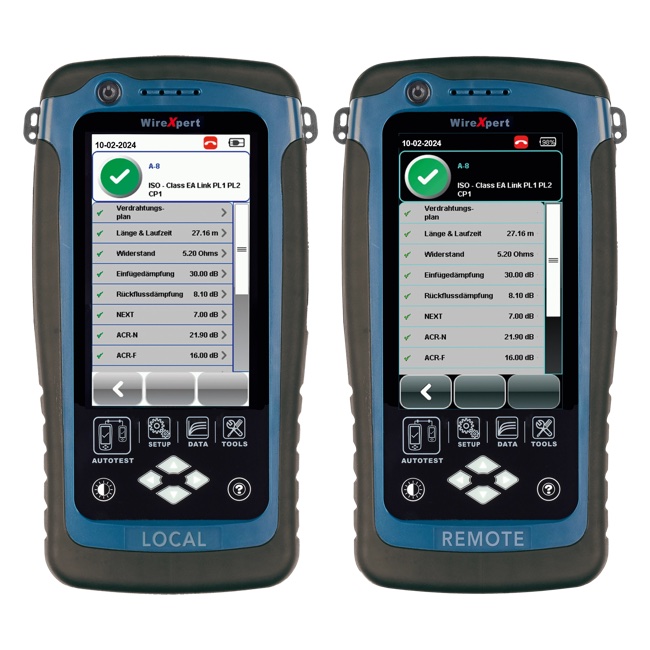
The report layout differs slightly between the standards. ISO reports use class designations (Class EA Permanent Link); TIA reports use category designations (Cat6A Permanent Link). Other than naming, the parameter list and measurement values are nearly identical.
Documentation Requirements Under ISO 11801
ISO 11801 requires that installations be documented with sufficient detail to support warranty claims, future modifications, and dispute resolution. Required documentation includes:
- As-built cable schedule with cable IDs matching the certification reports
- Test reports for every cable run, with the certifier serial number and calibration date
- Test configuration (permanent link or channel), test standard (ISO 11801 part and class), and date of test
- Operator identification
- Component category for cable, jacks, and patch cords
- Installation date and any subsequent re-test dates
These requirements parallel TIA-568 documentation expectations. Both standards effectively require the same record-keeping; the labels and terminology differ slightly.
Practical Summary
ISO/IEC 11801 is the international equivalent of ANSI/TIA-568. Class designations map directly to TIA category designations for most installations. Test configurations (permanent link and channel) are identical. The same certifier hardware tests against both standards by selecting the appropriate limit table at test setup.
For a North American technician picking up an ISO project for the first time, the practical adjustments are minimal: change the certifier setup from "TIA-568" to "ISO 11801," select the right class designation, and proceed normally. The measurements you take are the same. The pass/fail criteria are nearly the same. The reports look slightly different.
For deeper background on the parameters being measured see Cat6A Test Parameters Explained and Understanding Network Certification Reports.
Frequently Asked Questions
Is ISO/IEC 11801 the same as TIA-568?
No, but they are functionally equivalent for most purposes. ISO 11801 uses class designations and TIA uses category designations. Technical limits are similar but not identical, with ISO generally slightly more stringent on a few parameters. Modern certifiers support both standards by selecting the appropriate limit table.
Which standard should I test against, ISO 11801 or TIA-568?
Test against the standard called out in the project specification. North American projects almost always specify TIA-568. International, European, and multinational corporate standards usually specify ISO 11801. If silent, default to regional convention. Some projects require dual-standard reports, which modern certifiers handle easily.
What is the difference between ISO Class EA and TIA Cat6A?
Class EA and Cat6A are equivalent designations covering the same 500 MHz bandwidth and 10GBASE-T support. Technical limits are nearly identical. A cable certified to one will pass the other with very rare exceptions on individual parameters.
Does ISO 11801 require alien crosstalk testing?
Yes, for Class EA, FA, I, and II installations. Like TIA-568.2-D, ISO 11801 specifies PSANEXT and PSAACR-F limits but does not require field verification on every cable run. Manufacturer pre-qualification of the cable design typically satisfies the requirement; field testing is reserved for troubleshooting or projects that explicitly require it.
What is ISO 11801 Class I and Class II?
The highest-performance balanced twisted-pair classes, supporting 25 and 40 Gbps. Class I uses fully shielded F/UTP or U/FTP up to 1 GHz (equivalent to Cat8.1). Class II uses S/FTP up to 2 GHz (equivalent to Cat8.2). Both are limited to short channels (typically 30-40 meters) targeting data center applications.
Certifiers That Support Both Standards
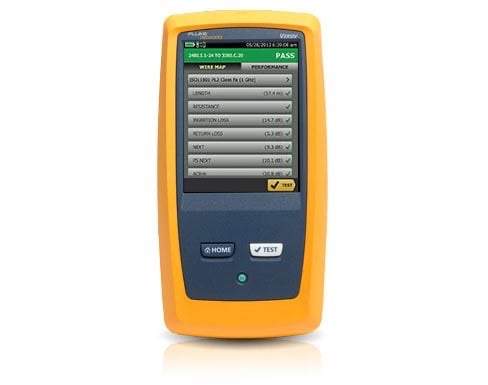
Every certifier in our inventory supports ISO 11801 and TIA-568 limit tables out of the box. Switch standards at test setup; no hardware change required.