Why Certification Reports Matter
A certification report is the documented proof that a cable installation meets a specific performance standard. It is not a formality. Three groups care deeply about these reports:
- Cable manufacturers require certified test results to honor extended warranties (often 15-25 years). Without test documentation, the warranty on the cable plant is typically void.
- Building inspectors and general contractors may require certification reports as part of the occupancy sign-off process. This is especially common in commercial construction, healthcare facilities, and education buildings.
- IT departments and end customers use certification reports to verify that the installed cable plant meets the performance specification they paid for. A report showing Cat6A certification at 500 MHz proves the infrastructure is ready for 10GBASE-T.
In disputes about installation quality, the certification report is the objective record. It eliminates subjective arguments about workmanship and replaces them with measured data against published standards.
Anatomy of a Certification Report
A typical certification report contains the following sections. Different certifier brands format reports differently, but the data points are standardized.
Header Information
Cable ID (the label or number assigned to the cable run), test date and time, operator name, certifier model and serial number, and firmware/software version. The certifier serial number ties the test results to a calibrated instrument, which matters for warranty claims.
Test Configuration
The test standard used (TIA-568.2-D, ISO 11801), the cable category tested against (Cat5e, Cat6, Cat6A), and the test limit applied (permanent link vs channel). Permanent link tests exclude patch cords. Channel tests include everything from equipment patch cord to user patch cord.
Overall Result
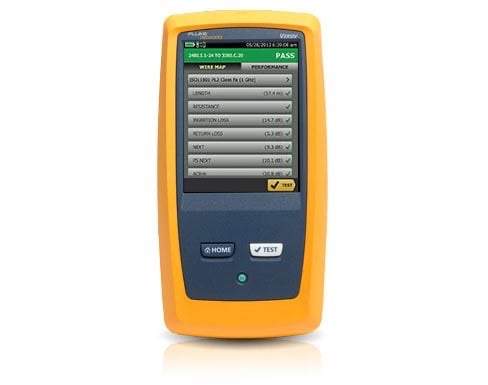
PASS or FAIL for the entire cable run. If any single parameter fails, the overall result is FAIL. Some certifiers also show a PASS* (marginal pass) result when a parameter passes but is within a few dB of the limit.
Parameter Results
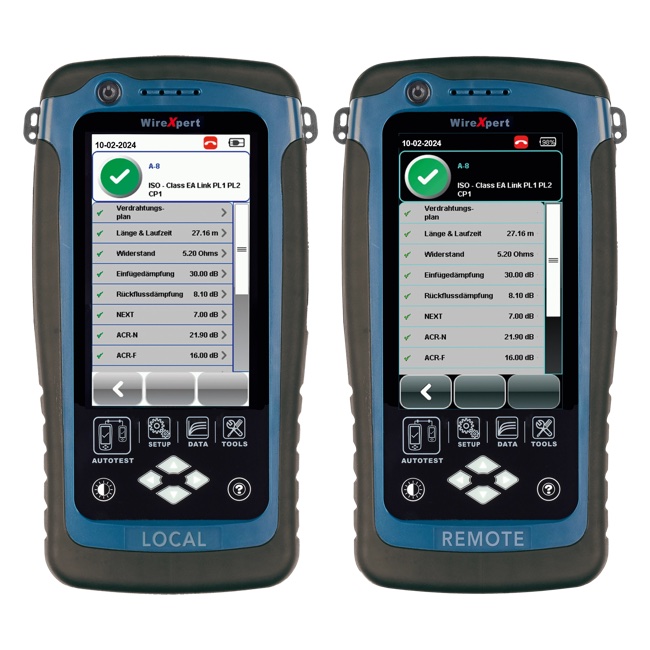
Individual pass/fail results and measured values for each test parameter. This is the bulk of the report and includes the parameters covered below.
Key Parameters Explained
Wire Map
Verifies the correct pin-to-pin wiring at both ends. The report shows each pin connection and flags opens, shorts, crossed pairs, split pairs, and reversed pairs. A wiremap failure means the cable is miswired and must be re-terminated.
Length
The physical cable length measured using propagation delay. For a permanent link, the maximum is 90 meters. For a channel, the maximum is 100 meters. The report shows the measured length and whether it passes the limit.
Insertion Loss
Signal attenuation across the cable run, measured in dB. Lower is better. Insertion loss increases with frequency and cable length. The report shows the worst-case insertion loss value and the frequency at which it occurred. If insertion loss fails, the cable is too long, the cable is damaged, or the wrong cable category was installed.
NEXT (Near-End Crosstalk)
The interference between pairs measured at the transmitting end. Higher is better (more isolation). NEXT is the parameter most affected by termination quality. The report shows NEXT for each pair combination (12-36, 12-45, 12-78, 36-45, 36-78, 45-78) and flags the worst case. NEXT failures are almost always caused by excessive untwist at the connector or patch panel.
PS-NEXT (Power Sum NEXT)
The combined crosstalk from all three other pairs onto one pair. This is a more realistic measure of crosstalk than individual pair-to-pair NEXT because in real network traffic, all four pairs transmit simultaneously.
ACR-F (Attenuation-to-Crosstalk Ratio, Far End)
The ratio between the signal that arrives at the far end and the crosstalk noise at the far end. A higher ACR-F means the signal is stronger relative to the noise. This parameter determines whether the receiving equipment can decode the signal correctly.
Return Loss
The amount of signal reflected back toward the transmitter due to impedance mismatches. Lower is better. Impedance mismatches occur at every connection point and at any location where the cable geometry changes. Return loss failures point to damaged connectors, poor-quality patch cords, or cable damage.
Propagation Delay and Delay Skew
The time for a signal to travel the cable length (propagation delay) and the difference in delay between the fastest and slowest pair (delay skew). Excessive delay skew means one pair delivers data later than the others, which can cause the receiving equipment to fail to reconstruct the data stream.
Pass/Fail Criteria by Cable Category
Each cable category is tested against a different frequency limit. The higher the category, the wider the frequency range and the tighter the performance limits.
| Category | Max Frequency | Max Channel Length | Application |
|---|---|---|---|
| Cat5e | 100 MHz | 100 m | 1000BASE-T (1 Gbps) |
| Cat6 | 250 MHz | 100 m (55 m for 10G) | 1000BASE-T, 10GBASE-T (limited) |
| Cat6A | 500 MHz | 100 m | 10GBASE-T (full distance) |
A cable can be tested against a lower category than its rating. Cat6A cable tested to Cat6 limits will typically pass with wide margins. However, this does not prove Cat6A compliance -- only a test at 500 MHz proves that.
What Building Inspectors Look For
When a building inspector reviews cable certification reports, they are typically looking for:
- Overall PASS result for every cable run. A single FAIL in a batch of reports will trigger questions. Fix and retest before the inspector arrives.
- Correct test standard. The report must test against the standard specified in the project documents. If the spec says Cat6A, the report must show Cat6A limits, not Cat6.
- Completeness. Every cable run on the as-built drawing should have a corresponding test report. Missing reports are treated the same as failures.
- Calibration. The certifier should be within its calibration period. Most certifiers require annual factory calibration. The calibration date appears in the report header.
- Cable identification. Each report should be traceable to a specific cable run using the cable ID or label number. Reports without identifiable cable IDs are not useful for future troubleshooting.
Practical Tips for Clean Certification
- Test as you install. Do not wait until all cables are terminated to start testing. Finding a NEXT failure on cable 147 of 200 is much easier to fix at the time of termination than during a bulk testing session days later.
- Use quality patch cords for channel tests. A cheap patch cord can cause a channel test to fail even when the permanent link is perfect. Use factory-tested patch cords rated for the cable category you are certifying.
- Minimize untwist at terminations. NEXT failures at 250+ MHz are almost always caused by too much untwisted wire at the connector or punch-down block. Keep the twist as close to the termination point as possible.
- Document everything. Export reports as PDF, organize by floor or zone, and include the as-built cable schedule. Complete documentation makes warranty claims, future troubleshooting, and building inspections straightforward.
- Keep your certifier calibrated. An out-of-calibration certifier produces test results that may not be accepted by inspectors or manufacturer warranty programs. Follow the manufacturer's calibration schedule.
Test with Confidence
Whether you need basic wiremap verification or full speed qualification, find the right tool for your testing workflow.