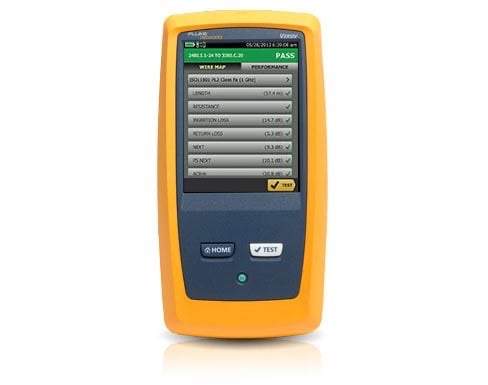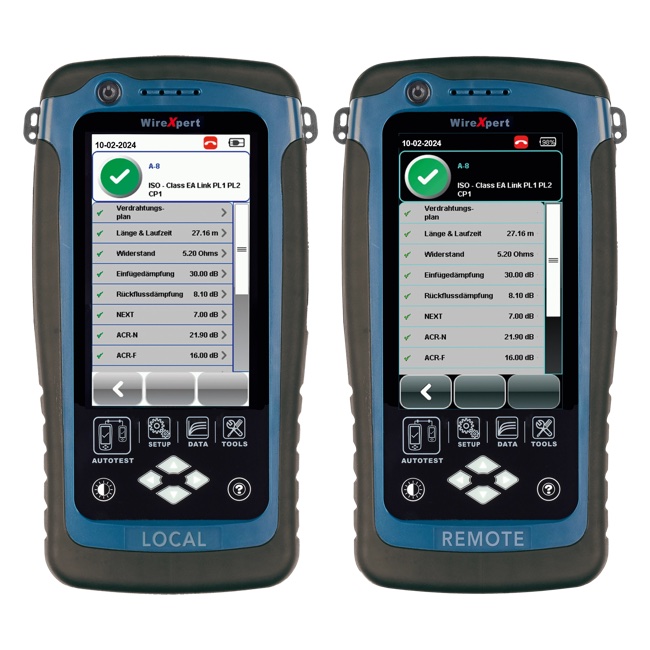
The Cat6A Parameter Set at a Glance
Why Cat6A Has More Parameters Than Cat6
The Cat6A standard exists to support 10GBASE-T (10 Gigabit Ethernet over twisted pair) at the full 100-meter channel length. 10GBASE-T uses PAM-16 modulation -- 16 amplitude levels per symbol -- which is dramatically more sensitive to noise than the simpler signaling in 1000BASE-T. Every dB of crosstalk margin matters, and every nanosecond of delay skew can break the link.
To verify that a cable installation can support 10GBASE-T, the standard requires measurements that earlier categories did not specify or specified less stringently. The frequency range doubles from 250 MHz (Cat6) to 500 MHz (Cat6A). Crosstalk parameters get tighter limits. Alien crosstalk -- interference between adjacent cables in the same bundle -- becomes a tested parameter for the first time.
The result is a Cat6A certification report with roughly twice as many measurements as a Cat5e report. None of the parameters are decorative. Each one targets a specific mechanism that can degrade 10GBASE-T performance.
Foundation Parameters: Wiremap and Length
Wiremap
Wiremap is the simple connectivity test: every conductor must connect to the correct pin at both ends with no opens, shorts, crossed pairs, or split pairs. A wiremap failure on a Cat6A run almost always indicates termination error -- the most common being two wires swapped within the punch-down sequence. Wiremap is pass/fail with no numerical headroom.
Length
The certifier measures cable length per pair using TDR. The maximum is 90 meters for permanent link, 100 meters for channel. Pairs in the same cable will measure slightly different lengths because the twist rate differs per pair, making some conductors physically longer. The reported length is the longest pair. Length failures cannot be fixed by re-termination -- the cable must be re-routed or shortened.
Insertion Loss (Attenuation)
Insertion loss measures how much signal energy is lost between the input and output of the cable, in dB. Lower numbers mean less loss, which is better. Insertion loss increases with frequency (higher frequencies attenuate faster) and with cable length (longer cables lose more signal).
For Cat6A permanent link, the insertion loss limit at 500 MHz is approximately 32.7 dB at 90 meters. The limit scales with frequency along a published curve. The certifier sweeps the full frequency range and compares the measured value to the limit at every frequency, reporting the worst-case violation.
Common causes of insertion loss failure: cable too long, cable damaged by crushing or stretching during installation, cable that does not actually meet the Cat6A specification (counterfeit or off-spec product), or excessive temperature (cable installed in unconditioned spaces near the upper temperature limit can show 10-20% higher attenuation than at room temperature).
The NEXT Family: Near-End Crosstalk
NEXT (pair-to-pair)
NEXT measures crosstalk from one transmitting pair onto another adjacent pair, measured at the same end as the transmitter. Higher dB values are better -- they indicate that less of the transmitted signal coupled onto the adjacent pair. NEXT is reported for each pair combination (1,2 to 3,6; 1,2 to 4,5; 1,2 to 7,8; 3,6 to 4,5; 3,6 to 7,8; 4,5 to 7,8) and the worst case is the pair-to-pair NEXT for the link.
Cat6A NEXT limit at 500 MHz is approximately 27.9 dB for permanent link. NEXT is the parameter most sensitive to termination quality. Excessive untwist at the connector or punch-down block is the dominant failure mode, especially at high frequencies. Maintaining the pair twist as close to the IDC contact as possible is critical.
PS-NEXT (Power Sum NEXT)
PS-NEXT is the combined crosstalk from all three other pairs onto the pair being measured. Because 10GBASE-T uses all four pairs simultaneously, the total crosstalk on any pair is the sum of contributions from the other three. PS-NEXT will always be lower (worse) than the best individual NEXT measurement because it represents cumulative interference.
Cat6A PS-NEXT limit at 500 MHz is approximately 25.5 dB for permanent link. If individual NEXT values are marginal, PS-NEXT may push into failure even when each pair-to-pair NEXT passes. Causes and fixes are identical to NEXT.
ACR-N and PS-ACR-N
ACR-N (Attenuation to Crosstalk Ratio at the Near end) is the difference between NEXT and insertion loss in dB. PS-ACR-N is the same calculation using PS-NEXT instead of NEXT. These parameters were prominent in Cat5e and Cat6 reports because they directly indicated whether the receiver could distinguish the desired signal from crosstalk noise.
In Cat6A, the standard guarantees positive ACR-N implicitly through the NEXT and insertion loss limits, but most certifiers still report ACR-N for diagnostic purposes. A negative ACR-N at any frequency means crosstalk exceeds signal at that frequency -- the link cannot work at protocols that use that frequency band.
ACR-F (Formerly ELFEXT) and PS-ACR-F
ACR-F (Attenuation to Crosstalk Ratio at the Far end) is the far-end equivalent of ACR-N. It measures crosstalk at the receiving end of the cable relative to the signal that survived attenuation across the full cable length. Older certifiers and training materials called this parameter ELFEXT (Equal Level Far-End Crosstalk). The TIA renamed it to ACR-F to align with ISO terminology.
ACR-F matters because far-end crosstalk has the same effective level as the signal at the receiver -- both have traveled the full cable length and been attenuated by it. If far-end crosstalk is significant relative to signal, the receiver cannot decode reliably. Cat6A ACR-F limit at 500 MHz is approximately 8.8 dB for permanent link.
PS-ACR-F (formerly PSELFEXT) is the power sum equivalent: combined far-end crosstalk from all three other pairs onto the pair being measured. Like PS-NEXT versus NEXT, PS-ACR-F is always lower than the best individual ACR-F.
ACR-F failures usually point to cable quality issues rather than termination quality. A short cable with great terminations can still fail ACR-F if the cable's intrinsic far-end crosstalk is poor. This typically indicates substandard cable or cable from a manufacturer whose Cat6A design has not been verified through the full ANSI/TIA test program.
Return Loss
Return loss measures the signal energy reflected back toward the transmitter due to impedance discontinuities along the cable. A perfect cable would have infinite return loss (no reflection). Real cables have impedance variations at every connector, every cable bend, and any manufacturing inconsistency.
Cat6A return loss limit at 500 MHz is approximately 14 dB for permanent link. Higher dB values are better -- they indicate less reflected energy. A return loss of 14 dB means about 4% of the signal energy is reflected; a return loss of 20 dB means only 1% is reflected.
Return loss failures typically come from poor connector terminations, kinked or crushed cable near connectors, mixed component categories (Cat5e jack on Cat6A cable), or factory defects in the cable. Diagnosing the location of a return loss problem requires looking at the certifier's TDR plot, which shows where the reflection occurred along the cable length.
Propagation Delay and Delay Skew
Propagation delay is the time in nanoseconds for a signal to travel from one end of the cable to the other. The maximum allowed for Cat6A is approximately 555 nanoseconds for a 100-meter channel. Propagation delay is rarely a fail by itself -- it correlates with cable length and very few installations push the length limit hard enough to fail delay alone.
Delay skew is the difference between the fastest and slowest pair's propagation delay. The Cat6A limit is 50 nanoseconds for a 100-meter channel. This parameter is critical because 10GBASE-T transmits simultaneously on all four pairs and reassembles the data at the receiver based on alignment timing. If one pair is too slow, the receiver cannot align the streams.
Delay skew failures are caused by mixed cable batches in one run (different manufacturing dates can have slightly different twist rates and therefore different delays), severely deformed cable, or cables with manufacturing defects in the twisted pair geometry. Delay skew cannot be fixed by re-termination -- the cable must be replaced.
Alien Crosstalk Parameters (Cat6A-Specific)
Alien crosstalk is interference between adjacent cables in the same bundle. Unlike NEXT and ACR-F which measure crosstalk between pairs within one cable, alien crosstalk measures noise coupled from neighboring cables. At Cat6A frequencies (up to 500 MHz) with 10GBASE-T's noise sensitivity, alien crosstalk can be the dominant impairment in densely packed cable trays.
PSANEXT (Power Sum Alien NEXT)
The combined near-end crosstalk from all surrounding cables onto the cable under test. Measured by transmitting on six surrounding "disturber" cables while measuring noise on the pair under test in the "victim" cable. Cat6A permanent link limit at 500 MHz is approximately 60 dB.
AvgPSANEXT (Average PSANEXT)
PSANEXT averaged across all four pairs of the victim cable. Average values smooth out individual pair anomalies and give a holistic view of bundle crosstalk performance.
PSAACR-F (Power Sum Alien ACR-F)
The far-end equivalent of PSANEXT, measuring far-end crosstalk from disturber cables onto the victim cable.
AvgPSAACR-F (Average PSAACR-F)
PSAACR-F averaged across all four victim pairs.
Alien crosstalk testing in the field is slow -- testing one cable requires connecting to 6 surrounding cables as disturbers and the certifier must perform measurements while the disturbers are excited. Most projects rely on the cable manufacturer's pre-qualification testing rather than field testing every run. Cable manufacturers publish test data showing their Cat6A cable design meets the alien crosstalk requirements when installed in standard bundle configurations.
Cat6A Permanent Link Limits Reference
The table below summarizes worst-case parameter limits for Cat6A permanent link at the top of the frequency range. These are reference values; the actual standard publishes limit curves that vary continuously with frequency.
| Parameter | Limit at 500 MHz | Higher or Lower is Better? | Primary Failure Cause |
|---|---|---|---|
| Insertion Loss | 32.7 dB | Lower | Long runs, damaged cable |
| NEXT | 27.9 dB | Higher | Excessive untwist at termination |
| PS-NEXT | 25.5 dB | Higher | Cumulative termination quality |
| ACR-F | 8.8 dB | Higher | Substandard cable design |
| PS-ACR-F | 5.8 dB | Higher | Substandard cable design |
| Return Loss | 14 dB | Higher | Poor connector, kinked cable |
| Delay Skew | 50 ns (full link) | Lower | Mixed batches, deformed cable |
| PSANEXT | 60 dB | Higher | Off-spec cable, dense bundles |
Diagnostic Patterns: Reading the Failure
The combination of parameters that fail tells you where to look for the problem. Some common patterns:
- NEXT fails on one end only, on one pair only. Termination problem at the failing end on the failing pair. Re-terminate that one location with attention to pair twist.
- NEXT fails on both ends, all pairs. Wrong category components (Cat5e or Cat6 jacks installed on Cat6A cable) or systemic termination technique issue. Verify component category and re-train if needed.
- Return loss fails, NEXT passes. Cable damage near connectors (kink, crush) or impedance mismatch from mixed components. Check TDR plot for fault location.
- Insertion loss fails, NEXT and return loss pass. Cable too long or bulk cable does not actually meet specification. Verify length and cable manufacturer.
- ACR-F fails on long runs, passes on short runs of the same cable batch. Marginal cable quality -- the cable's intrinsic far-end crosstalk is too high for the longer attenuation. Replace cable.
- Delay skew fails, all other parameters pass. Mixed cable batches in the run, or severely deformed cable. Replace cable; do not mix manufacturing batches.
For the broader interpretation framework see How to Read a Cable Certification Report and our Cat6A testing walkthrough.
Frequently Asked Questions
What is the difference between ELFEXT and ACR-F?
They are the same measurement. The TIA renamed ELFEXT to ACR-F to align with ISO terminology. PSELFEXT became PS-ACR-F. Older certifiers and older training materials still use ELFEXT; modern certifiers use ACR-F. The measurement quantifies far-end crosstalk relative to signal that survived cable attenuation.
Why does Cat6A require alien crosstalk testing but Cat6 does not?
Cat6A operates at 500 MHz and supports 10GBASE-T which uses noise-sensitive PAM-16 modulation. At those frequencies, crosstalk between adjacent cables in a bundle becomes significant and can degrade 10G performance even when each individual cable passes internal crosstalk parameters. Cat6A specifies alien crosstalk parameters to ensure cables installed in bundles still deliver 10GBASE-T performance.
Do I need to test alien crosstalk on every Cat6A run?
No. Cable manufacturers publish alien crosstalk test reports proving their Cat6A cable design meets the requirement. Field alien crosstalk testing is reserved for troubleshooting 10GBASE-T problems or for specifications that explicitly require it. Most installations rely on manufacturer pre-qualification.
What is PS-ACR and why is it important?
PS-ACR is the difference between insertion loss and PS-NEXT in dB. It tells you the margin between signal and combined crosstalk noise. Cat6 specified PS-ACR explicitly; Cat6A guarantees positive PS-ACR implicitly through its NEXT and insertion loss limits. A negative PS-ACR at any frequency means noise dominates and the link cannot work.
What is delay skew and why does it matter for Cat6A?
Delay skew is the difference in propagation time between the fastest and slowest pair. TIA-568.2-D limits Cat6A delay skew to 50 nanoseconds. 10GBASE-T transmits on all four pairs simultaneously and the receiver aligns the streams; if one pair is too late, the link cannot operate at 10G. Causes are mixed manufacturing batches in one run or severely deformed cable.
Cat6A Certification Equipment
For 10GBASE-T verification across the full Cat6A parameter set, you need a true certifier with Level VI accuracy. Browse our certifier inventory.