The Quick Overview
Why Certification Reports Matter
A certification report is not paperwork for its own sake. It serves four practical purposes that directly affect your business and your liability.
Manufacturer warranty registration
Every major cable manufacturer -- Belden, Panduit, CommScope, Leviton, Siemon -- requires certification test results as a condition of their extended system warranties. These warranties typically cover 20-25 years and include both the cable and connected hardware. Without certification reports, the warranty does not apply. When a cable fails five years into a building's life and the building owner files a warranty claim, the first thing the manufacturer asks for is the certification report.
Building sign-off and acceptance
On commercial construction projects, the general contractor or building consultant typically requires certification reports before accepting the low-voltage installation. The reports prove that every cable run meets the specification called out in the project documents. Without them, the GC may hold retainage, delay sign-off, or refuse to accept the work.
Legal liability protection
Certification reports are timestamped legal documents that prove the cable installation met standards at the time of completion. If a network problem occurs years later and the building owner claims it was an installation defect, your certification reports are your defense. They establish the baseline: "this cable passed all TIA-568.2-D Cat6A parameters on this date." Any degradation after that point is attributable to external factors, not your installation.
Customer deliverable
For many customers, the certification report is a deliverable they expect to receive alongside the as-built drawings. It is their documentation of what was installed, how it performed at installation, and what standard it was tested against. Contractors who deliver clean, organized certification reports project professionalism and give the customer confidence in the installation quality.
Anatomy of a Report: The Header
The top of every certification report contains identifying information. Understanding what each field means and what to check helps you catch errors before the report becomes a permanent record.
- Tester model and serial number -- identifies the specific certifier used. This is important for traceability. If test results are ever questioned, the tester's calibration records can be verified against this serial number.
- Calibration date -- certifiers require annual factory calibration. If the calibration date on the report is more than 12 months before the test date, the results may not be accepted by the cable manufacturer or the project consultant. Check this before testing.
- Test standard -- identifies which standard the cable was tested against: TIA-568.2-D (North America), ISO 11801-1 (international), or EN 50173-1 (European). The standard determines the pass/fail thresholds for every measurement.
- Test configuration -- permanent link or channel. Permanent link tests the fixed installation (patch panel to wall jack, max 90m). Channel tests the full end-to-end path including patch cords (max 100m). Most installation sign-offs use permanent link testing.
- Cable type and category -- the cable category being tested against (Cat5e, Cat6, Cat6A). The certifier tests against the performance limits for this category. Testing a Cat6 cable against Cat6A limits will produce different results than testing it against Cat6 limits.
- Cable ID -- the label or identifier assigned to this cable run. This should match the cable labels on the patch panel and wall jack so the report can be traced to a specific physical cable.
- Date and time -- when the test was performed. This establishes the timestamp for the installation record.
- Operator -- the technician who performed the test. Some specifications require the operator to be identified by name or certification number.
The Critical Measurements Explained
Below the header, the report contains the actual test results. Each measurement tests a specific electrical property of the cable installation. Here is what each one means in plain language.
Wiremap
Wiremap verifies that every conductor is connected to the correct pin at both ends, with no opens (broken conductors), shorts (two conductors touching), crossed pairs (pairs swapped), or split pairs (individual conductors from different pairs mixed). This is a simple pass/fail test with no numerical value. A wiremap failure means the cable is wired wrong and must be re-terminated.
Wiremap is the one test that even a $30 cable tester can perform. It is included in the certification report for completeness, but it rarely fails on a cable that was terminated by a trained technician. When it does fail, the fix is straightforward: re-terminate the failed end.
Length
The certifier measures the physical length of each conductor pair using TDR (Time Domain Reflectometry). TIA-568 limits permanent link length to 90 meters and channel length to 100 meters. The report shows length for all four pairs -- they will vary slightly because the twist rate differs per pair, meaning some pairs are physically longer than others even in the same cable jacket.
Length failures are uncommon but unfixable without re-routing the cable. If a run exceeds the maximum, the cable must be re-routed through a shorter path or a consolidation point must be installed. There is no way to "fix" a cable that is too long.
Insertion Loss (Attenuation)
Insertion loss measures how much signal is lost as it travels through the cable, measured in decibels (dB). Every cable loses signal over distance -- copper conductors have resistance, and that resistance converts signal energy to heat. Higher frequency signals lose more energy than lower frequency signals, so insertion loss is worst at the top of the cable's rated bandwidth (250 MHz for Cat6, 500 MHz for Cat6A).
The TIA-568 standard defines maximum allowable insertion loss values at each frequency for each cable category. A Cat6A permanent link, for example, has a maximum insertion loss of approximately 32.7 dB at 500 MHz for a 90-meter run. The actual limit varies with cable length -- shorter runs are allowed proportionally less loss per meter.
Insertion loss failures are typically caused by excessive cable length, poor-quality cable (thinner conductors, inconsistent twist), or damaged cable (kinked, crushed, or stretched during installation). Unlike NEXT failures, insertion loss problems cannot usually be fixed by re-terminating -- the issue is in the cable itself.
NEXT (Near-End Crosstalk)
NEXT measures the electromagnetic interference between adjacent conductor pairs at the end of the cable where the signal originates. When a signal is transmitted on one pair, some of that energy couples onto adjacent pairs -- this is crosstalk. NEXT measures how much of that coupled signal appears at the near end, where it is strongest and most damaging to signal integrity.
NEXT is measured in decibels, and unlike insertion loss, a higher number is better. A NEXT value of 50 dB means the crosstalk signal is 50 dB weaker than the transmitted signal -- excellent isolation. A value of 35 dB means the crosstalk is only 35 dB weaker -- poor isolation. The TIA standard sets minimum NEXT values for each frequency and cable category.
NEXT is the measurement most sensitive to termination quality. Excessive untwist at the connector is the number one cause of NEXT failures. Maintaining the pair twist as close to the termination point as possible is critical, especially on Cat6A where the frequency range is 500 MHz and crosstalk tolerance is tighter. A NEXT failure almost always means re-termination with proper technique.
PS-NEXT (Power Sum NEXT)
PS-NEXT measures the combined crosstalk from all three adjacent pairs onto the pair being measured, rather than measuring pair-to-pair individually. This is important because in Gigabit Ethernet and faster protocols, all four pairs carry data simultaneously, so the total crosstalk on any given pair is the sum of interference from the other three.
PS-NEXT will always be a worse (lower) number than the best individual pair-to-pair NEXT measurement, because it accounts for cumulative interference. If individual NEXT values are borderline, PS-NEXT may push into failure even when individual pairs pass. The causes and fixes are the same as NEXT -- termination quality is the primary factor.
ACR-F (Attenuation to Crosstalk Ratio, Far-End)
ACR-F (formerly called ELFEXT) measures crosstalk at the far end of the cable relative to the signal attenuation over the cable length. It answers the question: at the receiving end of the cable, how much crosstalk is present compared to the desired signal? If the cable has high insertion loss (weak signal at the far end) and also has significant far-end crosstalk, the ratio between them determines whether the receiver can distinguish the signal from the noise.
ACR-F is measured in dB, and a higher value is better (more signal relative to crosstalk). ACR-F failures are less common than NEXT failures because far-end crosstalk is naturally attenuated by the cable length. When ACR-F does fail, it typically indicates a combination of problems: marginal cable quality plus marginal termination.
Return Loss
Return loss measures how much signal is reflected back toward the transmitter due to impedance mismatches in the cable and connectors. In a perfect cable, all signal energy travels to the far end. In a real cable, impedance discontinuities at connectors, splices, and cable bends cause some signal energy to reflect back.
Return loss is measured in dB, and a higher value is better (less reflected energy). A return loss of 20 dB means only 1% of the signal energy is reflected. A return loss of 10 dB means 10% is reflected -- a significant impairment.
Return loss failures are caused by poor connectors, inconsistent cable impedance (damaged or kinked cable), mismatched components (mixing Cat5e and Cat6 components), and improper cable dressing at the patch panel. The fix depends on the cause: re-termination if the connector is the problem, cable replacement if the cable is damaged.
Propagation Delay and Delay Skew
Propagation delay measures the time (in nanoseconds) for a signal to travel from one end of the cable to the other. Delay skew measures the difference in propagation delay between the fastest and slowest pairs in the cable. TIA-568 limits delay skew to 50 nanoseconds for a 100-meter channel.
Delay skew matters because Gigabit Ethernet and faster protocols transmit data simultaneously on all four pairs and reassemble it at the far end. If one pair is significantly slower than the others (higher delay), the receiver cannot align the data streams. Delay skew failures are rare with quality cable and are typically caused by using cable from different manufacturing batches in the same run, or by cable that has been severely stretched or deformed.
Propagation delay and delay skew failures are not fixable by re-termination. They indicate a cable problem that requires cable replacement.
Understanding Pass, Fail, and Pass*
Pass
A clean Pass means the measurement met the standard's threshold with adequate headroom. The cable comfortably meets the specification. No action required.
Fail
Fail means the measurement did not meet the standard's threshold. The cable does not meet the specification for the tested category. The cause must be identified and corrected, then the cable must be re-tested. Common actions: re-terminate (for NEXT and return loss failures), replace the cable (for insertion loss and delay skew failures), or re-route (for length failures).
Pass* (Marginal Pass)
Pass* indicates the measurement technically passed the standard's threshold but with less than the certifier manufacturer's defined margin -- typically less than 1 dB of headroom. The result is within specification today, but it is near the edge. Environmental changes (temperature fluctuation), connector aging, or additional connector insertions could push it into failure over time.
Most cable manufacturers accept Pass* results for warranty registration, but some require a clean Pass on all parameters. Check your manufacturer's specific requirements. As a practical matter, a Pass* on one or two parameters out of dozens is common and usually acceptable. Multiple Pass* results on the same cable run suggest a systemic installation quality issue that should be investigated.
Common Failure Patterns and What They Indicate
When a cable fails certification, the specific parameter that failed tells you where to look for the problem. Here are the most common failure patterns and their typical causes.
| Failed Parameter | Most Likely Cause | Typical Fix |
|---|---|---|
| NEXT (one end only) | Excessive untwist at the connector on the failing end | Re-terminate the failing end with proper pair twist maintenance |
| NEXT (both ends) | Wrong category components or damaged cable near both terminations | Verify component category matches; re-terminate both ends |
| Return loss | Impedance mismatch from poor connector, kinked cable, or mixed components | Re-terminate; inspect cable for kinks near connectors |
| Insertion loss | Cable too long, cable damaged (crushed/stretched), or poor-quality cable | Re-route for shorter path; replace damaged cable |
| Length (over limit) | Cable run exceeds 90m permanent link / 100m channel | Re-route through shorter path or add consolidation point |
| Wiremap (open) | Broken conductor, unterminated wire, or conductor not seated in IDC | Re-terminate the failing end |
| Wiremap (short) | Two conductors touching at the termination or cable damaged | Re-terminate; inspect cable jacket for damage |
| Delay skew | Severely deformed cable or mixed cable batches in one run | Replace the cable |
The most important diagnostic clue on a failure report is whether the problem appears at one end or both ends, and whether it appears on one pair or all pairs. A NEXT failure on pair 3-6 at the near end only points directly to the near-end termination of that specific pair. A return loss failure across all pairs at both ends suggests a cable problem (kink, crush) rather than a termination problem.
Reading Headroom: The Quality Metric That Matters Most
The pass/fail result tells you whether the cable meets the specification. The headroom tells you how well it meets the specification. Two cables can both pass Cat6A certification, but the one with 8 dB of NEXT headroom is a significantly better installation than the one with 1 dB of headroom.
Headroom is calculated as the difference between the measured value and the standard's limit. For parameters where higher is better (NEXT, PS-NEXT, ACR-F, return loss), headroom is the measured value minus the limit. For parameters where lower is better (insertion loss), headroom is the limit minus the measured value. Positive headroom means pass. Negative headroom means fail.
Tracking headroom across a project gives you a quality metric for your installation team. If headroom trends downward over the course of a project, it may indicate technician fatigue, a bad batch of connectors, or tooling that needs replacement. If one technician's cable runs consistently show less headroom than another's, it identifies a training opportunity.
Certifier software (Fluke LinkWare, Softing eXport) can generate headroom summary reports across an entire project, showing the worst-case headroom for each parameter across all tested cables. This project-level view is valuable for quality assurance and for identifying systemic issues before they become failures.
Permanent Link vs Channel: Which Configuration Was Tested?
Every certification report specifies the test configuration. This distinction matters because the pass/fail limits are different, and the results mean different things.
Permanent link
A permanent link test covers the fixed cable installation from the telecommunications outlet (wall jack) to the patch panel or horizontal cross-connect, excluding equipment cords and patch cords. Maximum length: 90 meters. The certifier uses special permanent link adapters that are calibrated out of the measurement. This configuration tests the contractor's work and nothing else -- no customer patch cords, no equipment cords.
Permanent link testing is the standard for installation sign-off because it isolates the installed infrastructure. If the permanent link passes, the contractor's work meets the specification regardless of what patch cords the customer uses later.
Channel
A channel test covers the entire end-to-end path from equipment to equipment, including patch cords and equipment cords at both ends. Maximum length: 100 meters (90m permanent link + 10m total for patch/equipment cords). The certifier uses channel adapters that include the test cord in the measurement.
Channel testing is more representative of the actual network performance because it includes every component in the link. However, it tests components the contractor may not have supplied (the customer's patch cords). If a channel test fails due to a poor patch cord, that is not the contractor's fault -- but distinguishing the cause requires additional investigation.
Most project specifications call for permanent link testing during construction and channel testing during final acceptance after equipment cords are installed. Read your specification carefully to ensure you are testing in the correct configuration.
Frequently Asked Questions
What does Pass* (pass with asterisk) mean on a certification report?
Pass* is a marginal pass -- the measurement met the standard's threshold but with very little headroom, typically less than 1 dB. The cable technically meets the specification but is near the edge. Most cable manufacturers accept Pass* results for warranty purposes, but the cable should be investigated since environmental changes or connector aging could push it into failure over time.
What is headroom on a certification report?
Headroom (or margin) is the difference between the measured value and the pass/fail threshold. More headroom means a healthier installation. For example, if the NEXT limit is 39.9 dB and your cable measures 44.2 dB, you have 4.3 dB of headroom. Well-installed Cat6A runs typically show 3-8 dB of headroom on critical parameters. Low headroom indicates marginal installation quality even on a passing cable.
Why did my cable fail NEXT but pass everything else?
NEXT failures are almost always caused by poor termination quality, specifically excessive untwist at the connector or patch panel. Maintaining the pair twist as close to the termination point as possible is critical for NEXT performance. Other causes include using the wrong category components (Cat5e jacks on Cat6A cable) and damaged cable near the connector. Re-terminating with proper technique and category-matched components typically resolves NEXT failures.
What is the difference between permanent link and channel testing?
Permanent link tests the fixed installation from patch panel to wall jack (max 90m), excluding equipment and patch cords. Channel tests the entire end-to-end path including cords (max 100m). Most installation sign-offs use permanent link testing because it isolates the contractor's work. Channel testing is used for final acceptance after all equipment cords are installed. The pass/fail limits differ between the two configurations.
How long should I keep cable certification reports?
Keep reports for at least the duration of the cable manufacturer's warranty -- typically 20-25 years. In practice, keep them indefinitely in digital form. Certification reports are legal documents that prove the installation met standards at completion. If a dispute arises years later, the certification report is your primary evidence. Store digital copies in at least two locations, associated with the project address and cable ID labels.
Need Certification Equipment?
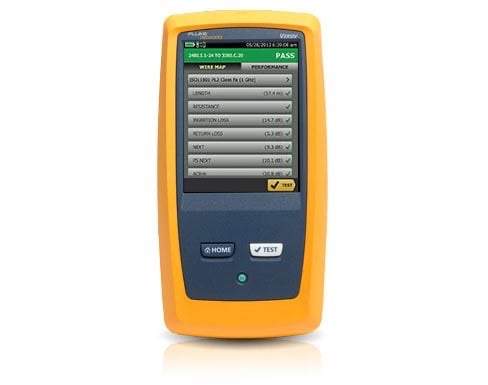
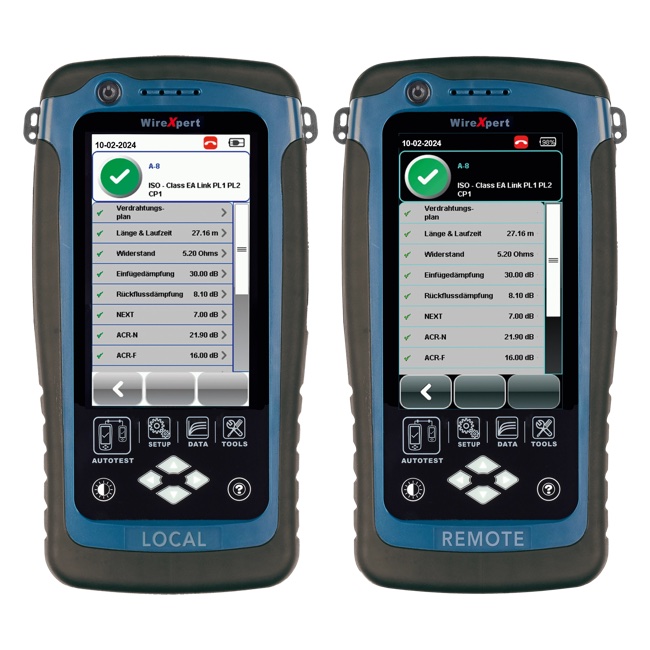
From the Fluke DSX series to the Softing WireXpert, find the certifier that matches your project volume and budget.