The Quick Answer
What TIA-1152 Actually Defines
TIA-1152 (and its IEC counterpart 61935-1) specifies the minimum performance requirements for field test instruments measuring balanced twisted-pair cabling. The standard does not define cable performance requirements -- that is TIA-568 and ISO 11801. TIA-1152 defines what the test equipment must be capable of measuring, and how accurately, to validly certify against the cable performance standards.
Specifically, TIA-1152 specifies:
- Frequency range the instrument must measure across (1 MHz to 100 MHz, 250 MHz, 500 MHz, 1 GHz, or 2 GHz depending on level)
- Dynamic range for each parameter -- the difference between the largest and smallest signal the instrument can measure with specified accuracy
- Measurement uncertainty -- the maximum allowable error in dB for each parameter at each frequency
- Cross-coupling requirements between parameters
- Linearity, repeatability, and stability requirements
- Test cord performance requirements (since the test cords are part of the measurement)
Each accuracy level corresponds to a different combination of frequency range and uncertainty tolerance. Higher levels measure higher frequencies with tighter accuracy. Cable certifiers are designed and certified to specific TIA-1152 levels by their manufacturers and verified through annual factory calibration.
Accuracy Levels: What Each One Certifies
Level II
An older designation rarely seen on current equipment. Limited frequency range and accuracy. Cannot certify modern cable categories. Mostly historical interest.
Level III
Frequency range 1 MHz to 100 MHz. Adequate for Cat5e certification (100 MHz bandwidth). Insufficient for Cat6 because Cat6 requires measurements up to 250 MHz. Level III certifiers were standard 15-20 years ago and are mostly out of service today.
Level IIIe
A transitional level extending Level III to higher accuracy at 100 MHz, but still not reaching the 250 MHz needed for Cat6. Limited certification capability. Rarely encountered on current equipment.
Level IV
Extended to 250 MHz. Capable of Cat6 certification with limitations. Older Level IV equipment may not meet the tighter accuracy required by current Cat6 limit interpretations. Some Level IV certifiers are still in service for Cat5e and Cat6 work.
Level V
Frequency range 1 MHz to 250 MHz with tighter accuracy than Level IV. Standard for Cat6 certification through the late 2000s and early 2010s. Cannot certify Cat6A because the frequency range only reaches 250 MHz, not 500 MHz.
Level VI
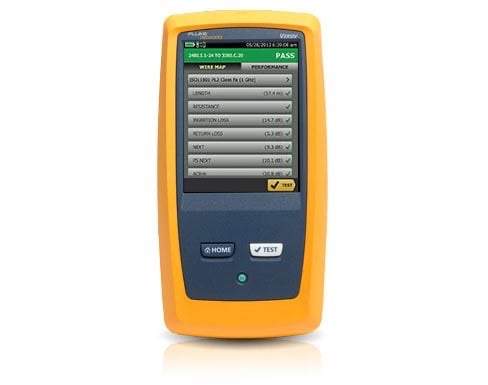
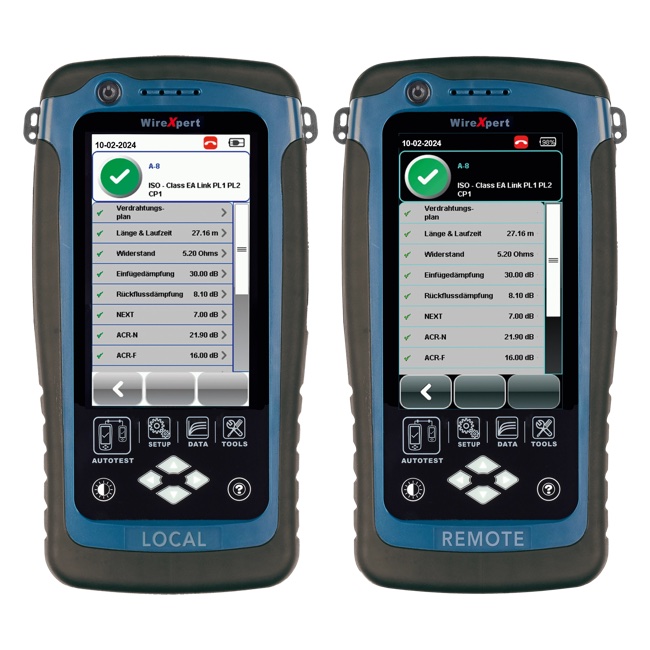
Frequency range 1 MHz to 500 MHz. The current standard for general-purpose enterprise cable certification. Level VI certifies Cat5e, Cat6, and Cat6A. This is the level most contractors need today. The Fluke DSX-5000, Softing WireXpert 4500, and equivalent NetAlly equipment are all Level VI.
Level VIA
Frequency range 1 MHz to 1 GHz. Adds support for Cat7A and ISO Class FA cabling. Used in European-influenced enterprise installations and specialized industrial environments. The Fluke DSX-5000 with the appropriate adapter set and the Softing WireXpert 4500 with extended modules can reach Level VIA performance.
Level 2G (Level VII)
Frequency range 1 MHz to 2 GHz. Required for Cat8.1 and Cat8.2 (ISO Class I and II) certification. Targets data center applications where 25GBASE-T and 40GBASE-T over short twisted pair runs is deployed. The Fluke DSX-8000 and Versiv 2 chassis support Level 2G.
Accuracy Level to Cable Category Lookup
| Accuracy Level | Frequency Range | Certifies | Typical Equipment |
|---|---|---|---|
| Level II | 1 - 20 MHz | Cat3 (legacy) | Historical only |
| Level III | 1 - 100 MHz | Cat5, Cat5e | Older Fluke DTX, MicroScanner Pro |
| Level IIIe | 1 - 100 MHz (tighter) | Cat5e | Older field equipment |
| Level IV | 1 - 250 MHz | Cat6 (limited) | Older Fluke DTX |
| Level V | 1 - 250 MHz | Cat5e, Cat6 | Older Fluke DTX-1500 |
| Level VI | 1 - 500 MHz | Cat5e, Cat6, Cat6A | Fluke DSX-5000, Softing WireXpert 4500 |
| Level VIA | 1 - 1000 MHz | + Cat7A, Class FA | DSX-5000 extended, WireXpert+ |
| Level 2G | 1 - 2000 MHz | + Cat8.1, Cat8.2 | Fluke DSX-8000, Versiv 2 |
Why Accuracy Level Matters in Practice
The difference between accuracy levels is not just frequency range -- it is also measurement uncertainty in dB. A Level VI certifier might specify 0.4 dB uncertainty on insertion loss at 500 MHz, while a Level V certifier specifies 0.6 dB at 250 MHz. That uncertainty matters because it determines how close to the standard's limit a measurement can pass without being flagged as marginal.
Measurement uncertainty and Pass*
The Pass* (marginal pass) result on a certification report is generated when a measurement passes the standard's threshold but is within the certifier's measurement uncertainty of the limit. A more accurate certifier (lower uncertainty) reports fewer Pass* results because more measurements are clearly inside the limit. A less accurate certifier reports more Pass* results because more measurements fall in the uncertainty band.
This matters for warranty registration. Some cable manufacturers reject Pass* results and require clean Pass on every parameter. If your certifier produces a lot of Pass* results, an accuracy upgrade may reduce them.
Dispute resolution
If a cable installation is disputed years after the fact, the original certification report's accuracy level is part of the evidence. A report from a Level VI certifier with 0.4 dB uncertainty is more defensible than a report from a Level IV certifier with 0.8 dB uncertainty when the dispute hinges on whether a measurement was inside or outside the standard's limit.
Project specification compliance
Some project specifications explicitly require Level VI or higher equipment. Showing up with a Level V certifier on a Cat6A project results in rejected work. Verify the spec's accuracy level requirement before mobilizing.
Calibration: Maintaining the Accuracy Level
A certifier's accuracy level is only valid if the instrument is operating within its calibrated specifications. Annual factory calibration -- typically required by the manufacturer and by most project specifications -- verifies that the instrument still meets the TIA-1152 accuracy requirements.
What calibration verifies
The factory calibration process measures the certifier's response across the full frequency range using traceable reference standards. Any drift outside the TIA-1152 tolerance is corrected through software calibration data updates or, in extreme cases, hardware repair. The output is a calibration certificate stating that the instrument meets its specified accuracy level on the calibration date.
Calibration interval
One year is the industry standard. Some manufacturers offer 18-month or 24-month intervals for instruments stored in controlled environments. Check the manufacturer's published interval and your project specification.
Self-calibration in the field
Most certifiers include a daily self-calibration routine using test cords or a reference adapter. This verifies that the instrument is operating consistently and that the test cords have not drifted. Daily self-calibration does not replace annual factory calibration; it complements it.
Test cord life
Test cords are part of the calibrated measurement system. Permanent link adapters typically include a precision test cord with a defined service life (5,000 mating cycles is common). After the service life, the test cord drifts outside calibration and the instrument's accuracy level is no longer valid until the cord is replaced and re-calibrated.
Practical Selection: Which Level Do You Need?
If you certify Cat5e only
Level III is sufficient. Used Level V or VI certifiers from prior decades sell for $1,000-$3,000 and provide reliable Cat5e certification. New entry-level certifiers in this range are also Level VI capable, often for similar money.
If you certify Cat6 work
Level V minimum. Level VI is recommended because it is widely available and future-proofs you for Cat6A.
If you certify Cat6A or 10GBASE-T installations
Level VI required. The Fluke DSX-5000 and Softing WireXpert 4500 are the two dominant Level VI certifiers in current production. Both are reliable choices.
If you certify data center Cat8 work
Level 2G required. Practically, this means the Fluke DSX-8000 with Versiv 2 chassis. The certifier population at this level is small because the Cat8 installation market is small. Most contractors who buy Level 2G equipment are dedicated data center specialists.
If you certify mixed work
Buy the highest level you reasonably need. A Level VI certifier costs about 30-50% more than a Level V certifier (when both are available) and handles Cat5e, Cat6, and Cat6A. The flexibility is usually worth the price difference.
For broader certifier comparison see Fluke DSX vs Softing WireXpert and DSX-5000 vs DSX-8000.
Frequently Asked Questions
What is TIA-1152?
TIA-1152 is the ANSI/TIA standard defining minimum performance requirements for field test instruments used to certify balanced twisted-pair cabling. It specifies accuracy levels (Level III through Level 2G) based on frequency range and measurement uncertainty. The IEC equivalent is IEC 61935-1.
What accuracy level do I need for Cat6A?
Level VI for standard Cat6A permanent link and channel testing. Level VI specifies measurement accuracy across 1 MHz to 500 MHz. Lower levels cannot meet Cat6A requirements at the upper frequency range. Most current-production certifiers from major manufacturers are Level VI or higher.
Is a higher accuracy level always better?
For categories the higher level can certify, yes. But you only need an accuracy level matching your highest cable category. If you only certify Cat5e and Cat6, a Level V certifier suffices and costs significantly less than Level VI. Match the level to the work.
What is Level VIA and Level 2G?
Level VIA extends to 1 GHz to support Cat7A and Class FA. Level 2G extends to 2 GHz to support Cat8.1 and Cat8.2. These levels target data center applications with 25GBASE-T and 40GBASE-T over short twisted pair runs. Most general-purpose certifiers in service today are Level VI; Level 2G is a specialty.
Where is the accuracy level documented on my certifier?
The instrument datasheet, user manual, calibration certificate, and the certifier's generated test reports all specify the accuracy level. Look for phrases like "Level VI compliant per TIA-1152." Manufacturer technical support can confirm the level from the model number and firmware version if documentation is unclear.
Match Your Certifier to Your Work
Browse certifiers organized by cable category support and accuracy level. Every model in our catalog has its TIA-1152 level documented on its product page.