The Quick Answer
What Each Model Certifies
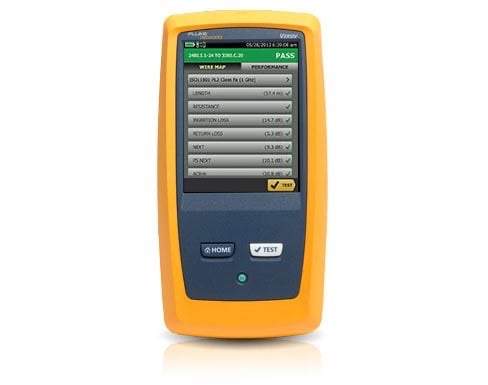
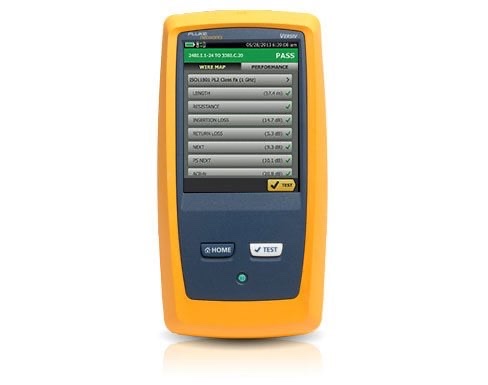
The fundamental difference between the DSX2-5000 and DSX2-8000 is frequency range, which determines what cable categories each unit can certify.
Fluke DSX2-5000: Up to 500 MHz
The DSX2-5000 certifies copper cable installations through Cat6A at 500 MHz. This covers Cat5e (100 MHz), Cat6 (250 MHz), and Cat6A (500 MHz) -- which accounts for virtually all horizontal cabling installed in commercial buildings, retail spaces, hospitals, schools, and government facilities. Cat6A supports 10GBASE-T Ethernet at distances up to 100 meters, which is the performance ceiling that most building networks require.
The DSX2-5000 measures all the parameters you need for TIA-568.2-D and ISO 11801-1 compliance: insertion loss, return loss, NEXT, PSNEXT, ACRF (ELFEXT), PSACRF, propagation delay, delay skew, and TCL. It generates standards-compliant reports through LinkWare and LinkWare Live. For the overwhelming majority of cabling contractors, this is a complete certification solution.
Fluke DSX2-8000: Up to 2000 MHz
The DSX2-8000 does everything the DSX2-5000 does, plus extends certification capability to 2000 MHz. This covers Category 8.1 (TIA) and Class I/II (ISO) cabling, which is specified for 25GBASE-T and 40GBASE-T Ethernet. Cat8 operates at frequencies four times higher than Cat6A, which demands proportionally tighter cable and termination specifications.
The additional frequency range requires different adapter hardware with tighter manufacturing tolerances. The DSX2-8000 uses specific Cat8 test adapters that are calibrated for accurate measurement at 2000 MHz. This is not a software difference -- it is a hardware capability that cannot be retrofitted to a DSX2-5000 unit.
Fluke DSX 5000 vs 8000: Head-to-Head Specification Comparison
Here is the DSX 5000 vs DSX 8000 specification comparison at a glance. Both run on the same Versiv platform, so the meaningful differences come down to frequency range, supported cable category, and price.
| Specification | Fluke DSX 5000 (DSX2-5000) | Fluke DSX 8000 (DSX2-8000) |
|---|---|---|
| Maximum frequency | 500 MHz | 2000 MHz |
| Highest cable category | Cat6A / Class EA | Cat8.1 / Class I & II |
| Accuracy level | Level V / Level 2G | Level V / Level 2G |
| Cat6A autotest time | ~10 seconds | ~10 seconds |
| Cat8 autotest time | N/A | ~10 seconds |
| Display | 5.7" color touchscreen | 5.7" color touchscreen |
| Platform | Versiv | Versiv |
| Wi-Fi | Yes | Yes |
| Bluetooth | Yes | Yes |
| Cloud reporting | LinkWare Live | LinkWare Live |
| Fiber module support | Yes (OLTS, OTDR) | Yes (OLTS, OTDR) |
| Standards | TIA-568, ISO 11801, EN 50173 | TIA-568, ISO 11801, EN 50173 |
| Supported Ethernet | Up to 10GBASE-T | Up to 25GBASE-T / 40GBASE-T |
| Battery life | ~8 hours | ~8 hours |
| Weight (main unit) | ~4.4 lb (2 kg) | ~4.4 lb (2 kg) |
| Typical street price | $12,000 - $15,000 | $20,000 - $27,000 |
| Annual calibration | Required (~$300-$500) | Required (~$400-$600) |
Notice how similar the two units are outside of frequency range and price. Same platform, same display, same software, same battery, same weight. The DSX2-8000 is not a "better" certifier for Cat6A testing -- it is the same certifier with an extended frequency range. If your work stays at Cat6A and below, you are paying $8,000-$12,000 for a capability you will never use.
When the DSX2-8000 Is Worth It
The DSX2-8000 earns its premium in specific scenarios. If one or more of these apply to your business, the investment makes sense.
Active data center work
Cat8 is a data center cable category. It was designed for switch-to-server connections in environments where 25GBASE-T or 40GBASE-T copper links replace fiber for short runs. If you are installing or certifying cabling in data center environments -- colocation facilities, enterprise server rooms, cloud provider edge deployments -- you will encounter Cat8 specifications. Contracts for this work will require certification to 2000 MHz, and only the DSX2-8000 (or comparable tools) can deliver that.
Data center contract pursuit
Even if your current work is primarily Cat6A commercial, owning an 8000 qualifies you to bid on data center projects that require Cat8 certification. For a contracting business looking to move into higher-margin data center work, the DSX2-8000 is a capability investment. One large data center contract can recoup the entire price premium.
Future-proofing for enterprise clients
Some enterprise clients are specifying Cat8 for backbone and high-density areas even in commercial buildings -- not because they need 25G today, but because they want the infrastructure to support it without recabling. If your client base includes Fortune 500 campuses, hospital systems, or government facilities with 20-year infrastructure planning horizons, you may see Cat8 requirements sooner than the broader market.
Test lab or consulting environments
If you operate a testing lab, provide cable system consulting, or work as a third-party certification authority, the DSX2-8000 ensures you can handle any cable category a client brings to you. The last thing a consulting firm needs is to turn away work because their tester cannot reach the required frequency.
When the DSX2-5000 Is Enough
For the majority of cabling contractors in 2026, the DSX2-5000 covers every job they will encounter. Here is why.
Commercial office and retail
Standard horizontal cabling in commercial buildings is Cat6A. The TIA-568.2-D standard specifies Cat6A as the recommended minimum for new commercial installations supporting 10GBASE-T. The DSX2-5000 certifies Cat6A completely. Cat8 is not specified for horizontal runs exceeding 30 meters, which means it has no role in typical office distribution.
Healthcare and education
Hospitals, clinics, and schools overwhelmingly specify Cat6A for new construction. The bandwidth requirements for medical imaging systems, nurse call systems, building automation, and classroom technology are all met by 10GBASE-T over Cat6A. These environments are unlikely to adopt Cat8 because their cable runs exceed Cat8's 30-meter distance limitation.
Cost-conscious fleet decisions
If you are equipping multiple crews, the math on the 8000 changes significantly. The per-unit premium is the same on every kit you buy, so a three-crew fleet pays it three times, and the accumulated difference buys significant additional capability elsewhere in your business -- more crews, better vehicles, additional fiber test equipment, or higher wages that attract experienced technicians.
Most general contractors
General contracting firms that subcontract cabling as part of larger construction projects are almost exclusively working with Cat6A specifications in 2026. The GCs who specify Cat8 are working on specialized facilities -- data centers, broadcast studios, defense installations -- that represent a small fraction of the construction market.
The Cat8 Reality Check
Here are the practical limitations that keep Cat8 out of standard commercial installations:
- 30-meter maximum channel length -- Cat8 is specified for a maximum permanent link of 24 meters (approximately 79 feet) and a maximum channel length of 30 meters including patch cords. In most commercial buildings, horizontal cable runs regularly exceed 50 meters. Cat8 simply cannot reach from the telecommunications room to the workstation in a typical floor plan.
- Shielded cable requirement -- Cat8.1 (TIA) uses shielded cable (F/UTP or better), which requires shielded connectors, shielded patch panels, and proper bonding and grounding. This adds material cost, labor complexity, and failure points. Many contractors and building owners prefer unshielded Cat6A specifically because it avoids grounding concerns.
- Cable cost -- Cat8 cable costs 3-5x more per foot than Cat6A. The termination components (plugs, jacks, patch panels) are also significantly more expensive. For a 200-drop floor in a commercial building, the cable cost difference alone can exceed $15,000-$20,000.
- No current demand for 25G at the workstation -- The devices at the end of a horizontal cable run -- laptops, desktops, VoIP phones, printers -- do not have 25GBASE-T network adapters. 10GBASE-T NICs are only now becoming common. There is no user-facing application in 2026 that demands 25G at the desk.
This does not mean Cat8 is irrelevant. In the environments where it is specified -- primarily data centers with dense rows of servers and short cable paths -- it is the correct solution. But contractors should not buy a DSX2-8000 because they think Cat8 will replace Cat6A in commercial buildings. That transition is not happening.
A Third Option: Budget for Cat6A Now, Plan for Cat8 Later
If you want Cat6A certification today with a path to higher frequencies in the future, consider the Softing WireXpert 500. The WireXpert platform offers software-based upgrades to higher frequency ranges (the WireXpert 4500 reaches 2500 MHz). You start with a Cat6A certifier at $8,000-$10,000, and if your business grows into data center work, you can upgrade to higher-frequency certification without replacing the hardware.
This approach costs less upfront than a DSX2-5000, provides equivalent Cat6A certification, and preserves optionality. The tradeoff is that you leave the Fluke ecosystem -- no LinkWare Live, less brand recognition on commercial job sites, and a smaller support network.
| Approach | Initial Cost | Cat6A | Cat8 Path | Ecosystem |
|---|---|---|---|---|
| DSX2-5000 | $12,000 - $15,000 | Yes | Buy DSX2-8000 separately | Fluke / LinkWare Live |
| DSX2-8000 | $20,000 - $27,000 | Yes | Included | Fluke / LinkWare Live |
| WireXpert 500 | $8,000 - $10,000 | Yes | Software upgrade available | Softing / eXport |
Software and Reporting: Identical Across Both Models
Both the DSX2-5000 and DSX2-8000 run the same Versiv firmware and connect to the same LinkWare ecosystem. There is no software difference between the two units. Both support:
- LinkWare Live -- cloud-based project management, real-time test result sync, multi-crew visibility
- LinkWare PC -- desktop report generation, batch export, customer-ready PDF reports
- ProjX management -- set up projects with target cable types, autotest configurations, and naming conventions before handing units to technicians
- Taptive interface -- Fluke's gesture-based touchscreen UI, consistent across both models
If you are choosing between the two based on software features, reporting capability, or cloud integration, there is no difference. The decision is purely about frequency range and the work you intend to certify.
Making the Decision
Frequently Asked Questions
What is the difference between the Fluke DSX 5000 and DSX 8000?
The core difference between the Fluke DSX 5000 (DSX2-5000) and DSX 8000 (DSX2-8000) is frequency range. The DSX 5000 certifies copper cabling up to 500 MHz, covering Cat5e, Cat6, and Cat6A. The DSX 8000 extends certification to 2000 MHz, which adds Cat8 (Category 8.1 / Class I and II). Both share the same Versiv platform, display, software, and reporting, and the DSX 8000 typically costs $8,000-$12,000 more. If you do not certify Cat8 in data center environments, the DSX 5000 covers your needs.
Can the Fluke DSX2-5000 be upgraded to test Cat8?
No. The DSX2-5000 hardware is designed for frequencies up to 500 MHz and cannot be field-upgraded to 2000 MHz. The frequency range is determined by the adapter hardware, not software. If you need Cat8 certification, you need the DSX2-8000 or a comparable platform like the Softing WireXpert 4500.
Is Cat8 cable actually being installed in 2026?
Yes, but in specific environments. Cat8 is installed in data center switch-to-server connections, high-frequency test labs, and some enterprise backbone links. It is not used for standard horizontal cabling in commercial buildings. Most commercial installations remain Cat6A. Cat8's 30-meter maximum channel length and higher cost per foot limit its deployment to short-run, high-density environments like data center rows.
What is the price difference between the DSX2-5000 and DSX2-8000?
The DSX2-8000 typically costs $8,000-$12,000 more than the DSX2-5000. Street prices for the DSX2-5000 run $12,000-$15,000. DSX2-8000 kits run $20,000-$27,000 depending on configuration. The premium reflects the higher-frequency adapter hardware required for accurate 2000 MHz measurement.
Does the DSX2-8000 test Cat6A faster than the DSX2-5000?
No. Both units perform Cat6A autotests at approximately 10 seconds. The DSX2-8000 offers no speed advantage for Cat6A work. Its additional capability is relevant only when testing at frequencies above 500 MHz. If all your work is Cat6A and below, you will see no performance benefit from the DSX2-8000.
Should I buy the DSX2-8000 to future-proof my business?
Only if your business trajectory includes data center work. For commercial, healthcare, and education environments, Cat6A will remain the standard for horizontal cabling for the foreseeable future. If you work in or plan to pursue data center contracts, the DSX2-8000 is a sound investment. Otherwise, the DSX2-5000 covers your certification needs at a lower cost, and the savings can be redirected to other business priorities.
Get the Free Certifier Buyer's Checklist
A one-page PDF: the exact questions to answer before you spend $12K-$27K on a Fluke certifier — frequency needs, Cat8 reality check, fleet math, and calibration costs. Built for contractors comparing the DSX2-5000 and DSX2-8000.
More in the Comparison Series
The DSX 5000 vs 8000 decision sits at the top of the certifier market. Two other comparisons are relevant earlier in the decision process.
- Ideal vs Fluke Cable Testers is the right starting point if you haven't yet decided that Fluke is the right brand for your shop -- it covers the full competitive landscape from verifiers through certifiers, including the Trend LANTEK factor.
- Klein vs Fluke Cable Testers addresses the earlier decision most general electrical contractors face: whether the Fluke ecosystem is the right investment for their scope of work versus Klein's value-tier verification tools.
Ready to Buy the Right Certifier the First Time?
We carry both the DSX2-5000 and DSX2-8000, plus alternative certifiers from Softing — and we'll tell you honestly when the 8000 premium won't pay for itself. Most contractors who call us walk away with the DSX2-5000 and redirect the $8K-$12K savings into more crews and fiber test gear.