The Quick Answer
Why Cat8 Exists and Where It Fits
The data center networking world has been migrating to higher Ethernet speeds: 10 Gbps to top-of-rack switches gave way to 25 Gbps and 40 Gbps backbones. Inside the rack, twisted-pair copper has cost and operational advantages over fiber for short runs. Cat6A could carry 10GBASE-T at 100 meters, but it cannot reliably support 25 or 40 Gbps even at short distances. Cat8 was developed to fill this gap.
The IEEE 802.3bq standard (2016) defined 25GBASE-T and 40GBASE-T over twisted pair. ANSI/TIA-568.2-D (2018) defined Cat8.1 and Cat8.2 cabling to support these protocols. ISO/IEC 11801-1 (2017) defined the equivalent Class I and Class II.
Cat8 is intentionally a short-link standard. The 2 GHz frequency range required for 40GBASE-T causes insertion loss to grow rapidly with cable length. The standard caps channel length at approximately 30 meters (24 meters horizontal + 6 meters patch cords) to keep insertion loss within receiver tolerance. This limit makes Cat8 unsuitable for typical office horizontal cabling, which needs to reach 100 meters from telecommunications room to wall jack.
The target deployment is the data center: top-of-rack switch to in-rack server connections, top-of-rack to end-of-row aggregation switches, and similar short links where fiber is the alternative and copper has a cost or operational benefit.
Cat8.1 (Class I) vs Cat8.2 (Class II)
Cat8.1 / ISO Class I
F/UTP or U/FTP shielded cable with standard 8P8C (RJ45) connectors. The most practical Cat8 variant because the connector is compatible with standard patch panels, switches, and server NICs. Most Cat8 deployments use Cat8.1 because the connector ecosystem is mature.
Bandwidth: 1 GHz. Although Cat8 is rated for 2 GHz, Class I limits are defined up to 1 GHz with extrapolation to 2 GHz for some parameters. Practical certifiers test Class I to its full bandwidth rating.
Cat8.2 / ISO Class II
S/FTP cable (overall braid shield + per-pair foil shield) with non-RJ45 connectors -- typically GG45 (Nexans) or TERA (Siemon). Higher EMC performance than Class I because the connector and cable are fully shielded. Bandwidth: 2 GHz across all parameters.
Class II is rare in field installations because the non-RJ45 connector is incompatible with mainstream networking equipment. Deployment requires specialized patch panels and conversion components, which adds cost and complexity. Class II is reserved for high-EMC environments where the additional shielding margin is required.
Which to choose
For nearly all data center Cat8 deployments, choose Cat8.1. The RJ45 connector compatibility outweighs the EMC advantages of Class II in environments that are already controlled. Choose Class II only for installations with extreme EMC requirements (high-RF environments, medical imaging suites, government secure facilities) where the non-standard connector is acceptable.
Cat8 vs Cat6A: Test Parameter Comparison
| Parameter | Cat6A (Class EA) | Cat8.1 (Class I) | Cat8.2 (Class II) |
|---|---|---|---|
| Frequency range | 1 - 500 MHz | 1 - 1000 MHz (extends to 2 GHz) | 1 - 2000 MHz |
| Max channel length | 100 m | ~30 m | ~30 m |
| Cable type | U/UTP or F/UTP | F/UTP or U/FTP | S/FTP |
| Connector | 8P8C (RJ45) | 8P8C (RJ45) | GG45 or TERA |
| Supported protocols | 10GBASE-T to 100 m | 25/40GBASE-T to 30 m | 25/40GBASE-T to 30 m |
| Required certifier | Level VI (TIA-1152) | Level 2G (TIA-1152) | Level 2G (TIA-1152) |
| Alien crosstalk testing | Required for full compliance | Required | Required |
| Typical deployment | Office horizontal cabling | Data center short links | EMC-sensitive environments |
Certifier Requirements for Cat8
Cat8 certification requires a Level 2G TIA-1152 certifier capable of measurements across the full 2 GHz frequency range. This is the most demanding certifier specification in TIA-1152. As of 2026, only a small number of certifier models meet Level 2G:
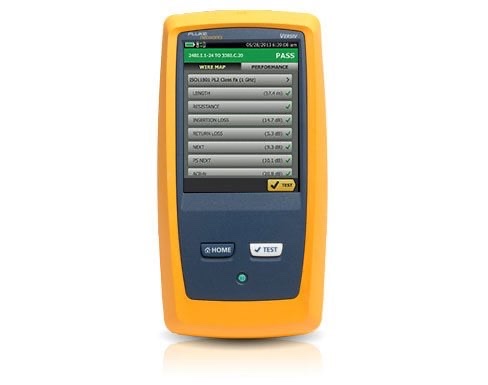
- Fluke Networks DSX-8000 with Versiv 2 chassis. The dominant Cat8 certifier in current data center deployments. Supports Cat8.1 and Cat8.2 with appropriate adapters.
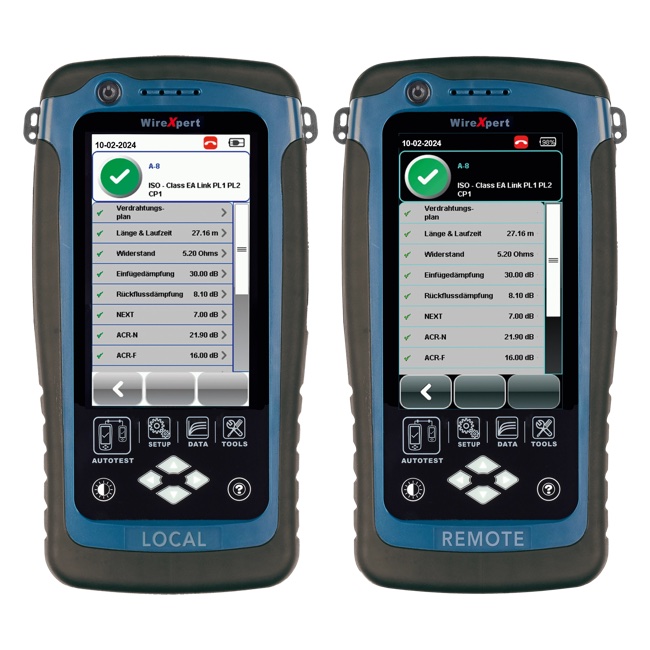
- Softing WireXpert 4500-Q (with extended bandwidth modules). Supports Cat8 testing with the Q-version chassis and Cat8 adapters.
Beyond the certifier itself, Cat8 testing requires Cat8-rated test cords, Cat8 permanent link adapters, and Cat8 channel adapters. The cords have a defined service life and must be tracked and replaced when worn. Full Cat8 calibration requires specialized factory equipment; annual factory calibration is mandatory.
Cat8 testing time per cable is longer than Cat6A because the certifier sweeps a much wider frequency range. A typical Cat8 permanent link test takes approximately twice as long as a Cat6A test. For projects with hundreds of Cat8 cables, this adds significant test time.
Cat8 Test Parameters: What Is Different
Cat8 uses the same parameter set as Cat6A -- insertion loss, NEXT, PS-NEXT, ACR-F, PS-ACR-F, return loss, propagation delay, delay skew -- plus alien crosstalk parameters. The difference is the frequency range and tighter limit values.
Insertion loss
Cat8 insertion loss is reported across 1 MHz to 2 GHz. The limit at 2 GHz for a 30-meter channel is approximately 33.5 dB. Beyond 30 meters, insertion loss exceeds receiver capability for 40GBASE-T.
NEXT and PS-NEXT
Cat8 NEXT limits are tighter than Cat6A throughout the frequency range. At 2 GHz, the Cat8.1 NEXT limit for a 30-meter permanent link is approximately 27 dB. Termination quality is even more critical than for Cat6A because higher frequencies are more sensitive to crosstalk.
Return loss
Cat8 return loss limit at 2 GHz is approximately 8 dB. Return loss is the parameter most likely to fail on Cat8 installations because the high frequencies are sensitive to even small impedance discontinuities.
Alien crosstalk
Cat8 specifies tighter PSANEXT and PSAACR-F limits than Cat6A. Field alien crosstalk testing is more commonly required for Cat8 because the high-density rack environments where Cat8 is deployed often have many cables in close proximity.
Shield continuity
All Cat8 cable is shielded, so shield continuity testing is mandatory. The certifier verifies low-resistance shield path through the connectors. Shield bonding is critical -- a poor shield termination defeats the cable's EMC performance and may also cause electrical faults that affect protocol operation.
Practical Cat8 Deployment Guidance
When Cat8 makes sense
- Data center top-of-rack switch to server NIC connections under 30 meters
- End-of-row aggregation switch to top-of-rack switch connections under 30 meters
- Cross-rack server-to-storage connections within a single row
- Locations where 25 or 40 Gbps is required and fiber is operationally undesirable (frequent reconfiguration, harsh environment)
When Cat8 does not make sense
- Office horizontal cabling -- the 30-meter limit is too short for typical building layouts
- Inter-floor risers -- usually exceed Cat8 distance limits
- Building backbones -- fiber is universally preferred for distances over 30 meters
- Locations supporting only 1 or 10 Gbps -- Cat6A is sufficient and significantly cheaper
Cost and complexity considerations
Cat8 cable costs significantly more per foot than Cat6A. Cat8 connectors and patch cords are more expensive. Cat8 termination requires more skill and care than Cat6A. The certifier (Level 2G) is more expensive to purchase and to calibrate annually.
For most data center applications below 25 Gbps, Cat6A is the right choice. Cat8 is appropriate when 25 or 40 Gbps over copper is genuinely required and fiber is not the better answer. In many cases, fiber is the better answer at these speeds.
For background on lower categories see Cat6A Test Parameters Explained and TIA-1152 Accuracy Levels.
Frequently Asked Questions
What is the difference between Cat8.1 and Cat8.2?
Both support 25GBASE-T and 40GBASE-T to 30 meters with the same data rate. Cat8.1 (Class I) uses F/UTP or U/FTP shielded cable with standard RJ45 connectors. Cat8.2 (Class II) uses S/FTP cable with non-RJ45 connectors (GG45 or TERA) for greater EMC margins. Cat8.1 is the practical choice because RJ45 compatibility means standard equipment ports work.
Why is Cat8 limited to 30 meters?
Cat8 is tested up to 2 GHz where insertion loss accumulates rapidly with cable length. At 100 meters, insertion loss at 2 GHz would exceed what 25 and 40GBASE-T receivers can handle. The 30-meter limit (24 m horizontal + 6 m cords) keeps insertion loss within receiver tolerance. Cat8 is intentionally a short-link standard for data center applications.
What certifier do I need for Cat8?
A Level 2G TIA-1152 certifier capable of measuring up to 2 GHz. The dominant Cat8-capable certifier today is the Fluke DSX-8000 with Versiv 2 chassis. The Softing WireXpert 4500-Q with extended modules is another option. The same certifier can test Cat6A and lower categories with the appropriate adapters.
Should I install Cat8 in a new office building?
Almost certainly not. Cat8 is a short-link data center standard. Office horizontal cabling needs 100 meters, far beyond Cat8's 30-meter limit. Cat6A is the right choice for office work supporting 10GBASE-T at 100 meters. Cat8 is appropriate when 25 or 40 Gbps over twisted pair is required within a server rack or between adjacent racks.
Is Cat8 the same as ISO Class I/II?
Yes. Cat8.1 corresponds to ISO Class I and Cat8.2 to ISO Class II. The standards were developed in coordination between TIA and ISO. A cable certified to one will pass the other with very minor edge cases. Naming reflects whether the project uses TIA or ISO conventions.
Cable Certifiers for Cat8 and Cat6A
Browse certifiers organized by cable category support and TIA-1152 accuracy level. Level 2G certifiers handle Cat8 and below.