The Brand Context
Ideal Industries and Fluke Networks have both been serving electrical and low-voltage trades for decades, but with different center-of-gravity. Fluke Networks comes from the electrical test and measurement world -- multimeters, thermal imagers, certifiers. They built a reputation for premium-priced precision instruments. Ideal Industries comes from the electrical contractor's tool bag -- wire strippers, fish tape, wire connectors, basic testers. They built a reputation for value-priced workman's tools sold through electrical supply houses.
The two brands meet in the middle around cable testing, where Fluke's premium instruments overlap with Ideal's higher-end testers. They do not compete cleanly across the full product line. Fluke offers tools Ideal does not (DSX certifier, LinkIQ qualifier, Versiv platform). Ideal offers tools Fluke does not (electrical hand tools, basic cable hand testers under $100). Where they overlap is the middle market: $200-$2,000 cable testers and qualifiers.
Ideal sold its higher-end LANTEK cable certifier line to Trend Networks in 2020. As a result, when contractors ask "Ideal vs Fluke for certification," the Ideal side of that comparison is now effectively the Trend Networks LANTEK. The remaining Ideal cable testing portfolio focuses on hand tools, basic verifiers, and qualifiers like the SignalTEK family.
Product Line Overview
| Category | Ideal Industries | Fluke Networks |
|---|---|---|
| Basic wiremap tester | VDV II / LinkMaster | MicroScanner 2 |
| Mid-tier verifier | VDV II Pro | MicroScanner PoE |
| Qualifier (Ethernet validation) | SignalTEK 10G / NT+ | LinkIQ |
| Copper certifier | None (LANTEK now under Trend) | DSX2-5000, DSX2-8000 |
| Fiber certifier | None | CertiFiber Pro, OptiFiber Pro |
| Network analyzer | NaviTEK NT (limited) | LinkIQ |
| PoE tester | SignalTEK PoE / hand tester variants | MicroScanner PoE / LinkIQ |
| Hand tools / strippers | Extensive line | Limited (specialty only) |
| Distribution | Electrical supply houses | Specialty + low-voltage distributors |
| Typical price range | $50 - $4,000 | $200 - $15,000 |
Where Fluke Wins
Cable certification
Fluke owns the high end of the cable testing market. The DSX2-5000 and DSX2-8000 are the industry-default certifiers in North America. Ideal does not currently sell a copper or fiber certifier (the LANTEK line moved to Trend Networks in 2020). If your work requires TIA/ISO certification documentation, you are buying Fluke (or Softing, or Trend) -- Ideal is not a player in this category.
The Versiv platform
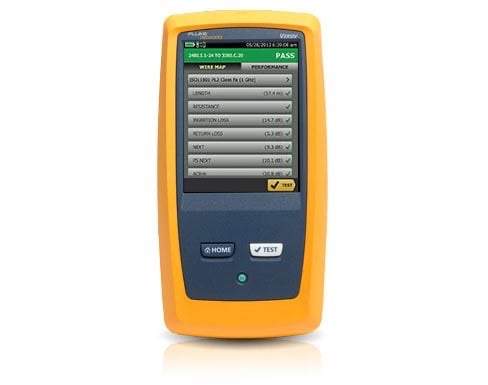
Fluke's modular Versiv platform consolidates copper certification, fiber OLTS, fiber OTDR, and Wi-Fi analysis into one mainframe with swappable modules. For shops doing mixed-media work, this consolidation is a real operational advantage. Ideal has no equivalent platform offering.
Network analyzer depth
The Fluke LinkIQ combines cable performance testing, wiremap, and network connectivity validation in one device. It identifies cable category, validates link speed, detects PoE, and reads VLAN/DHCP information. Ideal's NaviTEK NT is a more limited network test tool by comparison. For contractors who need cable testing plus network analysis in a single device, the LinkIQ is the stronger choice.
Cloud reporting ecosystem
Fluke's LinkWare Live cloud platform unifies test results from DSX certifiers, LinkIQ analyzers, and CertiFiber Pro fiber testers. Multi-crew project tracking, certification report generation, and project management integrations are all centralized. Ideal does not have an equivalent cloud platform across its testing line.
Where Ideal Wins
Entry-level pricing
Ideal's basic cable verifiers like the LinkMaster Pro and VDV II line cost $50-$150, well below Fluke's MicroScanner 2 at $370+. For contractors who need a basic continuity and wiremap tester for occasional use, Ideal delivers the core capability at a fraction of the cost. The build quality and feature set are scaled to match the price -- you do not get the MicroScanner's premium feel -- but for the use case, the pricing wins.
Distribution through electrical supply houses
Ideal Industries products are stocked at virtually every electrical supply house in North America. For contractors who do most of their tool buying through Graybar, Rexel, Border States, or local supply houses, Ideal is on the shelf next to the wire strippers and connectors they buy weekly. Fluke distribution is more specialty-oriented and may require online ordering for some products.
SignalTEK qualification line
Ideal's SignalTEK qualifier (and the Trend-branded successors) competes credibly with the Fluke LinkIQ in the qualification space. The SignalTEK 10G validates Ethernet up to 10 Gbps -- something the LinkIQ does not do. For contractors who need to verify 10G cable performance without buying a full certifier, the SignalTEK family is a strong option, and pricing is generally more aggressive than the LinkIQ.
Hand tools and integrated kits
Ideal's hand tool catalog is something Fluke simply does not offer at the same depth. Wire strippers, crimpers, punchdown tools, fish tape, and the modular tool kits Ideal builds for VDV technicians integrate cable testers with the other tools an installer carries. For a shop standardizing on one brand for both hand tools and basic testers, Ideal has a coherent offering Fluke cannot match.
Lifetime warranties on hand tools
Ideal backs many of its hand tools with lifetime warranties, similar to Klein. This is not a feature Fluke competes on. For contractors who lose or damage tools regularly in the field, the warranty matters.
The Decision Framework
Most established structured-cabling shops end up with both brands in the toolkit. A Fluke DSX for certification, an Ideal hand tester for quick verification, an Ideal qualifier for 10G validation work that does not require full cert. The brands address different jobs at different price points; treating them as direct competitors misses the structure of the market.
Other Tools Worth Considering
The Ideal-vs-Fluke framing leaves out important tools that may be better answers for specific jobs.
For basic wiremap and continuity testing at competitive prices, the VDV MapMaster 3.0 from Platinum Tools rivals both Ideal and Fluke entry-level testers. Platinum Tools' lifetime warranty, color display, and numbered remote ID support make it a strong middle-ground option.
For gigabit throughput verification, that is a gigabit speed qualifier's job. A qualifier is not a certifier and not a substitute for one, but it answers the practical question -- "will this cable run at gigabit?" -- and produces a report you can hand over. We do not currently list one: Platinum Tools discontinued the unit that filled that tier, so it is a rental or subcontract step.
For quick cable identification at a patch panel, the LANSeeker from Platinum Tools is a focused tool that beats general-purpose testers on the specific task of finding cables in a panel.
And for tone work, the Digital Tone Probe handles cable identification cleanly without committing to a full Fluke or Ideal ecosystem.
Related Comparisons
For other brand comparisons in the cable testing space, see:
The Trend Networks Factor
Any honest discussion of Ideal vs Fluke in 2026 has to address the elephant in the room: the certifier line that used to be the "Ideal" answer to the Fluke DSX is now sold under Trend Networks. Ideal Industries divested the LANTEK product line to Trend Networks in 2020, and the LANTEK continues as a current product under Trend's brand.
For contractors who shopped Ideal LANTEK certifiers in the past, this matters. The hardware is essentially the same product family, but the brand on the box, the cloud reporting platform (Trend's AnyWARE), and the support relationship are all Trend Networks now. If you are evaluating a "modern Ideal certifier," you are actually evaluating a Trend Networks LANTEK with Ideal's certification heritage.
Why this matters for the Ideal-vs-Fluke comparison:
- Buying new today: The certifier comparison is now Fluke DSX vs Trend LANTEK vs Softing WireXpert. Ideal is not in the certifier conversation under their own brand.
- Buying used: Used Ideal-branded LANTEK certifiers are still on the secondary market. They are functionally equivalent to current Trend LANTEK products in terms of test capability but may have older firmware and a fragmented service path between Ideal-branded and Trend-branded support.
- Customer recognition: "I tested it with my Ideal" used to mean a certifier; today on a job site, it more likely means a SignalTEK qualifier or a basic verification tool. GCs and inspectors have noticed the brand shift.
For full coverage of the certifier-tier comparison, see Fluke DSX vs Softing WireXpert -- the two main current options for new certifier purchases.
Where Ideal and Fluke Compete Most Directly
The cleanest head-to-head competition between Ideal and Fluke happens in the mid-tier qualifier and PoE tester categories.
SignalTEK 10G vs LinkIQ
The Ideal SignalTEK 10G (now sold as a Trend Networks product) and the Fluke LinkIQ both target installers who need qualification-level Ethernet validation without buying a full certifier. They take different approaches: SignalTEK uses bit-error-rate testing up to 10 Gbps; LinkIQ uses frequency-based testing up to 500 MHz with a 1G link speed cap.
For pure 10G validation, the SignalTEK 10G wins because it actually validates 10G, while the LinkIQ does not. For combined cable performance + active network analysis at 1G, the LinkIQ wins because of its broader feature set. Pricing is comparable in the $1,800-$2,500 range. For deeper analysis, see TestUm Validator vs Fluke LinkIQ -- the SignalTEK is a direct successor to the Validator NT+.
PoE testers
Ideal makes basic PoE testers in the SignalTEK family and as standalone units. Fluke's PoE detection is integrated into the LinkIQ and as an option on the MicroScanner PoE. For pure PoE testing without the broader network analyzer features, Ideal's standalone units may offer better value. For combined PoE + cable + network testing, the Fluke LinkIQ is the more complete tool.
Basic verifiers
Ideal's LinkMaster Pro and VDV II testers compete with Fluke's MicroScanner 2 in the basic wiremap category. Ideal generally wins on price ($100-$200 vs Fluke's $370+). Fluke generally wins on build quality and brand recognition. For most shops, the choice often comes down to personal preference and existing brand loyalties.
Frequently Asked Questions
Is Ideal still in the cable testing business?
Yes, but with a narrower focus than they once had. Ideal sold the LANTEK certifier line to Trend Networks in 2020. Today's Ideal cable testing portfolio focuses on hand testers, basic verifiers, and the SignalTEK qualifier line. For high-end certification, the LANTEK is now a Trend Networks product, not Ideal.
What is the Ideal SignalTEK?
The SignalTEK is a qualification tester that validates Ethernet performance up to 10 Gbps using bit-error-rate testing. It is similar in role to the Fluke LinkIQ -- a qualifier that proves the cable supports the required speed but does not produce TIA/ISO certification reports. The SignalTEK 10G adds 10G validation that the LinkIQ does not have.
Are Ideal cable testers good?
For their target market, yes. Ideal hand tools and basic verifiers are well-regarded, well-distributed through electrical supply houses, and competitively priced. For wiremap and basic verification work, Ideal testers are competitive. For high-end certification, you are looking at Fluke, Softing, or Trend -- not Ideal.
Where does Ideal beat Fluke on price?
Ideal beats Fluke on entry-level pricing: basic wiremap testers, hand tools, and field verifiers under $300. Ideal also competes aggressively on qualifiers like the SignalTEK 10G. At the high end, Fluke remains premium-priced regardless of competition.
Distribution Channels Matter
For some contractors, where the tool is sold matters as much as what the tool does. Ideal and Fluke have very different distribution strategies, and that affects buying convenience, support relationships, and pricing.
Ideal: electrical supply houses
Ideal Industries products are stocked at virtually every electrical supply house in North America: Graybar, Rexel, Border States, CED, Wesco, and the regional independents. For contractors who do most of their tool buying at the supply house counter alongside their daily wire, conduit, and connector orders, Ideal is on the shelf next to those purchases. Adding a tester to a $5,000 supply house order is frictionless.
This distribution strategy also means Ideal is well-supported by counter staff who know the products. Need a replacement remote, a different adapter, or a quick exchange? The supply house can usually handle it without a return shipment.
Fluke: specialty distributors and online
Fluke Networks products distribute through specialty low-voltage distributors and online resellers more than through general electrical supply houses. The DSX certifier is rarely in stock at a Graybar counter; it ships from a specialty distributor on a few-day lead time. The MicroScanner and LinkIQ are more widely available but still skew toward specialty channels.
This distribution strategy works for established structured cabling shops with relationships to specialty distributors. It is less convenient for general electrical contractors who occasionally need a cable tester and prefer to buy at their regular supply house.
Online distribution
Both brands sell through major online channels. Ideal's pricing is generally consistent across channels. Fluke's pricing varies more between authorized dealers, with kit configurations and bundled accessories changing the effective price. Comparison shopping for Fluke products often pays off in ways it does not for Ideal.
Long-Term Brand Relationships
Test equipment investments tend to be sticky. Once you train a crew on one brand, learn one cloud platform, and develop service relationships, switching brands has real friction. This is worth thinking about when making a first major investment.
Training and learning curve
Fluke's interface conventions across its product line are consistent. A technician who knows the DSX picks up the LinkIQ quickly. Ideal's product line has been more fragmented historically (and now further fragmented since the LANTEK divestiture), so cross-product learning is less linear. For shops standardizing on one brand for training simplicity, Fluke offers a more cohesive learning path.
Cloud platform lock-in
LinkWare Live is genuinely good for certification project management, and shops that have invested in setting up project structures, technician accounts, and customer report templates tend to stay on the platform. Migration to another platform requires recreating that infrastructure. Plan for this when making the original brand decision -- the platform investment can outlive the original tester purchase.
Service relationships
Both brands have authorized service networks. Fluke's is larger and more geographically distributed. Ideal's overlaps with the broader Ideal Industries service infrastructure, which is well-supported through electrical supply house relationships. For shops that prefer ongoing relationships with specific service providers, the brand decision often comes down to which provider the shop already trusts.
Switching Brands Mid-Career: What It Actually Costs
Many contractors face the question of switching from one brand to another at some point. Here's what that actually involves.
Hardware Investment Loss
The biggest barrier to switching is the sunk cost in modules, remotes, calibration adapters, and accessory kits. A full Fluke Versiv setup represents $10,000-$25,000 of equipment depending on configuration. Selling used to recover capital is straightforward through equipment resellers but typically returns 40-60% of new value depending on age and condition.
Software and Workflow Retraining
Technicians who have used LinkWare for years develop muscle memory around its specific workflow, report formatting, and project management. Switching to Ideal's software stack (or vice versa) requires retraining and revised SOPs. Plan for 2-4 weeks of reduced productivity during the transition.
Customer Documentation Continuity
If your customers are accustomed to receiving Fluke-format LinkWare reports, switching to Ideal-format reports can create friction. Some specifying engineers and warranty programs explicitly require LinkWare-format reports for audit consistency across multi-year projects. Verify customer requirements before switching.
The Hybrid Approach: Both Brands in One Shop
Many established contractors run both Fluke and Ideal gear depending on the use case.
Fluke for Certifier Work
The Versiv platform's market dominance and warranty manufacturer acceptance make it the safer choice for high-stakes certification work. Even shops that prefer Ideal for daily testing tend to keep a Versiv 2 / DSX-8000 in the truck for warranty-required jobs.
Ideal for Daily Verification
The SignalTEK NT and SecuriTEST IP product families work well for daily verification, security cable installation, and qualifier-level testing. Their lower price point makes outfitting multiple technicians more affordable than equipping everyone with Fluke gear.
The Total Toolkit Math
A two-brand approach often costs less than equipping every technician with a top-tier Fluke certifier. One certifier shared across the crew, plus a qualification tester in every technician's bag, costs a fraction of four certifier kits, because the certifier is the expensive item and most of the day's testing does not need one. The hybrid approach trades workflow consistency for capital efficiency.
Get the Free Ideal vs Fluke Buyer's Cheat Sheet
A one-page PDF that maps every job type — TIA/ISO certification, 10G qualification, PoE, basic wiremap — to the right tool across Ideal, Fluke, Trend, and Platinum Tools, with current street prices and the LANTEK-to-Trend gotcha spelled out. Built so you don't overpay for capability you'll never use.
More Brand Comparisons in This Series
If you found this Ideal vs Fluke comparison useful, two related posts cover the other common brand decisions structured cabling shops face.
- Klein vs Fluke Cable Testers covers the tradeoff between Klein's tradesman-tier pricing and Fluke's specialist-grade build quality -- useful for electrical contractors adding low-voltage work to their scope.
- Fluke DSX 5000 vs DSX 8000 breaks down whether the $8K-$12K premium for 2000 MHz Cat8 certification capability is warranted for your contract mix.
Ready to Buy the Right Tester, Not Just the Right Brand?
Tell us what you actually test, and we will say honestly when a $100 verifier does the job and when you genuinely need a DSX. The testers and verifiers in our catalog can be bought directly. Certifiers are quote-only, and brands we do not carry are covered here as comparisons, not as sales pitches.