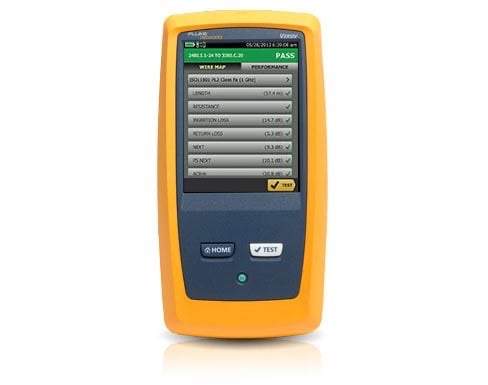
The Qualifier Category
Cable qualifiers occupy a middle tier between basic wiremap testers and full TIA/ISO certifiers. They prove the cable supports a target Ethernet speed (1G, 2.5G, 5G, or 10G) without producing the full frequency-based parameter measurements (NEXT, return loss, insertion loss) that certifiers do. Qualifiers cost 10-25% of what certifiers cost. For contractors whose contracts do not require TIA/ISO certification documentation, qualifiers answer the practical question -- "will this cable run at the required speed?" -- without the certifier price tag.
The TestUm Validator NT family and the Fluke LinkIQ are both qualifier-class tools, but they take different approaches. The Validator NT+ uses Ethernet bit-error-rate (BER) testing: it transmits actual Ethernet frames at the target speed and measures the error rate. If the BER is below the threshold for that speed, the cable qualifies. The LinkIQ uses frequency-based measurements up to 500 MHz to identify the maximum supported cable category, plus link speed negotiation when plugged into a switch. Same general role, different testing methodology, different feature emphasis.
This article focuses on the Validator NT+ and Pulsar variants (and their Trend Networks SignalTEK successors) since the lower Validator models are basic verification tools that compete more directly with the Klein VDV Scout Pro than with the LinkIQ.
Side-by-Side Comparison
| Feature | TestUm Validator NT+ (Pulsar) | Fluke LinkIQ |
|---|---|---|
| Qualification methodology | Ethernet bit-error-rate (BER) | Frequency-based (up to 500 MHz) |
| Maximum qualified speed | 10 Gbps (NT+ / SignalTEK 10G) | 1 Gbps (negotiated link) |
| Cable category identification | Indirect (via speed achieved) | Direct (Cat5e / Cat6 / Cat6A) |
| Wiremap (active end + remote) | Yes | Yes |
| Cable length (TDR) | Yes | Yes |
| Tone generator | Yes | No (via separate accessory) |
| PoE detection | Yes (class, voltage) | Yes (class, voltage, pair) |
| PoE load testing | Limited | No |
| VLAN discovery | Yes (basic) | Yes (port VLAN ID) |
| DHCP testing | Yes | Yes |
| CDP/LLDP neighbor info | Yes | Yes |
| Cloud reporting | Trend AnyWARE / proprietary | Fluke LinkWare Live |
| Display | 3.5" - 5" color (varies by model) | 2.4" color LCD |
| Typical price | $1,800 - $3,500 (NT+/SignalTEK 10G) | $1,500 - $2,200 |
TestUm Validator NT+: Strengths
Ethernet bit-error-rate testing
The Validator NT+ (and SignalTEK successors) test actual Ethernet performance by transmitting real frames at the target speed and measuring the error rate. This is the most direct possible answer to "will this cable run at 10G?" -- the cable either passes the BER threshold at 10G or it does not. The methodology mirrors how the actual network will use the cable, which is a different value proposition from the LinkIQ's frequency-based approach.
10G qualification
The NT+ Pulsar variant and the current SignalTEK 10G validate Ethernet up to 10 Gbps. As Cat6A installations and 10G-capable switches become standard, this capability is increasingly relevant. The LinkIQ tops out at 1 Gbps negotiated link speed and cannot validate 10G performance. For contractors whose work involves 10G installations, the Validator/SignalTEK is the stronger tool.
Active testing across the cable run
Because the Validator uses an active remote unit at the far end of the cable, it can perform testing across the actual installed run rather than relying on a single-ended measurement. The two-end active configuration provides a more direct verification that the entire link works at the target speed.
Trend Networks ecosystem
For contractors using other Trend Networks products (NaviTEK, the LANTEK certifier line acquired from IDEAL), staying within the Trend ecosystem keeps test reports and cloud platforms unified. AnyWARE cloud reporting integrates results across the Trend product line.
Fluke LinkIQ: Strengths
Cable category identification
The LinkIQ's frequency-based testing directly identifies the maximum supported cable category: Cat5e, Cat6, or Cat6A. For installation verification, this answers the question "did I actually install Cat6A cable?" rather than "will this cable run at 10G?". Both questions matter, but they are different. For contractors verifying cable quality during installation -- not just network speed at acceptance -- the LinkIQ's category identification is more useful.
Cable performance diagnostics
Beyond pass/fail at a target speed, the LinkIQ flags specific cable performance problems: excessive crosstalk, return loss issues, poor terminations, excessive untwist. When a cable fails, the LinkIQ tells you why in cable-performance terms, which helps the installer fix the actual problem. The Validator's BER approach tells you the cable failed at 10G but does not always isolate the specific cable performance issue.
Combined cable + network workflow
The LinkIQ is designed for the combined workflow: terminate a cable, wiremap test, cable performance test, then plug into the switch and verify link speed, PoE, VLAN, and DHCP. One tool covers the full installer handoff process. The Validator does many of the same network tests but the cable-performance side relies on speed-based BER rather than frequency-based diagnostics.
Fluke ecosystem
For shops standardized on Fluke (DSX certifiers, MicroScanner field testers, LinkIQ qualifiers), staying within Fluke keeps the LinkWare Live cloud reporting platform unified across all test types. Project results from DSX certification, LinkIQ qualification, and field verification all flow into one cloud system. This consolidation has real operational value for multi-crew operations.
The LinkIQ Duo configuration
Fluke offers the LinkIQ Duo kit with two full LinkIQ units instead of one unit and a passive remote. Both technicians get a display, both can initiate tests, and each unit works independently. For two-person crews, this is a workflow advantage the Validator's typical main-plus-remote configuration does not match.
The Decision Framework
For contractors whose work is primarily 1G installation verification with combined cable and network workflow, the LinkIQ is generally the stronger choice. For contractors whose work specifically targets 10G qualification and uses bit-error-rate as the verification standard, the Validator/SignalTEK 10G is the stronger choice. Many shops own both tools as they cover overlapping but not identical use cases.
Beyond Both Tools
If your work requires actual TIA/ISO certification documentation, neither the Validator nor the LinkIQ produces it. You need a full certifier -- see our breakdown of the Fluke DSX vs Softing WireXpert for the high-end certifier comparison.
For contractors who need gigabit throughput verification rather than 10G, a gigabit speed qualifier produces a BERT pass/fail result with PDF reporting. It does not qualify at 10G and is not as feature-rich as the Validator or LinkIQ. We do not currently list one: Platinum Tools discontinued the unit that filled that tier, so it is a rental or subcontract step.
For deeper network analysis without cable testing emphasis, the NetAlly LinkRunner 10G is the strongest option -- see our LinkIQ vs LinkRunner comparison.
BER Testing vs Frequency-Based Testing: Why It Matters
The fundamental design difference between the Validator NT+ family and the Fluke LinkIQ comes down to test methodology. Understanding the difference helps explain why one tool can validate 10G while the other cannot, and why the LinkIQ identifies cable category while the Validator does not.
Bit-error-rate testing (BER)
BER testing is exactly what it sounds like. The tester transmits known data patterns at a target Ethernet speed and measures how many bits arrive correctly versus how many are corrupted. The standard for "passing" is below a defined error threshold (typically 10^-12 errors for 10GBASE-T). If the cable can sustain that low error rate at the target speed, it qualifies.
Why this matters: BER testing measures actual usable performance at the target speed. If your contract says "the cable must support 10G," BER testing answers that exact question. If the cable passes 10G BER, it will run 10G in production. The methodology is direct and irrefutable for the specific speed it tests at.
The trade-off: BER testing tells you the cable works at the speed you tested. It does not tell you why the cable works or fails, which cable category it actually is, or whether it would meet TIA/ISO frequency-based parameter requirements. A cable can pass 10G BER while failing TIA Cat6A certification due to specific parameter issues that BER testing does not isolate.
Frequency-based testing
Frequency-based testing measures the cable's response across a range of frequencies up to a defined maximum (500 MHz for the LinkIQ, 1 GHz for the DSX2-5000, 2 GHz for the DSX2-8000). The tester sweeps signals across the frequency range and measures parameters: NEXT (near-end crosstalk), return loss, insertion loss, propagation delay, and others. Each parameter has TIA/ISO-specified limits at each frequency.
Why this matters: Frequency testing reveals the cable's full electrical character, not just whether it works at one speed. This lets the tester identify cable category (Cat5e, Cat6, Cat6A) by which set of parameter limits the cable meets across the full frequency range. It also produces the parameter data required for formal TIA/ISO certification reports.
The trade-off: Frequency testing is more complex to perform and interpret. The LinkIQ uses simplified frequency testing for category identification and basic performance flagging but does not meet Level V accuracy for certification. The DSX certifiers do meet Level V and produce certification reports. The Validator's BER methodology, while different, is not a substitute for frequency testing if your contracts require category-level information or certification.
What this means for the buyer
For "will this cable run at 10G?" -- BER testing (Validator NT+ or SignalTEK 10G) is the more direct answer. For "what category cable did I install?" -- frequency-based testing (LinkIQ) is the more direct answer. Neither replaces the other, and neither replaces a full TIA/ISO certifier when contracts require formal compliance documentation.
Workflow Comparison: A Day on the Job
Specifications matter less than how the tool fits into the actual workflow. Here is how a typical installation day plays out with each tool.
Day with the LinkIQ
Morning: Crew terminates 30 Cat6A drops from the telecom room to the conference room. Lead tech walks the panel with the LinkIQ at one end and the remote adapter at each jack. For each drop: wiremap test, cable performance test, length verification. Results sync to LinkWare Live in real time. Any cable that fails category Cat6A gets flagged for investigation -- usually a bad termination caught immediately.
Afternoon: Patch panel is dressed and connected to the switch. Tech moves to each jack with the LinkIQ. Plug in, verify link speed (1G negotiated), confirm PoE class for the IP camera ports, identify the VLAN tag, verify DHCP assigns an IP. Customer hands off the network ready to use. Project documentation is in LinkWare Live and a PDF report goes to the customer.
Day with the Validator NT+ / SignalTEK 10G
Morning: Same 30 Cat6A drops. Lead tech walks the panel with the Validator main unit at one end and the active remote at each jack. For each drop: wiremap, length, then BER test at the target Ethernet speed (typically 10 Gbps for Cat6A installations). Pass/fail at the target speed is the primary result. Results store on the device for later sync.
Afternoon: Patch panel is dressed and connected. The Validator can do basic link speed and PoE detection at the switch, but it is not as deep on network diagnostics as the LinkIQ. For active network testing, the crew either uses a separate tool or relies on the Validator's basic active features. Cloud sync to AnyWARE if using a current Trend SignalTEK; older Validator units typically sync via USB to a desktop application.
The takeaway
The LinkIQ workflow integrates cable testing and network testing in one device and one cloud platform. The Validator workflow emphasizes definitive 10G qualification but is less integrated for active network analysis. For shops doing both kinds of testing, the LinkIQ is more workflow-efficient. For shops where 10G qualification is the primary requirement and active network testing is handled separately, the Validator is more directly useful.
Frequently Asked Questions
What is the TestUm Validator?
The TestUm Validator NT line is a family of cable qualifiers and network testers (now succeeded by Trend Networks SignalTEK products in current production). They perform wiremap, length, tone, PoE detection, basic network testing, and Ethernet bit-error-rate qualification depending on the model. They target contractors who need qualification-level Ethernet validation without buying a full TIA/ISO certifier.
Does the TestUm Validator do 10G testing?
The Validator NT+ Pulsar (and SignalTEK 10G successor) perform 10G Ethernet bit-error-rate qualification testing. The Fluke LinkIQ does not -- it tops out at 1 Gbps negotiated link speed.
Is the LinkIQ better for cable testing or network testing?
The LinkIQ is designed for both, with its sweet spot being installation verification combined with basic network connectivity check. It tests cable performance up to 500 MHz, identifies cable category, and validates link speed plus PoE plus VLAN plus DHCP at the switch end. Its strength is the combined workflow rather than maximum depth in either side alone.
Are TestUm Validators still being made?
The TestUm brand has effectively been succeeded by Trend Networks SignalTEK and NaviTEK products following corporate consolidation. Used Validator NT and NT+ units remain available on the secondary market. New purchases generally happen through Trend Networks branded products with the same technology lineage.
Buying Considerations: New, Used, and Refurbished
The qualifier market has unique dynamics worth understanding before you spend.
New LinkIQ Pricing
Fluke LinkIQ kits typically run in the $1,500-$2,500 range depending on configuration and accessory bundle. The CIQ-KIT and IE-KIT variants add specific RJ45 IntelliTone or industrial Ethernet capabilities. Buying new gets you full warranty, current firmware, and Fluke's calibration certification out of the box.
Used Validator NT/NT+ Market
The TestUm Validator NT and NT+ remain in the field with thousands of contractors who bought them in the 2010s. Used units pop up regularly on eBay and equipment resellers in the $400-$900 range depending on condition and remote count. They still pass certification audits when documented properly, and replacement remotes are still available through aftermarket suppliers.
Trend Networks SignalTEK as the Modern TestUm
If you're a TestUm fan looking for current production hardware, the Trend Networks SignalTEK NT and SignalTEK 10G are the spiritual successors. They share design DNA with the Validator line — same general workflow, similar form factor, same focus on speed-and-services qualification. Pricing falls between LinkIQ and Validator NT, putting them in direct competition with the LinkIQ for new purchases.
Demo and Trial Programs
Both Fluke and Trend Networks offer demo programs for contractors evaluating new test gear. Fluke distributors will often arrange a 30-day trial of the LinkIQ before purchase. Trend Networks does similar through their authorized reseller network. If you're spending over $1,500 on test equipment, take advantage of these programs.
Field Reliability and Battery Life
For field use, durability and uptime matter as much as test depth.
LinkIQ Construction
Fluke's LinkIQ uses the same rugged housing philosophy as their other handhelds — IP-rated against dust and splash, drop-tested to standard heights, and built to survive typical jobsite abuse. The color display is recessed to protect against scratches and direct impact.
Validator NT Construction
The original TestUm Validator NT was designed for field use with a similar rugged philosophy. Older units in service for a decade often show wear on connectors and screen surfaces but typically still function within calibration. The remotes are the most common failure point — RJ45 plug fatigue from thousands of insertions eventually requires remote replacement.
Battery Life Comparison
Both platforms use rechargeable lithium batteries with 6-10 hours of typical field use depending on backlight and active testing. The LinkIQ charges via USB-C while older Validator NT units use proprietary chargers — keep that in mind if you're inheriting older gear or planning multi-day deployments away from power.
Qualifier or Certifier? Pick the Right Level
For basic field verification we list the LanSeeker and the VDV MapMaster 3.0. We do not currently list a qualifier: Platinum Tools discontinued the unit that filled that tier, so qualifier-grade speed validation is a rental or subcontract step. Full TIA/ISO certifiers are quote-only, and the two units compared above are not ones we carry.