Read the Failure Before You Touch the Cable
The single most common mistake after a failed cert is jumping straight to action -- re-terminating both ends, swapping patch cords, blaming the tester -- before reading what the certifier actually reported. The certifier did expensive work measuring this cable. The failure parameter, the worst-case frequency, the worst-case pair, and the location of the worst-case point along the cable are all on the report. Read them.
Every failure parameter has a small set of likely physical causes. NEXT failures point at termination quality. Return loss failures point at impedance discontinuities. Length failures point at run length or NVP calibration. Insertion loss failures point at cable damage or excessive length. Wiremap failures point at termination errors. The report tells you which of these you have before you spend a minute on the cable.
Failure Pattern Decision Tree
Match your failed parameter against this table to identify the most likely cause and the recommended first action. The vast majority of certification failures are resolved at the connector level without re-pulling cable.
| Failed Parameter | Most Likely Cause | First Action | Re-pull Required? |
|---|---|---|---|
| NEXT | Excessive untwist at termination | Re-terminate failing-end connector | Rare |
| PS-NEXT | Multiple pairs with NEXT issues | Re-terminate both ends carefully | Rare |
| Return Loss | Impedance discontinuity (kink, crush, bad termination) | Inspect cable, re-terminate | If mid-span damage |
| Insertion Loss | Cable too long or damaged | Verify length, inspect for damage | If damage exists |
| ACR-F / FEXT | Far-end crosstalk -- termination or cable quality | Re-terminate far end | If cable is sub-spec |
| Length | Run exceeds 90m permanent link or 100m channel | Verify NVP, then physical length | If length truly exceeded |
| Propagation Delay | Run too long or NVP mis-calibrated | Same as length | If length truly exceeded |
| Delay Skew | Pair-to-pair length differences in cable | Replace cable (rare cable defect) | Yes |
| Wiremap | Termination error | Re-terminate to T568A or T568B | No |
| Resistance Unbalance | Bad punch-down on one conductor | Re-terminate failing pair | No |
NEXT Failures: The Most Common, the Easiest to Fix
NEXT (Near-End Crosstalk) failures are the most frequent cert failure on Cat6 and Cat6A installations. The cause is almost always excessive untwist of the conductor pairs at the connector or punch-down. NEXT performance depends critically on maintaining the pair twist as close as possible to the contact point. Cat6A in particular has very tight NEXT requirements that leave no margin for sloppy termination.
How to fix a NEXT failure
- Identify the failing end from the certifier report (the report shows worst-case location)
- Cut the connector off and re-strip the cable, leaving conductors as long as needed for proper seating
- Untwist each pair only as much as required to reach the contact -- ideally less than 1/2 inch (12 mm) for Cat6/6A
- For RJ45 plugs, use a category-rated plug (a Cat5e plug on Cat6A cable will fail NEXT regardless of technique)
- For keystone jacks, use category-matched jacks and follow the manufacturer's punch-down sequence
- Re-test after re-termination
For more on the parameters certifiers measure see our guide on how to read certification reports.
Return Loss Failures: Find the Discontinuity
Return loss measures how much signal energy is reflected back toward the source due to impedance mismatches in the cable. Failures point to physical impedance discontinuities -- places where the cable's characteristic impedance changes abruptly.
Common return loss causes
- Tight cable bend exceeding the manufacturer's minimum bend radius (typically 4x cable OD for unshielded, 8x for shielded)
- Crushed cable from a tile drop, conduit pinch, or staple driven through the run
- Sharp kink introduced during pulling
- Mismatched components -- Cat5e patch cord on a Cat6A run, or a non-category jack mid-channel
- Excessive untwist at the connector (also causes NEXT)
Many certifiers report the location of the worst impedance discontinuity along the cable run as a distance from one end. Use that distance to physically inspect the suspected damage location. For deeper context see our guide on cable impedance mismatch troubleshooting.
Length and Propagation Delay Failures
If the certifier reports a length failure, the run is longer than the standard allows. TIA-568 limits permanent link to 90 meters and channel to 100 meters total. Before assuming the run is too long, verify two things:
Step 1: Verify NVP calibration
Length is calculated from propagation delay using the cable's nominal velocity of propagation (NVP). If the NVP value programmed into your certifier does not match the actual NVP of the installed cable, the reported length will be wrong by a percentage error across the full run. Most modern certifiers ship with NVP libraries for major cable brands, but unknown-brand cable or relabeled cable may need manual NVP calibration against a known-length sample.
Step 2: Verify the physical run length
If NVP is correct and the certifier reports excessive length, measure the cable physically. If the run is 95 meters when the spec is 90 meters permanent link, you cannot certify it -- you have to shorten the run, add a consolidation point, or accept that this drop cannot be certified. If the run is actually 87 meters but the certifier reports 95, NVP is the problem.
Wiremap Failures: Always Termination
A wiremap failure on a certifier is the same fault class as on a basic wiremap tester: open, short, miswire, reversed pair, crossed pair, or split pair. The fix is always re-termination. Identify which end has the wrong pin assignments, cut the connector, and re-pin to T568A or T568B (whichever your installation standardizes on).
Watch out for split pairs -- they may show as a wiremap fault on certifiers but pass-with-NEXT-failure on others. See our dedicated split pair fault guide for detection and fix details.
The Standard Repair Workflow After a Failed Cert
For nearly every failure type that is not a wiremap error, this workflow gets you to pass:
- Read the failed report fully -- failure parameter, worst-case pair, worst-case frequency, location of worst-case
- Inspect both ends visually for obvious termination quality issues
- Re-terminate the failing end first using clean technique with category-correct components
- Re-test; if pass, you are done
- If still failing, re-terminate the other end
- Re-test; if pass, you are done
- If still failing after both ends, inspect the cable run for physical damage
- If no damage found and cable is correct category, the cable itself may be defective or sub-spec -- replace it
- Update the certification report with the new passing result
This sequence resolves 90% of certification failures within 15 minutes. The exceptions -- mid-span damage in inaccessible runs, defective cable, environmental issues like extreme bundle EMI -- require additional steps but are uncommon.
Handling Pass* (Marginal Pass) Results
Pass* indicates the cable passed but with very low headroom -- typically less than 1 dB of margin on at least one parameter. The cable technically meets the standard but is uncomfortably close to the fail threshold. Pass* results should always be investigated even though they are reported as passing.
Causes of Pass* are usually marginal versions of the same issues that cause outright failures: slightly excessive untwist, slightly tight bend, slightly mismatched component category. Re-terminating with cleaner technique typically pushes Pass* into clean Pass with several dB of headroom.
Some specifications, particularly for high-availability data centers and 10GBASE-T installations, require clean Pass on all parameters. Always check the project specification before delivering Pass* results to the customer. For more context see our guide on network certification reports.
Frequently Asked Questions
What does it mean when a cable fails certification?
A certification failure means one or more measured parameters fell outside the TIA-568 or ISO 11801 limits for the tested cable category. The specific parameter that failed tells you what physically went wrong. Most failures are caused by termination issues rather than the cable itself.
Should I re-pull the cable if it fails certification?
Almost never as a first step. The vast majority of certification failures can be fixed by re-terminating one or both ends. Re-pulling cable is a last resort after re-terminations have failed and you have ruled out other causes.
Can I document a Pass* as Pass for the customer?
Pass* is technically a Pass but indicates low headroom. Most cable manufacturers accept Pass* for warranty purposes, but some specifications demand clean Pass. Always check the project spec.
Do I need to redo certification after a fix?
Yes. After any fix, run the full certification test again to produce a new pass result. The customer's documentation should contain only the passing certification results.
Tools to Get You From Fail to Pass
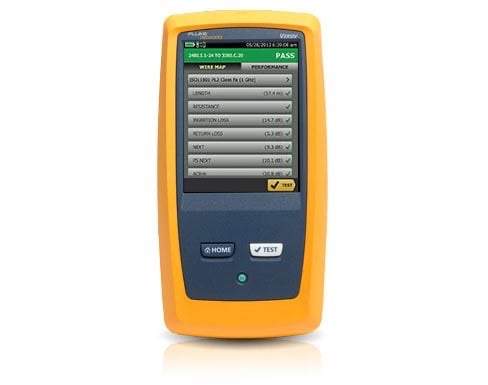
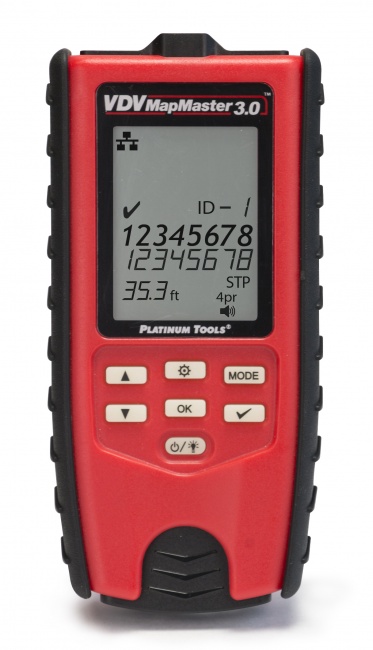
Wiremap, qualification, and certification tools that diagnose failures and verify the fix.