What Characteristic Impedance Actually Means
Every transmission line has a property called characteristic impedance, determined by its physical geometry: the spacing of the conductors, the dielectric material between them, the diameter of the conductors. For twisted pair Ethernet cable, the design target is 100 ohms across the operating frequency range. Cat5e, Cat6, Cat6A, and Cat8 cables are all engineered to present 100 ohms ± a small tolerance to the equipment connected to them.
The reason this matters is that signals propagate cleanly along a transmission line only when the impedance is constant. When a signal traveling down a 100 ohm cable reaches a section that presents 80 ohms or 120 ohms, part of the signal energy reflects back toward the source. The reflected signal causes return loss failures on cert reports and noise on the actual network signal at the receiver.
Maintaining 100 ohms over the full length of the cable run -- including connectors, jacks, patch cords, and patch panels -- is the engineering job that makes Ethernet work at high speeds. Anything that breaks the 100 ohm uniformity creates an impedance mismatch.
Causes of Impedance Mismatch
Impedance mismatches come from physical changes to the cable's geometry or material properties.
Tight bend radius
Bending a cable changes the spacing between conductors at the bend point and changes the dielectric properties locally. Mild bends within the manufacturer's minimum bend radius are fine. Bends below minimum bend radius (typically 4 times cable outer diameter for unshielded, 8 times for shielded) cause measurable impedance changes that show on cert reports.
Crushed or pinched cable
A crush flattens the cable cross-section, bringing conductors closer together and lowering the local impedance. Common crush sources: tile drops onto cable in plenum spaces, conduit pinches, screws driven into the cable through drywall, foot traffic on raised floors with poor cable management, and zip ties pulled too tight on cable bundles.
Kinks from improper pulling
Cables that get kinked during installation often retain a permanent deformation at the kink point. The conductor geometry at the kink is permanently altered. Kinks frequently survive testing -- the cable still passes wiremap and continuity -- but show up as return loss failures during certification.
Mismatched component categories
Cat5e jacks, Cat6 patch cords, and Cat6A cable mixed in the same channel create impedance discontinuities at every component boundary. The cable may be Cat6A but if the patch cords are Cat5e, the channel performance drops to Cat5e levels and the impedance varies at every patch cord interface. Always match component categories across the entire channel.
Excessive untwist at terminations
Twisted pair cable maintains 100 ohms only when the conductors stay twisted. When you untwist a pair to terminate it, the local impedance rises above 100 ohms in the untwisted section. Excessive untwist (more than 1/2 inch / 12mm for Cat6/6A) creates a measurable impedance discontinuity at every termination.
Mid-span splices
A splice in the middle of a run creates an impedance discontinuity unless executed with great care using impedance-matched splice hardware. For Ethernet applications, splices should be avoided -- pull a new cable instead.
Counterfeit or sub-spec cable
Cable from low-quality manufacturers or counterfeit sources may not meet the 100 ohm specification consistently along its length. Variations in conductor gauge, twist rate, or dielectric properties cause low-level impedance drift that shows on certification but is invisible on basic wiremap testing.
How Impedance Mismatch Shows Up on Test Equipment
Return loss failures on certifiers
Return loss is the certification parameter that directly measures impedance uniformity. A return loss failure means signal reflections exceed the standard's threshold. The certifier reports the worst-case frequency and often the location along the cable where the worst impedance discontinuity sits. This location data is the most useful diagnostic clue.
Distance-to-fault on TDR-equipped testers
A time domain reflectometer (TDR) sends a pulse down the cable and measures the time and amplitude of reflections. Each reflection corresponds to an impedance discontinuity. TDR-equipped certifiers and qualification testers can graph these reflections, showing exactly where along the cable the impedance changes. See our guide on how to perform a TDR cable test for the full procedure.
Network performance degradation
Without test equipment, impedance mismatches show as throughput problems, CRC errors on switch port counters, intermittent connectivity, and inability to negotiate higher speeds. The pattern is usually "the cable works but works poorly," which is the same pattern as several other fault classes -- you need test equipment to confirm impedance is the cause.
Impedance Mismatch Severity Reference
| Cause | Typical Impedance Variance | Network Impact at Gigabit | Network Impact at 10G |
|---|---|---|---|
| Mild excessive untwist | ± 5 ohms | Pass with low headroom | Marginal |
| Severe excessive untwist | ± 10-15 ohms | Pass* or fail | Fail |
| Tight bend within radius | ± 5 ohms | Pass | Pass with reduced headroom |
| Bend below minimum radius | ± 10-20 ohms | Pass* or fail | Fail |
| Mild crush from tile drop | ± 10-15 ohms | Pass* or fail | Fail |
| Severe crush or kink | ± 20+ ohms | Fail, packet errors | Will not link |
| Mismatched component category | Variable along run | Pass at lower category | Cannot certify |
| Mid-span splice | ± 5-15 ohms at splice | Pass* to fail depending on splice | Usually fail |
Fix Workflow for Impedance Mismatch
Step 1: Get the location from the certifier
Read the cert report's worst-case return loss location. This is the distance from the tester end where the cable's impedance varies most from 100 ohms.
Step 2: Inspect the indicated location
Walk to the cable and look at the section indicated. Check for visible damage, tight bends, crush points, hidden splices, or component changes. About 70% of return loss failures are visually identifiable at the indicated location.
Step 3: Address the physical cause
Re-route the cable away from crush points, increase bend radius at tight bends, replace damaged sections, replace mismatched patch cords, and re-terminate connectors with less untwist. The fix depends on what the inspection finds.
Step 4: Re-test
After the physical fix, run the certification or qualification test again to confirm the impedance discontinuity has been resolved. Return loss should now show clean pass with adequate headroom.
Step 5: If you cannot fix in place, replace
For mid-span damage in inaccessible locations, the practical fix is pulling a new cable. Splicing twisted pair to repair impedance damage usually creates a new impedance discontinuity at the splice, defeating the purpose. New cable is the cleaner answer.
For broader cert failure context see our guide on what to do when cable fails certification.
Preventing Impedance Mismatch During Installation
- Respect minimum bend radius -- 4x OD for unshielded, 8x for shielded, on every bend
- Pull with appropriate tension -- check the cable manufacturer's spec, never exceed
- Use cable trays and conduit sized for the cable count -- avoid cramming that causes crushing
- Match component categories across every channel -- Cat6A jacks for Cat6A cable, Cat6A patch cords for Cat6A channels
- Limit untwist to less than 1/2 inch at every termination, less for Cat6A
- Avoid splices entirely -- if a cable is damaged before installation, replace the spool
- Buy cable from reputable suppliers -- counterfeit cable is a real problem and shows up as inconsistent impedance
- Test as you install -- a qualification tester on every drop catches problems before walls close
Tools for Impedance Diagnosis
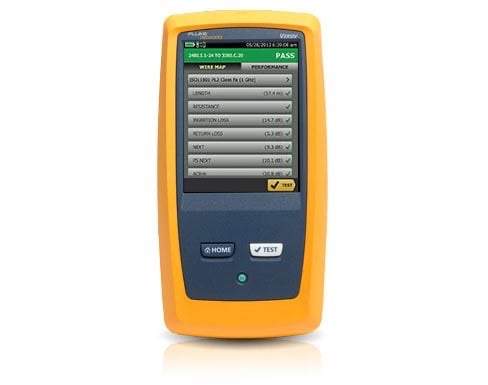
Cable certifier with TDR
Full certifiers measure return loss across the rated frequency range and report the location of the worst impedance discontinuity. Browse cable certifiers for the right unit.
Length and distance-to-fault
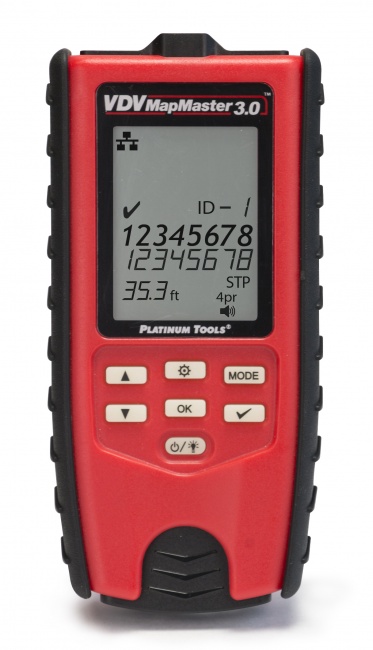
Length and distance-to-fault will place a hard open on the run without going to full certification. The VDV MapMaster 3.0 measures length and reports distance to an open on copper; the PT-OTDR-100 works as a copper TDR as well and exports the result as a PDF report.
TDR cable length meter
For dedicated impedance investigation, a TDR-based cable length meter shows reflections graphically along the cable.
Frequently Asked Questions
What is impedance mismatch on a network cable?
It is a discontinuity in the characteristic impedance of the cable, which should be a uniform 100 ohms for twisted pair Ethernet. Mismatched sections cause partial signal reflection, showing as return loss failures on cert reports and as throughput problems on the network.
What causes impedance mismatch?
Tight bends, crushed cable, kinks, mismatched component categories, excessive untwist at terminations, splices, and counterfeit cable. Each creates a section where the cable's effective impedance differs from 100 ohms.
How do I find an impedance mismatch?
Cable certifiers report return loss measurements and the location of worst discontinuity. Many qualification testers report distance-to-fault. Use the reported location to drive physical inspection.
Can I splice twisted pair to fix damage?
Technically yes, but you should not. Splices introduce new impedance discontinuities. The accepted practice is to pull a new cable when the existing run is damaged. Splices are explicitly prohibited by most certification specifications.
Diagnose Impedance Problems Before They Cost You
Certifiers, qualification testers, and TDR tools that locate and quantify impedance discontinuities.