The Quick Answer
Three IEEE 802.3 standards govern PoE, each delivering progressively more power:
- PoE (802.3af, 2003) -- 15.4W at the switch, 12.95W at the device. Two pairs used.
- PoE+ (802.3at, 2009) -- 30W at the switch, 25.5W at the device. Two pairs used.
- PoE++ (802.3bt, 2018) -- Type 3 delivers 60W/51W, Type 4 delivers 90W/71.3W. All four pairs used.
Higher-numbered standards are backward-compatible with lower-numbered devices, but a high-power device cannot operate on a low-power port. Match the switch capability to the highest-draw device on each port.
Why the Standards Matter on Real Jobs
The difference between 802.3af and 802.3bt is not academic. A PTZ security camera with an integrated heater can draw 45W. A Wi-Fi 6E access point with multiple radios and a USB pass-through port can pull 35W. A laptop docking station that delivers data, video, and charging through a single Ethernet cable needs the full 71.3W of 802.3bt Type 4. None of these devices will operate on a basic 802.3af port that caps out at 12.95W.
The flip side: deploying 802.3bt switches for a network of 802.3af VoIP phones is wasted budget. The phones will never use the extra capacity, and you have paid a premium for switches that operate well below their rated capability.
Specifying the right PoE class -- and verifying it after installation -- is what separates installs that work the day they are commissioned from installs that work three years later when the next-generation devices are added.
PoE Standards Side by Side
| Spec | PoE (802.3af) | PoE+ (802.3at) | PoE++ Type 3 | PoE++ Type 4 |
|---|---|---|---|---|
| Common name | PoE / Type 1 | PoE+ / Type 2 | PoE++ / 4PPoE | PoE++ / 4PPoE |
| Year ratified | 2003 | 2009 | 2018 | 2018 |
| Max PSE power | 15.4W | 30W | 60W | 90W |
| Available at PD | 12.95W | 25.5W | 51W | 71.3W |
| Voltage range | 44-57V DC | 50-57V DC | 50-57V DC | 52-57V DC |
| Max current per pair | 350 mA | 600 mA | 600 mA | 960 mA |
| Pairs used | 2 | 2 | 4 | 4 |
| Cable required | Cat5e or better | Cat5e or better | Cat5e (Cat6 recommended) | Cat6 or better |
| Classes supported | 0-3 | 0-4 | 0-6 | 0-8 |
Pair Usage: 2-Pair vs 4-Pair PoE
The difference between 2-pair and 4-pair PoE is one of the most important practical differences between the generations.
2-pair PoE (802.3af and 802.3at)
Standard PoE and PoE+ deliver power on two pairs only. There are two valid modes:
- Mode A -- power on the data pairs, pins 1-2 and 3-6. Endspan PSEs (network switches) typically use Mode A.
- Mode B -- power on the spare pairs, pins 4-5 and 7-8. Midspan PSEs (PoE injectors that sit between a non-PoE switch and the powered device) typically use Mode B.
The PD must support both modes per the standard, even though it only receives power on one mode at a time. This is why a PoE camera works on either an 802.3af switch (Mode A) or a separate PoE injector (Mode B) interchangeably.
4-pair PoE (802.3bt)
PoE++ uses all four pairs simultaneously. By splitting the current across four conductors instead of two, the standard doubles the power capacity without exceeding the per-conductor current limit that would damage cabling. This is also why a Type 3 or Type 4 install requires every conductor terminated correctly -- a single broken pair cuts the available power in half.
Classes: How Devices Negotiate Their Power Need
Every PoE PD declares a power class during the negotiation handshake with the PSE. The class tells the switch how much power to budget for that port. The standards expanded the available classes as wattage grew.
| Class | Max PD Power | Used By |
|---|---|---|
| Class 0 | 12.95W | Default (unclassified) 802.3af devices |
| Class 1 | 3.84W | Sensors, basic IoT |
| Class 2 | 6.49W | VoIP phones |
| Class 3 | 12.95W | IP cameras, basic APs |
| Class 4 | 25.5W | PTZ cameras, dual-radio APs (802.3at) |
| Class 5 | 40W | Multi-radio APs (802.3bt Type 3) |
| Class 6 | 51W | High-power APs, video conf (802.3bt Type 3) |
| Class 7 | 62W | Digital signage (802.3bt Type 4) |
| Class 8 | 71.3W | Laptop docks, thin clients (802.3bt Type 4) |
The class negotiation matters because the switch reserves power based on the declared class, not actual draw. A Class 8 device on a switch with 71.3W remaining in budget will lock in that allocation even if the device only uses 30W in normal operation. Understanding classes helps you size switch budgets correctly -- see our PoE power budget guide for the math.
Three Common Misconceptions
"PoE+ is just PoE with more watts"
Mostly true, but not entirely. 802.3at also raised the minimum voltage from 44V to 50V at the PSE, which means an aging power supply that just barely passes 802.3af voltage spec may fail 802.3at outright. Higher voltage also means slightly more conservative cable derating in dense bundles.
"PoE++ uses two cables"
No. PoE++ uses one cable but utilizes all four twisted pairs in that cable. The "4PPoE" name (four-pair PoE) sometimes confuses people into thinking two cables are required. One Cat6 cable, all 8 conductors, all 4 pairs carrying power simultaneously.
"My switch advertises 802.3bt, so every port can deliver 90W"
Almost never true. A 24-port 802.3bt switch with a 720W power budget can deliver 30W to every port simultaneously, but cannot deliver 90W to every port -- the math says 24 ports x 90W = 2160W, far above the budget. Switches use the budget to allocate power on demand. When the budget is exceeded, lower-priority ports stop receiving power. Always check the per-switch power budget separately from the per-port maximum class.
How to Test Each PoE Standard
The IEEE 802.3 negotiation handshake is identical in concept across all three generations -- the PSE checks for a valid PD signature, then negotiates a class -- but the voltage and current levels differ. A modern PoE tester handles all three:
Dedicated PoE Tester
Identifies all three standards (802.3af, 802.3at, 802.3bt Type 3 and Type 4), shows voltage and wattage, and reports which pairs are carrying power. Pocket-sized for tool bags.
PoE-Aware Cable Qualifier
Confirms the run carries traffic at its rated speed and reports PoE presence on the same plug-in. For installs commissioning both data and power, that is one visit instead of two.
Wiremap Verification First
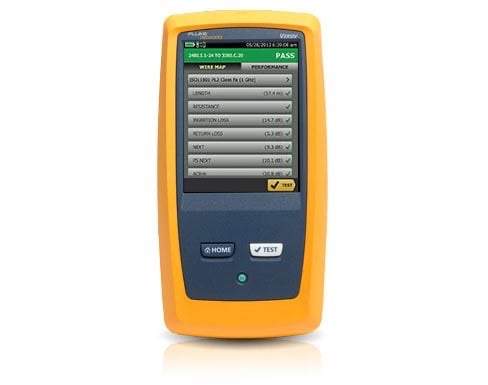
Before testing PoE, confirm the cable wiremap with the VDV MapMaster 3.0 or LanSeeker. Pair faults invisible to standard PoE will fail 802.3bt negotiation.
For a step-by-step test procedure across all three standards, see our guides on how to test PoE and the broader PoE testing reference.
Frequently Asked Questions
What is the difference between PoE, PoE+, and PoE++?
PoE (802.3af) delivers up to 15.4W from the switch, with 12.95W usable at the device, on two pairs. PoE+ (802.3at) delivers up to 30W from the switch and 25.5W at the device, also on two pairs. PoE++ (802.3bt) delivers either 60W (Type 3) or 90W (Type 4) at the switch, with 51W or 71.3W usable at the device, using all four pairs simultaneously.
Are PoE, PoE+, and PoE++ backward-compatible?
Yes. A higher-class switch will negotiate down to power a lower-class device correctly. The reverse is not true: a high-power device cannot operate on a low-power port. If a 50W camera requires 802.3bt Type 3 and the port only supplies 802.3af, the camera will not power on or will reboot under load.
Does 802.3bt require new cabling?
Not strictly. 802.3bt operates on Cat5e or better, but Cat6 or Cat6A is recommended because larger conductors reduce voltage drop and handle the higher current with less heating. More important than the cable category is the integrity of all 8 conductors -- 802.3bt requires all four pairs intact. A miswired cable that worked on 802.3af may fail 802.3bt.
How do I tell which PoE standard a switch port is providing?
Use a PoE tester at the device end. The tester negotiates with the switch and reports the class actually being delivered. The switch datasheet tells you what is supported, but per-port settings, power budget constraints, and cable losses can change what is delivered to a specific port. Trust the tester reading.
Can I mix PoE and PoE++ devices on the same switch?
Yes, if the switch supports 802.3bt. The switch negotiates each port independently -- it will deliver Class 4 to a PoE+ access point on port 1 while delivering Class 8 to a docking station on port 2. The only caveat is the total power budget: the sum of all per-port allocations cannot exceed the switch's overall PoE budget.
Verify the PoE Standard on Every Install
We do not sell a PoE tester. What we do sell tests the cable the power runs on: wiremap, continuity, length, and distance to fault, with certifiers available by quote. Budget for a PoE tester from another supplier, and verify the cable before you commission the link, so the power reading has a known-good run underneath it.