Understanding PoE Standards
Power over Ethernet delivers DC power over the same copper cable that carries data. The IEEE 802.3 standard defines several PoE levels, each delivering more power to the endpoint device (called a Powered Device, or PD). The device providing the power is called a Power Sourcing Equipment (PSE) -- typically a PoE switch or a midspan injector.
| Standard | Common Name | Max Power (PSE) | Max Power (PD) | Pairs Used | Typical Devices |
|---|---|---|---|---|---|
| 802.3af | PoE | 15.4W | 12.95W | 2 pairs | VoIP phones, basic IP cameras |
| 802.3at | PoE+ | 30W | 25.5W | 2 pairs | PTZ cameras, wireless APs, thin clients |
| 802.3bt Type 3 | PoE++ / 4PPoE | 60W | 51W | 4 pairs | Video conferencing, multi-radio APs |
| 802.3bt Type 4 | PoE++ / 4PPoE | 90W | 71W | 4 pairs | Displays, high-power LED lighting, POS terminals |
Why PoE Testing Matters
PoE failures are uniquely frustrating because they can be intermittent, temperature-dependent, and difficult to reproduce. A cable that passes data fine may not deliver enough power. A switch that provides PoE on 23 ports may run out of power budget on port 24. A device that works perfectly in the lab may brown out on a 90-meter cable run in the field.
Common PoE failure modes
- Insufficient power budget -- the switch's total PoE budget is exhausted, so new devices can't power on even though the port negotiates PoE
- Voltage drop over distance -- long cable runs lose voltage to resistance, especially with 23AWG or thinner cable
- Bad terminations -- a connector with one or two high-resistance contacts reduces the power delivered to the device
- Wrong PoE standard -- device requires PoE+ (30W) but the switch port only provides PoE (15.4W)
- Cable fault on power pairs -- an open or short on the pairs carrying power kills PoE while data may still work on the remaining pairs
- Heat-related failures -- bundled cables carrying PoE generate heat, which can degrade performance in densely packed cable trays
A dedicated PoE tester catches these problems in minutes. Without one, troubleshooting PoE failures typically involves swapping cables, swapping switch ports, swapping devices, and hoping something changes -- a process that can take hours.
What to Test: Step by Step
Step 1: Verify cable integrity first
Before testing PoE, make sure the cable itself is good. Use a wiremap tester to confirm all 8 conductors are connected correctly. A PoE failure caused by a bad cable will masquerade as a PoE problem. 802.3bt PoE++ uses all 4 pairs for power -- any conductor fault will affect power delivery.
Step 2: Identify the PoE standard at the switch
Connect your PoE tester to the switch port. It should identify which 802.3 standard the port provides (af, at, or bt) and show the negotiated PoE class. Verify this matches the endpoint device's requirements. A camera that needs PoE+ (30W) won't work reliably on a PoE-only (15.4W) port, even if it powers on initially.
Step 3: Measure voltage
Standard PoE operates at 44-57V DC. Your PoE tester should display the voltage being delivered. Note the voltage at the switch port and, if accessible, at the far end of the cable run where the device connects. The difference between these two measurements is your voltage drop across the cable run.
Step 4: Verify wattage and active pairs
Your PoE tester should show which pairs are carrying power and the wattage being delivered. For 802.3af and 802.3at, power typically runs on pairs 1-2/3-6 or 4-5/7-8. For 802.3bt, all 4 pairs carry power. If a pair that should be carrying power shows zero, there's a fault on that pair -- check the termination and cable.
Step 5: Test under load (when possible)
Some PoE testers can apply a simulated load to test the switch port's ability to deliver power under real conditions. This is the most definitive test: it confirms the switch, cable, and terminations can actually deliver the wattage the endpoint device will draw, not just that the PoE handshake succeeds.
Step 6: Document everything
Record the PoE standard, voltage, wattage, active pairs, and cable length for each run. This documentation is critical for troubleshooting future issues. If a camera goes offline in six months, having baseline PoE measurements from installation day lets you compare current values to known-good values and identify what changed.
Tools for PoE Testing
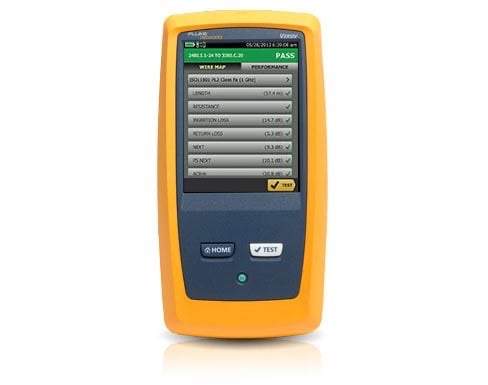
What this procedure needs is a tester that presents a valid powered-device signature, then reports the negotiated class, the voltage at the pins, the wattage the port is actually delivering, and which pairs are carrying it. That is a dedicated instrument and it is the one piece of kit here you will be sourcing from somebody else. Anything that only lights an LED when it senses power will tell you a port is live and nothing about whether it is live enough.
Troubleshooting Common PoE Problems
Device doesn't power on at all
- Check the switch's total PoE power budget -- it may be exhausted
- Verify the switch port has PoE enabled (some ports may be data-only by default)
- Test the cable for opens or shorts on the power-carrying pairs
- Confirm the device supports the PoE standard the switch provides
- Try a different switch port to rule out a dead port
Device powers on but reboots or drops intermittently
- Measure voltage at the device end -- voltage drop over a long run causes brownouts under load
- Check cable length -- if the run exceeds 80-90 meters, voltage drop may be marginal
- Inspect terminations for high-resistance contacts (especially if using CCA or thin-gauge cable)
- Check for cable damage -- a partially crushed cable may pass data but not deliver full power
- Verify the switch port's per-port power allocation matches the device's requirement
PoE negotiates but wattage is too low
- The device may be requesting more power than the switch can provide on that port
- Check the switch's per-port power limit settings -- some switches cap individual ports
- If using 802.3bt, verify all 4 pairs are connected -- a fault on any pair reduces available power
- Check for cable issues using a qualification tester to rule out wiring problems
PoE works on short patch cable but not on permanent run
- The permanent run has excessive resistance -- test cable length and check for damage
- Termination quality: re-terminate connectors at both ends and retest
- Cable quality: CCA (copper-clad aluminum) cable has higher resistance than solid copper and causes more voltage drop over distance. This is the most common hidden cause of PoE failures on long runs
Cable Requirements for PoE
Not all ethernet cable is equally capable of carrying power. Several cable characteristics directly affect PoE performance:
Conductor gauge
Thicker conductors (lower AWG number) have lower DC resistance, which means less voltage drop over distance. Cat5e typically uses 24AWG conductors. Cat6 can use 23AWG. Cat6A often uses 22AWG or 23AWG. For long PoE runs (over 60 meters), thicker gauge cable makes a measurable difference in delivered power.
Solid copper vs CCA
Copper-clad aluminum (CCA) cable uses aluminum conductors with a thin copper coating. CCA has approximately 50% higher DC resistance than solid copper at the same gauge. This means significantly more voltage drop on PoE runs, especially at longer distances. CCA cable is non-compliant with TIA standards and should not be used for PoE installations. If you find CCA cable on a PoE troubleshooting call, replacing the cable is often the fastest fix.
Bundle heat
When many PoE cables run through the same pathway, the power dissipated as heat in the cables raises the temperature inside the bundle. Higher temperatures increase cable resistance, which increases voltage drop, which increases heat -- a feedback loop that can cause failures in large PoE deployments. 802.3bt installations with high power levels should derate cable fill rates in conduit and cable trays.
Frequently Asked Questions
Can I damage a PoE tester by connecting it to a powered port?
A proper PoE tester is designed to be connected to live PoE ports safely. It participates in the PoE negotiation handshake and accepts power without damage. Do not connect non-PoE test equipment to PoE ports without verifying it can handle the voltage -- standard cable testers not rated for PoE could be damaged by the 44-57V DC power.
What is the maximum cable length for PoE?
The IEEE 802.3 standard specifies a maximum channel length of 100 meters for both data and PoE. However, PoE performance degrades with distance due to voltage drop. For high-power 802.3bt devices on 24AWG cable, practical PoE reliability often drops off around 80-90 meters. Using thicker gauge cable or reducing cable length improves PoE reliability on marginal runs.
Do I need a PoE tester if my cable tester detects PoE?
Many qualification testers detect PoE presence and identify the standard, which is useful for basic verification. A dedicated PoE tester adds detailed voltage measurement, current draw, wattage under load, and active pair identification. For troubleshooting PoE failures, a dedicated tester provides the detail you need. For routine verification that PoE is present on newly installed drops, the PoE detection built into a network-aware qualification tester may be sufficient. Note that CableTestShop does not list one: the Platinum Tools units that filled that tier are discontinued and nothing in our catalog measures PoE.
Test the Cable Before You Test the Power
We do not sell a PoE tester. Nothing we carry measures PoE voltage, class, or wattage. Our Digital Tone & Probe Kit detects which pairs a port is powering, and nothing more. What we sell beyond that proves the cable: wiremap, continuity, length, and distance to fault. Run that test before you buy anything for the power side, because it costs less and it is where a large share of PoE complaints actually end.