What "PoE Budget" Actually Means
A PoE switch contains an internal power supply that feeds DC voltage to the PoE controller circuitry, which distributes power to the ports. The wattage rating of that internal supply, minus overhead for the switch itself, is the PoE power budget. It is a hard ceiling. Every port draws from this single pool.
A 24-port switch advertised as "802.3bt PoE++" does not mean every port can deliver 90W. It means every port has the hardware to deliver up to 90W if the budget allows. With a 720W PoE budget, the switch can deliver 30W (PoE+) to every port simultaneously, or 90W to 8 ports while leaving 16 ports unpowered, or any combination that adds up to 720W or less.
Misreading this is the number one cause of "the cameras worked yesterday but ten of them are dead today" calls. The site added a few more cameras, total allocation crossed the budget, and the switch started shedding ports.
The Math: Calculating Your Required Budget
Calculating the budget you need is straightforward arithmetic with two adjustments.
Step 1: List devices and their PoE classes
For each device, find its IEEE 802.3 class. Use the device datasheet -- the manufacturer publishes the class. Common examples:
- VoIP phone (basic) -- Class 2 (6.49W)
- Standard IP camera -- Class 3 (12.95W)
- PTZ camera with heater -- Class 4 (25.5W) or Class 5 (40W)
- Wi-Fi 6 access point -- Class 4 (25.5W)
- Wi-Fi 6E multi-radio AP -- Class 6 (51W)
- Outdoor AP with heater -- Class 6 (51W) or Class 8 (71.3W)
Step 2: Sum the PSE-side wattage
The class wattage you sum is the PSE-side number (what the switch must allocate), not the PD-side (what the device receives). Use 15.4W for Class 0/3, 30W for Class 4, 60W for Class 6, and 90W for Class 8.
Step 3: Add 15-20% headroom
Multiply your sum by 1.15 (minimum) to 1.20 (recommended). This covers cable losses already counted in PSE allocation, device class declarations that overestimate actual draw, and a margin for future additions.
Step 4: Round up to a switch budget tier
Switches come in fixed budget sizes (e.g., 195W, 370W, 480W, 720W, 1440W). Pick the next-larger tier above your calculated requirement.
Worked Example: 16-Camera Office Install
An office is deploying 16 IP cameras across a single PoE switch. The mix:
| Device | Quantity | Class | PSE Wattage Each | Total Allocation |
|---|---|---|---|---|
| Indoor fixed camera | 10 | Class 3 | 15.4W | 154W |
| Outdoor camera w/ heater | 4 | Class 4 | 30W | 120W |
| PTZ camera | 2 | Class 5 | 40W | 80W |
| Subtotal | 16 | -- | -- | 354W |
| + 20% headroom | -- | -- | -- | +71W |
| Required budget | -- | -- | -- | 425W |
The smallest switch budget that covers 425W is typically the 480W tier. A 24-port switch with a 480W PoE budget covers this install with room for two or three additional standard cameras down the road.
A 24-port switch advertised at "30W per port" with no published total budget is a red flag -- it either means the switch genuinely has 720W of budget (24 x 30W) which is rare at a low price point, or the manufacturer is hiding a smaller actual budget behind per-port maximums.
Class Allocation Quirks That Bite Installers
Class 0 reserves the maximum
A Class 0 device is "unclassified" and reserves 15.4W from the budget by default, even if it only draws 5W in operation. Older 802.3af devices and cheap PoE injectors often default to Class 0. If you have a switch that is mysteriously running near its budget despite light loads, count how many Class 0 devices are connected -- each one is reserving more than its actual draw.
LLDP can negotiate down
If both the switch and the PD support LLDP-MED PoE negotiation, they can exchange wattage information dynamically and refine the class allocation after initial connection. A device that initially declares Class 4 may negotiate down to "I only need 12W" via LLDP, freeing budget. Not all devices support this; check whether your IP cameras and APs use LLDP-MED PoE negotiation.
Static allocation overrides
Many managed switches let you statically configure per-port maximum wattage in the CLI (e.g., power inline static max 30000 on Cisco). Static allocation is useful when a device under-declares its class but you know it will draw more, or when you want to cap a port to prevent budget overruns. The downside: misconfigured static allocation can waste budget on idle ports.
Priority-based shedding
When the budget is exceeded, most switches use port priority to decide which ports stay powered. The default is usually "low" or "medium" priority for all ports, which causes shedding to be effectively random by port number. For production deployments, set high priority on critical devices (security cameras, access control) and low priority on non-critical (digital signage, optional sensors) so the switch sheds the right ports first.
Verifying the PoE Budget on Live Equipment
Calculations are only as good as the assumptions behind them. Verify the actual allocation on the running switch.
From the switch CLI
Most managed switches expose PoE allocation via commands. On Cisco IOS: show power inline. On Aruba/HPE: show power-over-ethernet brief. On generic vendors: look in the web UI under "PoE Status" or similar. The output shows total budget, allocated power, available power, and per-port allocation.
From the device end
A PoE tester at the device end shows the wattage the switch is actually delivering on that port. If a Class 4 camera shows 18W delivered (not 30W allocated), the actual draw is well within the allocation -- the switch is not in budget pressure. If multiple devices show wattage near their class maximum simultaneously, the budget is under stress.
Cross-check totals
Sum the per-port wattage from your tester readings. Compare to the switch's declared allocated power. If the totals match, the switch is reporting accurately. If the switch claims 250W allocated but your testers measure 180W total delivery, the switch is over-allocating (likely from Class 0 devices reserving more than they use).
When Your Switch Budget Is Not Enough
Add a midspan injector
Single-port and multi-port PoE injectors sit between the switch and the device, providing PoE power independently of the switch. This offloads the highest-draw devices (like a single 60W outdoor AP) from the main switch budget. Useful for incremental deployment without replacing the switch.
Use multiple smaller switches
Two 24-port switches with 370W budget each provide 740W total -- and isolate failures so a switch problem only affects half the devices. Splitting cameras across two switches also enables priority designation per switch (one for critical, one for general).
Upgrade to a larger budget
If the install will grow, replace the switch with a larger-budget unit before adding more devices. Switch upgrades are easier when planned than when triggered by an outage.
Distribute high-power devices
Concentrating all high-draw devices on one switch creates a budget bottleneck. Spread Class 8 devices across multiple switches so no single switch is loaded near its budget limit.
Tools to Verify PoE Allocation
PoE Tester
Reads class, voltage, and wattage at each port, which is the only way to check whether the allocation you calculated matches what the switch is actually handing out.
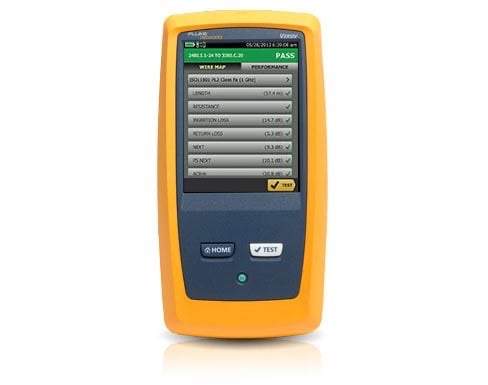
Network Qualifier
Documents cable quality alongside the PoE allocation at commissioning, so the budget you calculated and the cable carrying it are proved in the same record. CableTestShop does not list a qualifier; a throughput result on a specific job is a rent-or-subcontract step.
Cable Wiremap
The VDV MapMaster 3.0 verifies all 8 conductors -- essential before assigning Class 8 devices to a port, since 802.3bt uses all four pairs.
For the broader PoE diagnostic procedure, see how to test PoE and the best PoE testers for 2026.
Frequently Asked Questions
What is a PoE power budget?
The total wattage a PoE switch can deliver across all its ports simultaneously. A 720W budget on a 24-port switch supports 30W on every port, or 90W on 8 ports, or any combination summing to 720W or less. The budget is a hard ceiling -- exceeding it triggers port shedding or new-port denial.
How do I calculate PoE budget for an install?
Sum the PSE-side wattage of each device's PoE class (15.4W for Class 0/3, 30W for Class 4, 60W for Class 6, 90W for Class 8). Multiply by 1.15-1.20 for headroom. The result is the minimum PoE budget the switch must provide.
What happens when a switch runs out of PoE budget?
The switch refuses to power new devices, sheds lower-priority ports to make room for higher-priority ports, or drops the next port to request power. Behavior depends on the switch's PoE policy. Set port priorities deliberately for production deployments.
Should I trust device class declarations or measured draw?
Both. Class determines budget allocation -- a Class 8 device locks in 71.3W regardless of actual draw. Measured wattage tells you operational efficiency. For budget calculations, use class wattage. For thermal and PSU sizing, use measured wattage.
How much margin should I leave in a PoE budget?
15-20% headroom minimum. Devices may declare higher classes than they use, cable losses already counted in PSE allocation, future additions, and simultaneous high-load events all argue for margin. A switch at 100% PoE budget is one camera reboot away from a service call.
Verify Your PoE Allocation in the Field
We do not sell a PoE tester. What we do sell tests the cable the power runs on: wiremap, continuity, length, and distance to fault, with certifiers available by quote. Budget for a PoE tester from another supplier, and verify the cable before you commission the link, so the power reading has a known-good run underneath it.