What to Look For
We do not sell one. Nothing in our catalog measures PoE voltage, class, or wattage, so the instrument is a purchase from another supplier. What we can put underneath it is the cable proof: wiremap, continuity, length, and distance to fault on the run feeding the device. A large share of PoE complaints end at the cable, which makes it the cheapest thing to rule out first.
Why PoE Testing Matters More Than Ever
Power over Ethernet has gone from a convenience for VoIP phones to a critical building infrastructure system. In 2026, PoE powers IP security cameras, wireless access points, LED lighting systems, building access controls, digital signage, point-of-sale terminals, and IoT sensors. With the adoption of 802.3bt (PoE++), a single Ethernet cable now delivers up to 90 watts -- enough to power PTZ cameras, outdoor access points with heaters, and even some laptop docking stations.
This expansion creates real liability for installers. When a PoE-powered security camera goes offline because the switch port cannot deliver sufficient wattage, or when an access point reboots intermittently because cable resistance causes voltage drop, the installer gets the call. A PoE tester isolates the cause in seconds instead of hours of guesswork.
The cost of not having a PoE tester is not the tool price -- it is the truck roll, the troubleshooting time, and the reputation damage from a system that should have been verified at commissioning.
What a PoE Tester Actually Measures
A proper PoE tester does more than confirm "power present." Here is what the measurements mean and why each matters.
Voltage (V)
PoE operates at 44-57V DC, depending on the standard and cable length. Voltage at the powered device end is always lower than at the switch due to resistance in the cable. A tester at the device end shows the actual delivered voltage. If it drops below the device's minimum operating voltage (typically 37-42V depending on the standard), the device may brown out, reboot, or refuse to power on. Voltage measurement at the far end of the cable is the single most important PoE diagnostic.
Current and wattage (mA / W)
The tester measures how much current the port is delivering and calculates wattage. This tells you the actual power draw versus the port's rated capacity. A camera rated for 25W drawing 28W will eventually trigger the switch's overload protection. Seeing the actual wattage helps you match devices to port capabilities and catch power budget problems before they cause outages.
PoE standard / class identification
The tester identifies which PoE standard the switch port is advertising: 802.3af (Type 1, 15.4W), 802.3at (Type 2, 30W), or 802.3bt (Type 3 at 60W or Type 4 at 90W). This matters because a mismatch between the device's PoE requirement and the port's configuration is one of the most common causes of PoE failure. A device that requires 802.3at power will not operate on a port configured for 802.3af -- the tester identifies this mismatch immediately.
Pair identification
PoE can deliver power on data pairs (Mode A: pairs 1-2 and 3-6), spare pairs (Mode B: pairs 4-5 and 7-8), or all four pairs (4-pair PoE, used in 802.3bt). Knowing which pairs carry power is essential for troubleshooting. If a cable has a fault on one pair, knowing whether that pair carries data only, power only, or both determines the impact and the fix.
Load testing
Some advanced PoE testers can draw a configurable load from the port to verify the switch can sustain power delivery under stress. This catches problems that appear only when the device actually draws full power -- marginal cable quality, oversubscribed PoE budgets, and ports that negotiate correctly but cannot sustain the rated wattage.
PoE Tester Comparison
Here is how three widely available PoE testers compare. We sell none of them, and they are listed here on their merits so you can pick properly and buy from whoever stocks them.
| Feature | Fluke MicroScanner PoE | Klein Scout Pro 3 PoE | NOYAFA NF-8601S |
|---|---|---|---|
| Price tier | ~$500 | ~$200 | ~$110 |
| PoE detection | Yes | Yes | Yes |
| 802.3af (15.4W) | Yes | Yes | Yes |
| 802.3at (30W) | Yes | Yes | Yes |
| 802.3bt (60W/90W) | Yes | Limited | Limited |
| Voltage display | Per-pair | Yes | Yes |
| Wattage display | Yes | Yes | Yes |
| Powered pair ID | Yes | Yes | Yes |
| Cable wiremap | Yes (full) | Yes | Yes |
| Cable length / TDR | Yes | Yes | Yes |
| Distance to fault | Yes | Yes | Yes |
| Tone generator | IntelliTone | Yes | Yes |
| Cable ID / mapping | Yes | Yes (remote kit) | Yes (8 remotes) |
| Display type | Backlit LCD | Backlit LCD | Color LCD |
| Coax testing | No | Yes | No |
| Form factor | Handheld | Handheld | Handheld |
| Available from us | Not sold here | Not sold here | Not sold here |
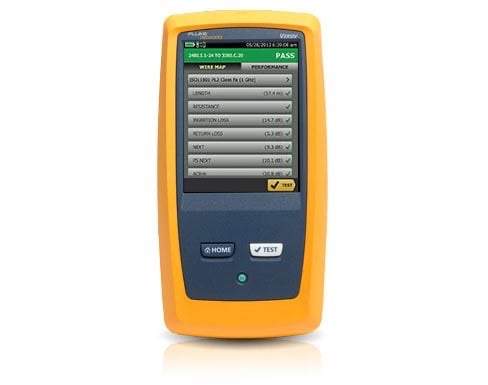
Fluke MicroScanner PoE
Not sold here
The MicroScanner PoE is Fluke's answer to the "I need one tool for cable and PoE" question. It combines full cable qualification -- wiremap, length, distance-to-fault, split pair detection -- with detailed PoE diagnostics showing voltage on each individual pair. The IntelliTone capability adds digital cable identification that filters out noise from adjacent cables.
The PoE testing is not an afterthought on this unit. It identifies the PoE standard being delivered, measures voltage per pair, and shows which pairs carry power. For an installer who tests both cable quality and PoE on every job, the MicroScanner eliminates carrying two separate tools. The Fluke build quality and calibration standards are what you would expect at this price point.
Best for: Installers and IT technicians who need cable qualification and PoE testing in a single unit. Fluke shops that want to stay within the Fluke ecosystem. Professionals who value per-pair voltage readings for advanced diagnostics.
Klein Scout Pro 3 PoE
Price: ~$200 | Not sold here
The Klein Scout Pro 3 PoE is a multi-cable verification tester with PoE detection added. It tests RJ45 (data), coax (video/CATV), and RJ11/RJ12 (voice) -- making it the most versatile tester on this list for electricians who work across multiple cable types. The PoE detection identifies the standard and displays voltage and wattage.
The Scout Pro 3 includes cable length measurement via TDR, distance-to-fault for locating breaks, a tone generator for cable tracing, and location ID mapping with the included remote kit. The PoE testing is a built-in feature rather than the primary function, which means the PoE interface is simpler than a dedicated PoE tester -- but for installation verification (confirming the port delivers the expected standard and voltage), it provides the information you need.
Where the Scout Pro 3 PoE stands out is in mixed-trade environments. If you are an electrician pulling data, phone, and coax in the same building, one tool handles all three cable types plus PoE verification. You do not need to carry a separate tester for each cable type.
Best for: Electricians working with multiple cable types (data, coax, voice) who also need PoE verification. Contractors who want cable testing and PoE detection in one rugged unit. Klein tool users who want consistency across their test equipment.
NOYAFA NF-8601S PoE
Price: ~$110 | Not sold here
The NOYAFA NF-8601S is a multifunction network cable tester with PoE detection, wiremap, cable length, TDR, tone generation, and port flash capability. It includes 8 numbered remote identifiers for mapping multiple cables in a patch panel. The color LCD display shows results clearly, and the unit comes in a carrying case with all accessories.
At $110, the NF-8601S delivers an impressive feature set. The PoE detection identifies the standard and shows voltage and wattage. The TDR-based cable length and distance-to-fault measurements are useful for troubleshooting. The 8-remote cable identification kit maps more locations than most testers at this price.
The tradeoff is build quality and accuracy relative to Fluke or Platinum Tools. The NF-8601S is a solid tool for the price, but the cable length measurements can vary by 5-10% compared to reference-grade instruments. For PoE detection and basic cable verification, the accuracy is sufficient. For situations where precision cable length measurement matters (warranty claims, close-to-limit runs), a higher-tier tool is more reliable.
Best for: Budget-conscious installers who want the most features per dollar. Technicians who need basic PoE detection plus cable testing and cable identification in one affordable package. Small shops building out their tool kit.
How to Choose: By Use Case
You only need PoE verification
If you already own a cable tester and just need to add PoE diagnostics, buy a dedicated pocket unit rather than replacing the tester you have. Single-purpose PoE testers are the cheapest tier here and they are faster in the hand, because there are no menus between plugging in and reading the screen. Do not buy a multi-function instrument for one of its functions when cable testing is already handled by something in your bag.
You need cable testing and PoE in one tool
If you want a single tool that handles both cable qualification and PoE, the Fluke MicroScanner PoE is the premium option, with per-pair voltage readings and Fluke-grade cable testing. The Klein Scout Pro 3 PoE is the value option and the only one here that also tests coax and voice. Both save carrying two instruments, and neither is one we sell.
You need maximum features on a tight budget
The NOYAFA NF-8601S at $110 packs PoE detection, wiremap, TDR, tone generation, and 8-location cable mapping into a single unit. It is not as precise or durable as Fluke or Platinum Tools, but it covers a remarkable range of functions for the price. Good for new installers building out their tool kit or technicians who need a versatile backup tool.
You work across multiple cable types
If your jobs involve data, coax, and voice cabling in addition to PoE verification, the Klein Scout Pro 3 PoE is the only tool on this list that tests all three cable types. Electricians and low-voltage generalists benefit most from this versatility.
PoE Standards: A Quick Reference
Understanding the PoE standards helps you match devices to switch ports and diagnose power issues. Here is the progression from the original 802.3af to the current 802.3bt.
| Standard | Common Name | Max PSE Power | Available at PD | Pairs Used | Typical Devices |
|---|---|---|---|---|---|
| 802.3af | PoE (Type 1) | 15.4W | 12.95W | 2 pairs | VoIP phones, basic IP cameras, small sensors |
| 802.3at | PoE+ (Type 2) | 30W | 25.5W | 2 pairs | PTZ cameras, wireless APs, video intercoms |
| 802.3bt Type 3 | PoE++ / 4PPoE | 60W | 51W | 4 pairs | Video conferencing, multi-radio APs, LED panels |
| 802.3bt Type 4 | PoE++ / 4PPoE | 90W | 71.3W | 4 pairs | Laptop docking stations, digital signage, thin clients |
The "Max PSE Power" column shows the total power the switch port sends. The "Available at PD" column shows what the powered device actually receives after cable losses. The difference -- roughly 2.5W to 18.7W depending on the standard -- is lost to cable resistance. This is why cable quality matters for PoE: a cable with high resistance (poor terminations, damaged conductors, excessive length) drops more voltage, reducing the power available at the device. In marginal cases, this causes devices to operate unreliably even though the switch port is configured correctly.
Common PoE Problems a Tester Catches
These are the PoE issues that generate the most service calls -- and the ones a tester diagnoses in seconds.
PoE budget exhaustion
Every PoE switch has a total power budget shared across all ports. A 24-port switch with a 370W budget cannot deliver 30W to every port simultaneously -- the math does not work. When the budget is exhausted, the switch stops powering lower-priority ports. A PoE tester shows you the actual wattage being delivered to each port, which, combined with the switch's budget capacity, tells you whether you are oversubscribed. This is the number one cause of "the camera worked yesterday but not today" calls.
Voltage drop from cable resistance
On long cable runs or cables with poor terminations, the resistance causes voltage to drop below the device's minimum operating threshold. The switch port shows correct configuration. The cable passes continuity testing. But the device at the far end sees 38V instead of the 48V it needs, and it browns out or reboots under load. A PoE tester at the device end measures the actual delivered voltage and exposes the problem.
Standard mismatch
A network administrator configures a switch port for 802.3af because "it is a camera." The camera is a multi-sensor panoramic unit that requires 802.3at. The port negotiates, the camera partially powers up, and then shuts down when it tries to activate all sensors. The tester shows the port is delivering af power and the device needs at, pointing to a configuration change rather than a hardware problem.
Passive PoE injector issues
Older installations and some proprietary equipment use passive PoE injectors that do not negotiate -- they apply voltage to specific pairs regardless of what is connected. A PoE tester identifies passive power and measures the voltage, which helps you determine compatibility with replacement devices and avoid connecting equipment to an unexpected voltage.
Frequently Asked Questions
What is the best PoE tester for a network installer?
The one that reports all four readings that matter: the negotiated PoE class, the voltage at the pins, the wattage actually being delivered, and which pairs are carrying power. A unit that only confirms power is present will tell you a port is live and nothing about whether it is live enough, which is the failure most PoE complaints turn out to be. If you also test cable, a multi-function unit that adds wiremap and length saves carrying two instruments. We do not sell a PoE tester, so this is a purchase from another supplier.
Can I test PoE with a regular cable tester?
Most basic cable testers cannot test PoE. PoE requires a detection handshake -- the tester must present a valid signature resistance before the switch will apply voltage. Some multi-function cable testers like the Fluke MicroScanner PoE and Klein Scout Pro 3 PoE include PoE detection, but standard verification and wiremap testers do not. Do not probe powered PoE ports with equipment not designed for it.
What is the difference between PoE, PoE+, and PoE++?
PoE (802.3af) delivers up to 15.4W. PoE+ (802.3at) delivers up to 30W. PoE++ (802.3bt) delivers up to 60W (Type 3) or 90W (Type 4) using all four cable pairs. Each generation uses higher current and voltage to deliver more power. When buying a PoE tester, ensure it supports at least 802.3bt to test all current installations, including high-power devices like PTZ cameras and outdoor access points.
Do I need a PoE load tester or just a PoE detector?
A PoE detector confirms presence, identifies the standard, and measures voltage. A load tester draws actual power to verify the switch can sustain delivery under stress. For most installation verification, a detector is sufficient. Load testing is valuable when troubleshooting intermittent power issues, verifying PoE budgets under real-world conditions, and commissioning high-power devices that draw near maximum rated power.
Why does my PoE device keep rebooting or losing power?
The most common causes are: insufficient switch PoE budget (too many devices drawing more total power than the switch supplies), cable quality issues (high resistance from poor terminations reduces delivered voltage), PoE standard mismatch (device requires 802.3at but port is configured for 802.3af), and excessive cable length (voltage drops over long runs). A PoE tester at the device end measures actual delivered voltage under load and isolates the cause.
Before You Buy the PoE Tester
We do not sell any of the testers compared above, and we do not sell a PoE tester. Nothing we carry measures PoE voltage, class, or wattage. Our Digital Tone & Probe Kit detects which pairs a port is powering, and nothing more. The units above are covered here on their merits so you can choose properly and buy from whoever stocks them. What we can do is prove the cable underneath: wiremap, continuity, length, and distance to fault, which is the test worth running before you spend anything on the power side.