The Short Version
Why As-Built Documentation Matters
Cable plants outlast IT staff turnover, building ownership changes, and contractor business cycles. The structured cabling installed in a building today will be in service when the IT director, facility manager, and original installer have all moved on. The documentation is what survives.
Warranty enforcement
Manufacturer system warranties (Belden, Panduit, CommScope, Leviton, Siemon) require certified test results in native format for warranty registration. Without documentation, the 25-year warranty does not exist. See our structured cabling warranty guide for detailed requirements by manufacturer.
Liability protection
When a network failure happens 18 months after install, the question becomes: was it an installation defect or post-install damage? Documented pass results from the day of installation shift the burden of proof. Without documentation, every failure becomes your problem.
Service and upgrade efficiency
The next time someone needs to add a drop, troubleshoot a slow connection, or relocate a workstation, the cable schedule tells them what is where without manual tracing. This is valuable to the client and frequently leads to repeat business for the original installer.
Contract compliance
Most commercial contracts include a closeout requirement for as-built documentation. Failure to deliver complete as-builts can hold up final payment or trigger backcharges.
Components of an As-Built Package
1. Cover sheet
One page summarizing the project. Includes:
- Project name and site address
- Project completion date
- Installer company name, address, contact info, license numbers
- Project manager name and signature
- Drop count summary (e.g., "248 Cat6A drops, 16 fiber strands")
- Test result summary (e.g., "248 of 248 drops pass; 16 of 16 fiber strands pass")
- Test equipment used and last calibration date
- Standard tested against (TIA-568.2-D Cat6A permanent link, etc.)
- Warranty information (term, manufacturer, registration ID if applicable)
- Notes section for project-specific notes
2. Cable schedule
Spreadsheet (or PDF table) with one row per drop:
- Drop number (matching label on cable, jack, and patch panel)
- Patch panel and port location
- Room or area served
- Wall plate position
- Cable type and category (Cat6, Cat6A, OM4, etc.)
- Measured cable length
- Test result (pass/fail with reference to detailed report)
- Notes (any field changes, substitutions, or special conditions)
3. Test results (native + PDF)
Native files from your certifier in the manufacturer's proprietary format (.flw, .wxp, .nct). These are required for warranty submission and allow re-analysis. PDF exports of each test for easy review without proprietary software.
For each test result include: drop ID, test standard applied, pass/fail, measured values for key parameters (length, NEXT margin, return loss margin, insertion loss margin), and the limit values for reference.
4. Materials list
Complete list of installed components by manufacturer part number:
- Cable type, category, jacket rating, manufacturer, part number, lot number
- Patch panels: manufacturer, part number, port count
- Keystone jacks: manufacturer, part number, color
- Patch cords: type, length, manufacturer, part number, quantity
- Termination tools used (relevant if manufacturer requires specific tools)
5. Photos
Visual record of the finished installation:
- Patch panel front (showing cable dressing and labeling)
- Patch panel back (showing cable management)
- Equipment closet overall
- Any unusual installations (cable routing, custom termination, etc.)
- Wall plate locations in each room
- Fiber tray and splice locations (for fiber installs)
6. Warranty documentation
If the install is covered by manufacturer system warranty: warranty certificate from manufacturer, registration confirmation, and warranty terms document. If covered only by installer workmanship warranty: terms document with what is and is not covered, contact info for warranty claims.
7. Drawings (if available)
Updated floor plans showing actual cable routing, patch panel locations, and wall plate positions. The "as-built" version of the original cable design drawings.
File Formats and Storage
| Document Type | Recommended Format | Why |
|---|---|---|
| Cover sheet | Universal, signed if required | |
| Cable schedule | Excel + PDF | Excel for editing, PDF for archive |
| Certifier test results | Native + PDF | Native for warranty, PDF for review |
| Speed certifier results | Native + PDF | Net Chaser exports both |
| Materials list | Excel + PDF | Searchable |
| Photos | JPEG or PNG | Original resolution preserved |
| Drawings | PDF + DWG/RVT | PDF for review, native for future edits |
| Complete package | ZIP archive | Single-file delivery |
Retention Periods
How long should you keep as-built documentation? The answer is "as long as someone might need it." Cloud storage costs are negligible compared to the value of the documentation when needed.
Workmanship warranty period (1-3 years)
Absolute minimum retention. Documentation needed to defend against any callback or workmanship claim during the warranty.
Manufacturer warranty period (25 years)
For installations covered by Belden IBDN, Panduit PCI, CommScope SYSTIMAX, Leviton Network Solutions, or Siemon System warranties, retain documentation for the full warranty period. Manufacturer claim processes may require the original test data.
Statute of limitations on construction defects
State-by-state, typically 6-10 years from substantial completion for construction defect claims. Documentation showing the cable plant was tested and passed at completion is your defense.
Recommended: indefinite retention
Cloud storage at $5-$10 per month for hundreds of project archives is trivial. Recommendation: never delete as-built documentation. Use clear file naming (CompanyName_ProjectName_CompletionDate) and tag by client and year for easy retrieval.
Common As-Built Documentation Mistakes
1. PDF only, no native files
Some manufacturers require native test files for warranty submission. PDF-only test results may not be accepted. Always export both formats from your certifier.
2. No cable schedule
Test results without a cable schedule mapping drop numbers to physical locations are nearly useless. The schedule is what makes the test results actionable.
3. No materials list
Future troubleshooting often requires knowing exactly what cable and components were installed. "Cat6 cable, some patch panels" is not enough -- "Belden 7965ENH Cat6, lot 4523, Belden 24-port patch panel part KGAS3-ID" is.
4. Photos taken from too far away
A wide shot of an equipment closet does not show the labeling clearly. Take close-up shots of patch panel faces with labels visible.
5. Documentation delivered weeks after handoff
Final payment often depends on documentation delivery. Late delivery delays your payment and can trigger contract penalties. Compile documentation as the project progresses, not after.
6. No copy retained
Delivering documentation to the client without keeping your own copy means you have no defense if a claim arises and the client can no longer find their copy.
Equipment That Simplifies Documentation
Some testers and certifiers significantly reduce the documentation burden by exporting clean reports directly:
- Gigabit speed qualification -- exports per-drop reports with project and client naming; rental or subcontract, we do not currently list one
- VDV MapMaster 3.0 -- on-screen results that can be photographed for documentation when no native export is available
- LanSeeker -- generates cable identification reports useful for documenting existing infrastructure during retrofit work
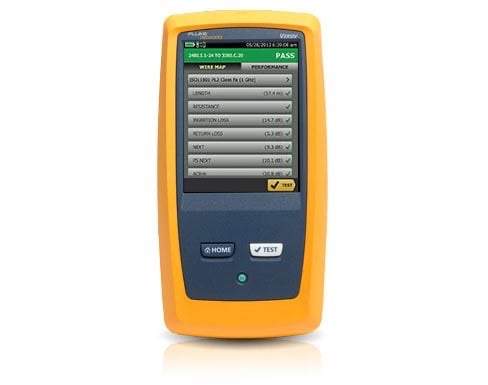
- Full TIA certifiers (Fluke DSX, Softing WireXpert) -- native files plus PDF exports, project management software for batch reporting
For test methodology that produces good as-builts on small projects, see our small office checklist. For general guidance on certification reports, see network certification reports and data center cert best practices.
Frequently Asked Questions
What is as-built cable test documentation?
The complete record of how the cable plant was installed and how it tested at completion. Includes test results, cable schedule, materials list, photos, and warranty information. Documents what actually exists, including field changes from the original design.
How long should I retain as-built test documentation?
Minimum: through the workmanship warranty (1-3 years). For manufacturer warranty work: 25 years. Best practice: permanent digital retention -- cloud storage cost is trivial vs the value of having the docs when needed.
What file formats should test results be saved in?
Both native (.flw, .wxp, .nct) and PDF. Native files are required for warranty registration. PDFs are universally readable for review and handoff.
Do I need as-built documentation for residential work?
Not always contractually required, but strongly recommended. The cable schedule helps future contractors. Test results protect against disputes. For high-end residential, expect clients to request documentation as a quality differentiator.
Equipment That Documents Itself
Testers and certifiers that export clean reports reduce documentation burden and improve handoff quality.