What a Modern School Cable Plant Looks Like
The K-12 cable plant has scaled up dramatically. A school built in 2010 might have had two drops per classroom and a single AP per hallway. The same school today, after a refresh, has 4-6 drops per classroom, an AP in every classroom, IPTV at every wall display, and door access at every classroom door.
Drivers behind the density:
- 1:1 device programs. Every student on a Chromebook or iPad means high concurrent wireless density. One AP serving four classrooms is no longer adequate.
- IPTV and digital signage. Wall-mounted displays in every classroom and common area, fed over PoE.
- Door access control. Every classroom door now has an electronic reader for building lockdown and access logs.
- Security cameras. Hallways, stairwells, exterior, and increasingly inside classrooms.
- VoIP phones. Every classroom has a phone, every phone is PoE.
Standards That Drive School Cable Cert
School cable testing is governed by a stack of overlapping standards. The district IT spec is the local source of truth.
District IT Standards Document
Every district worth its IT budget has a written cable spec that defines minimum cable category, certifier model, deliverable format, labeling scheme, and acceptance procedure. This document supersedes assumptions. Pull it before the bid.
State Education Department Specs (where applicable)
Some states publish minimum cabling specs for K-12 facilities (Texas, Florida, California are notable). State specs typically set floors, not ceilings, and the district spec usually exceeds them.
ANSI/TIA-568.2-D
The national copper performance standard. Cited by district specs as the test method. Cat6A permanent link is the standard test limit.
E-Rate Program Requirements
Federal E-Rate funding for school cabling does not mandate certification but does require documentation that the work was completed and that competitive bidding was followed. Certification reports become part of the audit-ready file.
Test Plan by School Zone
| Zone | Drops | Test Type | PoE Required |
|---|---|---|---|
| Classroom (general) | 4-6 per room | Cat6A perm link cert | If AP/IPTV/phone |
| Classroom AP | 1 ceiling | Cat6A perm link + PoE class | Yes (Type 3-4) |
| Computer Lab | 30+ student stations | Cat6A perm link cert | No (data only) |
| Library / Media Center | Variable + APs | Cat6A perm link + AP PoE | For APs and self-checkout |
| Cafeteria / Gym | APs + AV + POS | Cat6A perm link + PoE | Yes (APs, POS) |
| Door Access | 1 per door | Cat6 / Cat6A perm link + PoE | Yes (Type 1-2) |
| IP Cameras | Hallways + exterior | Cat6A perm link + PoE class | Yes (Type 2-3) |
| MDF/IDF Backbone | OS2 SM fiber | OLTS + OTDR | No |
The Summer Schedule Problem
Most K-12 cabling work happens between the last day of school and the first day of the next year. That is a 10-12 week window for what would otherwise be a 16-week project. Certification testing eats time at the end of the schedule. Plan for it from the start.
- Pre-stage cable IDs. Before pulling, have the labeling and cable ID scheme finalized so the certifier can be loaded with the project file on day one.
- Test as you go. Do not wait until all cables are pulled to start certifying. Run permanent link tests floor by floor as terminations complete.
- Sequence by classroom. Work by classroom, not by trade. Pull, terminate, certify, label, sign off, move to the next room.
- Build in re-test buffer. Plan for 3-5% of cables to fail first test and need re-termination. That is normal and within scope.
- Hand off in phases. Floors that finish early can be accepted by the district before the whole building is done.
Classroom AP Testing in Detail
The AP cable is the most critical drop in a school. If it fails after the ceiling is closed, the cost to access it is high. Test it twice: once before tile goes back up, once after the AP is mounted and powered.
Pre-Closeout Test
While the cable is accessible above the tile, run a permanent link certification and a PoE class verification with simulated AP load. Use the planned PoE switch model (or a load-capable PoE tester) at the IDF end and the certifier or PoE tester at the AP end.
Post-Mount Test
After the AP is mounted, powered, and joined to the controller, walk every AP and confirm: link speed (should be 2.5G or 5G for Wi-Fi 6E), PoE wattage drawn (should match the AP class), and AP visible to the controller. The LanSeeker reports link speed and PoE class at the AP RJ-45 jack without needing controller access.
Common Failures
The most common AP cable failure is bend radius violation at the AP mount. The technician pulled the cable through a tight grommet, the cable is in spec at the patch panel but too tight at the AP, and PoE++ wattage cannot pass cleanly. Fix: re-pull with proper bend radius and a strain-relief boot.
Deliverable for District IT Acceptance
The district IT team will review the cable cert deliverable. Most district IT teams are small and overworked, so the easier the package is to navigate, the faster acceptance happens.
- Cover summary. Project name, school address, date range, total drop count, PASS count, FAIL count (should be zero at hand-off).
- By building wing or floor. Reports grouped to match how the district physically walks the building.
- By classroom. Each classroom has its own page showing every drop in that room with results.
- AP results separately. AP cables get their own section with both perm link cert and PoE class results.
- As-built drawing. Updated floor plan with every cable run and panel position.
- Cable BOM and warranty registration. Cable manufacturer, part number, warranty registration confirmation.
- Certifier calibration cert. Calibration certificate for the certifier used, valid for the test period.
Field Tools for School Cable Work
School work is high-volume, repetitive, and often run by smaller crews. The right tools speed the workflow without adding cost.
- VDV MapMaster 3.0 with numbered ID remotes for room-by-room verification
- LanSeeker for switch port and PoE verification at the AP end
- Digital Tone & Probe for tracing through ceiling tile spaces and shared conduit
- A rented qualifier for throughput validation on AP and IPTV drops
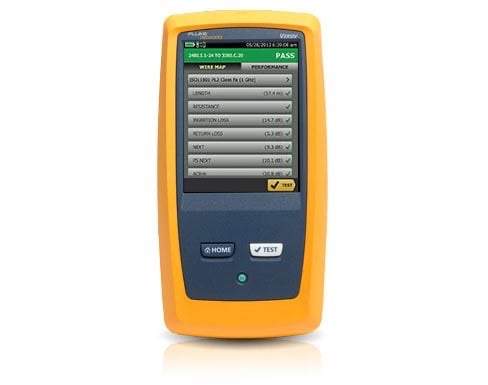
- A Cat6A-rated certifier for full TIA acceptance
For more on PoE testing, see our how to test PoE guide. For background on certification reports, see our network certification reports reference.
Frequently Asked Questions
What cable category is required for K-12 school cabling?
Cat6A is the practical standard for new K-12 cable installs in 2026. State and district IT specifications increasingly require Cat6A as a minimum to support modern Wi-Fi 6E APs, 1:1 device programs, and IPTV distribution.
Do E-Rate funded cable installs require certification reports?
E-Rate eligible category 2 cabling does not federally mandate cable certification reports, but the district or state will typically require them as part of the project acceptance. If certification was specified in the bid documents, certification reports are required for acceptance and for inclusion in the project documentation file.
How many drops should each classroom have?
Modern K-12 classroom standards typically call for 4-6 horizontal drops per classroom: one for the teacher workstation, one for the wall-mounted display, one or two for projector/AV, one for the wireless AP if room-mounted, and one or two general purpose drops.
What goes wrong most often in school cable certification?
Three things consistently fail: long runs that exceed 90m permanent link distance because the IDF was placed for convenience instead of distance budget; PoE failures on AP cables because the cable was field-terminated to a plug instead of a jack and not tested as MPTL; and missing certification on drops added during construction.
Do classroom AP cables need PoE testing?
Yes. Modern classroom Wi-Fi 6E APs draw PoE+ or PoE++ depending on band configuration. The cable must certify electrically and deliver the wattage class the AP requires. Test with a PoE tester that draws the rated load and reports voltage at the AP end.
Tools for School Cable Work
Equip your K-12 or higher ed cabling team with the right verification, qualification, and certification tools.