The Quick Summary
What ANSI/TIA-570 Is
ANSI/TIA-570 is the residential equivalent of TIA-568. While TIA-568 governs commercial telecommunications cabling, TIA-570 governs cabling in single-family homes, townhomes, condominiums, and apartments. The current revision is ANSI/TIA-570-D, published with periodic addenda.
TIA-570 addresses residential-specific topics that commercial standards do not cover well:
- Multi-service infrastructure. Residential cabling typically supports voice (POTS or VoIP), data (broadband internet, in-home networking), video (cable TV, satellite, streaming), and security (alarm, cameras, access control) on related but distinct cable plants.
- Distribution device. The central termination point in a home, equivalent to a commercial telecommunications room but smaller and located differently.
- Grade designations. Two performance tiers (Grade 1 basic, Grade 2 enhanced) appropriate for typical residential bandwidth needs without requiring full commercial-grade infrastructure.
- MDU support. Multi-dwelling unit (apartment, condo, townhome) requirements for distributing services from a building entry point to individual units.
TIA-570 references TIA-568.2-D for the technical performance specifications of twisted-pair components. So a Cat6 cable specified in a TIA-570 Grade 2 installation must meet TIA-568.2-D Cat6 performance limits. The certification testing uses the same parameters and the same equipment as commercial Cat6 testing.
Grade 1 and Grade 2: What Each Provides
Grade 1 (Basic Residential Service)
Grade 1 specifies the minimum cabling needed for traditional residential telecommunications:
- Minimum Cat3 four-pair UTP for voice service to each outlet
- Minimum Cat5e four-pair UTP for data service to each outlet
- One coaxial cable (75 ohm RG-6 quad shield typical) for video service to each outlet
- At least one outlet per habitable room
Grade 1 is appropriate for budget residential construction or retrofits where modern broadband service is not the primary requirement. The Cat3 voice cabling supports POTS and basic VoIP. The Cat5e data cabling supports up to Gigabit Ethernet. Grade 1 is increasingly rare in new construction because Grade 2 costs only marginally more and provides much better future-proofing.
Grade 2 (Enhanced Residential Service)
Grade 2 specifies higher-performance cabling appropriate for modern residential broadband and integrated services:
- Minimum Cat5e four-pair UTP for both voice and data service to each outlet (often Cat6 or Cat6A in 2026 construction)
- Two coaxial cables (RG-6 quad shield) for video service to each outlet, supporting both incoming and outgoing video signal paths
- Optional optical fiber to each outlet for future broadband service expansion
- At least one outlet per habitable room, with multiple outlets recommended in larger rooms
Grade 2 is the practical default for new residential construction in 2026. Most builders specify Cat6 or Cat6A horizontal cabling, sometimes with bundled coax and fiber to each outlet. The incremental cost over Grade 1 is small relative to the lifetime benefit of supporting future broadband service tiers.
The Distribution Device
The distribution device (DD) is the central termination point for all residential cabling. It is the residential equivalent of a commercial telecommunications room, sized and located appropriately for a home rather than a multi-tenant building.
Typical DD configuration
A residential DD is usually a wall-mounted enclosure -- either a recessed in-wall structured wiring panel or a surface-mounted box. Inside the DD:
- Patch panel for terminating horizontal data cables from each outlet
- Voice block (66-block, 110-block, or modular voice patch panel) for terminating voice pairs
- Coaxial splitter for distributing video signals to individual outlets
- Service provider termination for the incoming broadband service (cable modem, ONT for fiber, or DSL modem)
- Network switch for distributing data signals from the modem/router to each outlet
- Wireless access point often co-located with the DD for whole-home Wi-Fi
- Grounding bar for shielded cable bonding and surge protection
- Power outlet within the DD enclosure
DD location
TIA-570 recommends DD location in a centralized, climate-controlled, accessible space within the home. Common locations include a closet, basement, utility room, or garage. The DD should not be located in a bathroom, attic, crawl space, or other space subject to extreme temperature or humidity. The DD should be accessible without entering occupied bedrooms.
DD sizing
TIA-570 provides guidance on DD enclosure size based on home square footage and service complexity. Small homes with basic services need a 14-inch enclosure. Larger homes with comprehensive services may need a 28-inch enclosure or larger. Provide more space than the immediate need anticipates -- adding a network switch or PoE injector later is much easier in a DD with spare space.
Cabling Topology and Length Limits
Star topology
TIA-570 specifies a star topology: every outlet has its own home-run cable from the DD. Daisy-chained outlets are not permitted. This matches commercial structured cabling practice and ensures each outlet performs independently.
Length limits
The maximum horizontal cable length is 90 meters from the DD to the outlet, identical to commercial TIA-568. In practice, residential runs are usually much shorter -- a typical home has cable runs of 10-30 meters. Length is rarely a constraint in residential installations.
Cable types per service
- Data: Cat5e minimum (Grade 2), Cat6 or Cat6A typical for new construction
- Voice: Same Cat5e or higher data cable usually doubles for voice (one cable per outlet supporting both)
- Video: RG-6 quad shield coax, typically two per outlet in Grade 2
- Optional fiber: Single-mode or multimode for future expansion
Outlet quantity
Minimum is one outlet per habitable room. Recommended is multiple outlets in larger rooms (living room, master bedroom, home office) and in locations where future devices may be installed (mounted TVs, exterior cameras, smart home hubs).
Certification Testing for TIA-570 Installations
Test against the component standard
TIA-570 references TIA-568.2-D for twisted-pair component performance. Certification testing applies the TIA-568.2-D limit table appropriate for the cable category installed:
- Cat5e cable: TIA-568.2-D Cat5e permanent link limits, Level III certifier minimum
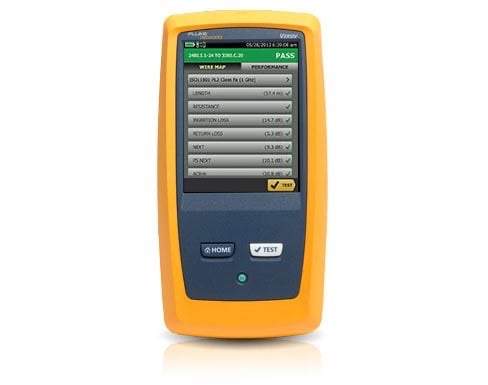
- Cat6 cable: TIA-568.2-D Cat6 permanent link limits, Level V certifier minimum
- Cat6A cable: TIA-568.2-D Cat6A permanent link limits, Level VI certifier required
Test parameters
Same parameter set as commercial: wiremap, length, insertion loss, NEXT, PS-NEXT, ACR-F, PS-ACR-F, return loss, propagation delay, delay skew. Residential cables are generally short (under 30 meters) so insertion loss and propagation delay rarely fail. NEXT and return loss are the most common parameter issues in residential work, usually termination-quality related.
Coaxial testing
RG-6 coax is not tested under TIA-568.2-D because that standard covers twisted-pair only. Coax testing uses a different methodology -- typically TDR for length and continuity verification, plus signal level measurement at each outlet for video service quality. Some certifiers (Fluke MicroScanner, NetAlly) include coax testing modules.
Service-level acceptance testing
In addition to certification testing of the cable plant, residential installations often include service-level testing: verifying broadband internet speed at each outlet, video signal level on coax outlets, voice service to each outlet. This is independent of TIA certification but is what the homeowner cares about.
Documentation
Provide the homeowner with: certification reports for each data cable run, service-level test results, as-built drawing showing cable routing and outlet locations, and DD inventory listing the equipment installed. Many residential customers value the documentation even though they may not consume it directly.
TIA-570 vs TIA-568 at a Glance
| Topic | TIA-570 (Residential) | TIA-568 (Commercial) |
|---|---|---|
| Application | Single-family and MDU residential | Commercial buildings |
| Central termination | Distribution device (DD) | Telecommunications room (TR) |
| Cable categories | Grade 1: Cat3+Cat5e; Grade 2: Cat5e+ | Cat5e through Cat8 |
| Topology | Star (home-run from DD) | Star (home-run from TR) |
| Max horizontal length | 90 m | 90 m |
| Component performance | References TIA-568.2-D | TIA-568.2-D directly |
| Service types | Data, voice, video, security | Data, voice (video and security as optional) |
| Outlet density | Min 1 per habitable room | Driven by occupancy and equipment density |
Practical Recommendations for Residential Installers
Default to Grade 2 with Cat6
The cost difference between Grade 1 and Grade 2 is small relative to the lifetime value. Cat6 horizontal cable supports 1 Gbps comfortably and 10 Gbps over short residential runs. Future-proofing the installation costs little extra during construction and is expensive to retrofit.
Run more outlets than seem needed
The most common homeowner regret is not having enough outlets. Run multiple Cat6 cables to TV mounting locations, home office areas, and exterior camera locations. Future flexibility is cheap during rough-in and expensive after drywall.
Choose a DD location with care
The DD location is hard to change later. Pick a location accessible without going through a bedroom, with adequate space for current and future equipment, with available 120V power, and out of extreme environments. A large utility closet or basement corner is usually ideal.
Certify every data cable
Certification documentation is increasingly expected by builders, real estate agents, and discerning homeowners. The certifier hardware investment pays back across many homes. Use the same certifier you use for commercial work; the methodology is identical.
For background on the underlying standards see Understanding Network Certification Reports and Cable Tester vs Certifier.
Frequently Asked Questions
What is ANSI/TIA-570 and how is it different from TIA-568?
TIA-570 is the residential telecommunications cabling standard; TIA-568 is the commercial standard. TIA-570 references TIA-568 for component performance but addresses residential-specific topics: distribution device location, multi-service support (data, voice, video, security), MDU requirements, and grade designations appropriate for residential bandwidth needs.
What is the difference between Grade 1 and Grade 2 in TIA-570?
Grade 1: minimum Cat3 voice + Cat5e data, basic residential service. Grade 2: Cat5e or better for all services with Cat6 or Cat6A recommended, supports multi-gigabit broadband and integrated whole-home systems. Grade 2 is the practical default for new construction in 2026.
Do I need to certify residential cable installations?
Required by warranty programs and recommended by best practice. Cable manufacturer warranties typically require certification testing. Many builders require certification documentation in the home turnover package. Even where not required, certification is the only way to confirm the installation will support modern broadband.
Can I use the same certifier for residential and commercial work?
Yes. Residential cabling tests against the same TIA-568 component performance limits as commercial cabling. A Level VI certifier tests Cat6 and Cat6A residential the same way it tests commercial. The difference is project specification (TIA-570 grade, distribution device location, outlet quantity) rather than test methodology.
What is the distribution device in TIA-570?
The residential equivalent of a commercial telecommunications room. The central termination point for all home cabling and service provider equipment. Typical DDs are wall-mounted enclosures with patch panels, switches, modem space, and grounding. TIA-570 specifies minimum size, location requirements, and cable management.
Certifiers for Residential and Commercial Work
The same Level VI certifier handles Cat6 and Cat6A residential installations and commercial Cat6A horizontal cabling. Browse our inventory.