The Vocabulary: PSE, PD, Endspan, Midspan
PoE has its own terminology, and the words matter when reading datasheets or talking to manufacturer support.
- PSE (Power Sourcing Equipment) -- the device that supplies PoE. A network switch with PoE ports is a PSE. So is a PoE injector. So is a network appliance with built-in PoE output.
- PD (Powered Device) -- the device that receives PoE. Cameras, access points, phones, building access controllers, sensors.
- Endspan PSE -- a PSE that combines the data and power sources, like a PoE network switch. Sends data and power on the same physical port. Usually uses Mode A (data pairs).
- Midspan PSE -- a PSE that adds power to an existing data link, like a PoE injector. Sits between a non-PoE switch and the PD. Usually uses Mode B (spare pairs).
- Mode A -- power on data pairs (pins 1-2 and 3-6).
- Mode B -- power on spare pairs (pins 4-5 and 7-8).
- 4PPoE -- power on all four pairs (802.3bt only).
The PoE Negotiation, Step by Step
The PoE handshake follows a strict sequence. Every step has a defined voltage range and timing window. If any step fails, the PSE retreats to the previous step and retries -- which is why a marginal cable can produce a port that "almost" powers up over and over.
Step 1: Detection (signature)
The PSE applies a low-voltage probe (2.7V to 10.1V) to the power conductors and measures the resistance back. A valid PD presents a 19-26.5 kOhm signature resistance via a precision resistor between the power pairs.
- Signature in range (19-26.5 kOhm) -- valid PD detected, proceed to classification
- Signature too high (open circuit or non-PD device) -- no device, do not power
- Signature too low (short circuit) -- fault, do not power
- Signature wildly out of range -- legacy device or proprietary PoE, behavior depends on switch
This is why a non-PoE laptop plugged into a PoE switch port does not get fried: the laptop has no signature resistor in the kOhm range, so the switch sees an open circuit and never applies high voltage.
Step 2: Classification
Once detection succeeds, the PSE raises the probe voltage to 15.5-20.5V and measures the current the PD draws. The current level corresponds to a class:
| Class | PD Class Current | Allocated Power | Standard |
|---|---|---|---|
| Class 0 | 0-4 mA | 15.4W (default) | 802.3af |
| Class 1 | 9-12 mA | 4W | 802.3af |
| Class 2 | 17-20 mA | 7W | 802.3af |
| Class 3 | 26-30 mA | 15.4W | 802.3af |
| Class 4 | 36-44 mA | 30W | 802.3at |
| Class 5 | 2-event | 45W | 802.3bt T3 |
| Class 6 | 2-event | 60W | 802.3bt T3 |
| Class 7 | 2-event | 75W | 802.3bt T4 |
| Class 8 | 2-event | 90W | 802.3bt T4 |
Classes 0-4 use a single classification event. 802.3at PD devices that are 802.3bt-aware can perform a two-event classification to declare classes 5-8. The PSE applies the classification voltage twice; on the second event, the PD signals its 4-pair PoE capability.
Step 3: Power-up
If detection and classification succeed, the PSE applies full PoE voltage (44-57V) to the port. The PD's input circuitry detects the rising voltage, switches from passive signature mode into active operation, and begins drawing power. The transition is fast -- 50-300 milliseconds -- but during this window any cable fault or load anomaly can cause the PSE to abort.
Step 4: Maintain power signature (MPS)
Once powered, the PD must continuously draw at least 10 mA (with brief permitted dips). If the PD draws below this threshold for too long, the PSE assumes the device has been disconnected and removes power. This is why a PD that goes into deep sleep can lose its PoE -- the switch sees the low draw and decides nothing is connected.
Step 5: LLDP-MED negotiation (optional)
If both ends support LLDP-MED, after power-up they exchange detailed PoE information including precise wattage requirements. This allows the switch to refine the budget allocation -- a Class 4 device that only needs 12W can release 18W back to the budget pool via LLDP. Not all devices implement LLDP-MED PoE; many older 802.3af devices do not.
Where the Handshake Fails in the Field
Detection failure: cable break on the wrong pair
If the cable has a break on the pair the PSE uses for signature detection, the PSE sees an open circuit and never applies power. A wiremap tester catches this in seconds. The trick: data may still flow on the other pairs, so the cable looks "working."
Classification failure: PD declares wrong class
A PD with a damaged classification circuit may declare a different class than expected. A camera that should be Class 4 declares Class 0; the switch reserves 15.4W instead of 30W; the camera tries to draw 25W and the switch trips its overcurrent protection. Symptom: the camera powers briefly then dies.
Power-up failure: cable resistance too high
The PD draws inrush current during power-up. High cable resistance causes the voltage at the PD to dip below the operational threshold during inrush, triggering the PD to drop offline before completing boot. Symptom: continuous reboot loop. Diagnosis: voltage drop measurement under load.
MPS failure: deep-sleep IoT device
An IoT sensor with a low-power sleep mode draws less than 10 mA between polls. The switch removes power. The sensor cannot wake to draw power again. The whole device appears dead. Some switches have configurable MPS timing; others require static PoE allocation that bypasses MPS entirely.
How a PoE Tester Reads the Handshake
A PoE tester presents the correct signature resistance during detection, then declares a class during classification, exactly like a real device. By stepping through the handshake, the tester reports:
- Detection result -- did the PSE apply the probe voltage and recognize the signature?
- Classification result -- which class did the PSE acknowledge?
- Voltage at power-up -- the voltage the PSE applied after handshake completion
- Wattage delivered -- what the PSE is actually delivering under the simulated load
- Active pairs -- which conductor pairs are carrying power (Mode A, Mode B, or 4PPoE)
The tester effectively replays the handshake transparently. If the handshake fails, the tester reports where it failed, which tells you whether the issue is detection (cable or PSE), classification (PSE configuration), or power delivery (cable losses or PSE overload).
Per-Port PoE Configuration: The Hidden Variable
Most managed switches let you override PoE behavior per port. The defaults vary by vendor and firmware version; two ports on the same switch can have wildly different effective PoE behavior. Common per-port settings:
- Admin enable/disable -- some firmware defaults new ports to PoE-disabled even though the hardware supports PoE
- Maximum class -- cap the highest class the port will negotiate (e.g., limit to Class 4 even on a Class 8-capable switch)
- Static allocation -- override classification with a fixed wattage value
- Priority -- determines which ports get shed when budget is exceeded
- 4-pair enable -- 802.3bt switches may default to 2-pair PoE only, requiring explicit 4-pair enable for Class 5+
When a PoE port behaves unexpectedly, check the per-port configuration before assuming hardware failure. A show power inline interface command on most managed switches shows the current configuration alongside the negotiated state.
Tools for Verifying PoE Negotiation
PoE Tester
Performs the full handshake and reports class, voltage, wattage, and active pairs. The fastest way to verify negotiation in the field.
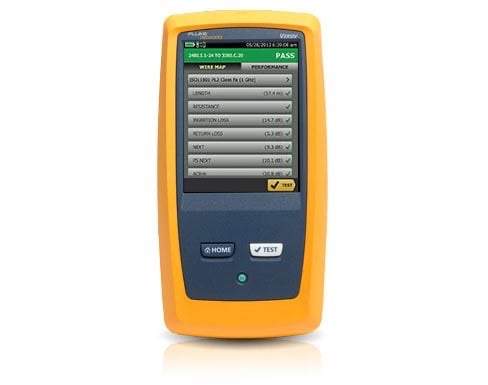
Network Analyzer with PoE
Puts cable performance and the PoE reading on one plug-in, which is what commissioning paperwork wants when data and power both have to be documented per drop. CableTestShop does not list a qualifier; a throughput result on a specific job is a rent-or-subcontract step.
Wiremap Verification
The VDV MapMaster 3.0 verifies all 8 conductors. Pair faults that pass data testing can break PoE detection.
For the broader troubleshooting procedure, see how to troubleshoot PoE not working and the complete PoE testing guide.
Frequently Asked Questions
What is the difference between PSE and PD in PoE?
PSE (Power Sourcing Equipment) supplies PoE -- typically a network switch or injector. PD (Powered Device) receives PoE -- IP cameras, access points, phones. The PSE drives the negotiation handshake; the PD responds. Every PoE link has exactly one PSE and one PD.
How does PoE detection work?
The PSE applies a low-voltage probe (2.7-10.1V) and measures resistance. A valid PD presents a 19-26 kOhm signature. If the resistance is in range, the PSE proceeds to classification. Out-of-range resistance (open or short) prevents the PSE from applying full voltage -- this is what protects non-PoE devices from accidental damage.
What is PoE classification?
After detection, the PSE applies a higher voltage probe (15-20V) and measures the current the PD draws. The current corresponds to a class number (0-8) that declares the maximum power the PD will use. The PSE allocates budget based on this class.
Can a PoE tester act as a real PD?
Yes. A PoE tester presents the correct signature during detection and declares a class during classification, exactly like a real device. Better testers can declare any class on demand, letting installers verify the switch handles each class correctly.
Why does my PoE device power up briefly then shut down?
The classic class mismatch symptom. The PD declares a higher class than the PSE provides. The switch starts powering at the lower class, the device begins booting, then the device tries to draw beyond the limit and the switch trips overload protection, cutting power. Verify with a PoE tester that the switch is configured for the correct class.
See the PoE Handshake in the Field
We do not sell a PoE tester. What we do sell tests the cable underneath the power: wiremap, continuity, length, and distance to fault. Source the PoE tester from a supplier who stocks one, and prove the cable first, because a split pair or a bad termination will fail PoE for a reason no PoE tester will ever name.