Three Tools, Three Categories
The most common confusion in cable testing is the conflation of three distinct categories: verification, qualification, and certification. Each category answers a different question. Each requires a different class of tool. Each costs a different amount of money. Picking the wrong category means either spending too much for what your contracts require, or worse, owning a tool that cannot satisfy your contracts at all.
The three tools in this comparison sit in three different categories:
- Net Chaser -- qualifier, discontinued: Ethernet bit-error-rate testing up to 1 Gb/s, PDF reporting, no TIA/ISO compliance. Platinum Tools has discontinued it and it is not orderable at any price, so it is in this comparison as a tool you may already own rather than one to buy.
- Fluke LinkIQ -- qualifier + network analyzer: Frequency-based cable testing to 500 MHz, cable category identification, link speed plus PoE plus VLAN plus DHCP. Not one we carry.
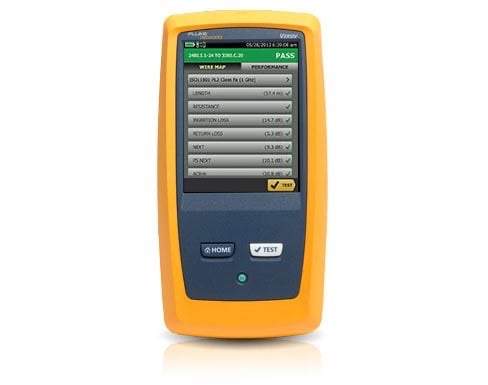
- Fluke Versiv 2 / DSX2 -- certifier: Full TIA-1152-A Level V certification, all frequency-based parameters, formal compliance reporting. We list this one by quote.
The gap between those three is not a continuum. They are three distinct test methodologies answering three distinct contract requirements. Work out which category your contract falls into before you look at any price, because a tool in the wrong category will not satisfy the contract at any price.
Three-Way Comparison
| Feature | Net Chaser | Fluke LinkIQ | Fluke Versiv 2 / DSX2 |
|---|---|---|---|
| Test methodology | Ethernet BER | Frequency to 500 MHz | Frequency to 1 GHz (DSX2-5000), 2 GHz (DSX2-8000) |
| Maximum speed validated | 1 Gb/s | 1 Gbps (negotiated) | 10G+ (parameter-based) |
| Cable category identification | Indirect (via speed) | Yes (Cat5e/Cat6/Cat6A) | Yes (Cat5e through Cat8) |
| TIA/ISO certification | No | No | Yes (Level V) |
| NEXT / return loss / insertion loss | No | No | Yes |
| PDF reporting | Yes | Yes (LinkWare Live) | Yes (LinkWare Live) |
| Wiremap | Yes | Yes | Yes |
| Cable length / TDR | Yes | Yes | Yes |
| PoE detection | Limited | Yes (class, voltage, pair) | No (focus is certification) |
| VLAN / DHCP / network analysis | Limited | Yes | No |
| Fiber testing | No | No | Yes (with CertiFiber/OptiFiber modules) |
| Annual calibration required | Recommended, not required | Recommended, not required | Required (annually) |
| How you get one | Discontinued -- not orderable at any price | Not one we carry | By quote |
| Cloud reporting | USB / desktop | LinkWare Live | LinkWare Live |
The Decision Framework: Read the Contract First
The decision is simpler than the price ranges suggest. Read the contract language for the work you do. The contract tells you which tool category you need.
Net Chaser: The Speed Question, and Where the Tool Stands Now
The Net Chaser was built for a specific use case: contractors who need to prove a cable supports gigabit Ethernet but whose contracts do not require formal TIA/ISO certification documentation. Its bit-error-rate testing methodology answers the actual question -- "will this cable run at gigabit?" -- with an Ethernet pass/fail result and a PDF report. Platinum Tools has since discontinued it, and it is not orderable at any price. What follows is written for the contractors who already have one in the truck, because there are a lot of them and the tool did not stop working when the listing did.
What it does well
- Gigabit qualification -- bit-error-rate proof that a link carries error-free traffic at 1 Gb/s
- PDF reporting -- professional-looking documentation customers can file
- Standalone operation -- no need to buy into a Versiv platform or LinkWare Live ecosystem
- Simple workflow -- terminate the cable, run the test, get the report
- Wiremap and length included -- covers basic field tester functions too
What it does not do
- No formal TIA/ISO compliance -- the report is not a certification report, even though it looks professional
- No frequency-based parameters -- does not measure NEXT, return loss, insertion loss
- No cable category identification -- tells you the cable runs at gigabit but not whether it is Cat6 or Cat6A
- Limited network analysis -- not a substitute for the LinkIQ or LinkRunner for active network diagnostics
Who it was for
The Net Chaser fit residential integrators, commercial AV installers, and low-voltage contractors whose customers ask "will this cable support gigabit?" but do not require formal certification documentation. That job has not gone away. What has gone away is the tool, and there is no qualifier in our catalog to point you at instead: nothing we stock measures throughput. If a contract in front of you asks for gigabit proof, the section further down on getting that result without owning the instrument is the practical answer.
Fluke LinkIQ: When You Need Cable Category + Network Analysis
The Fluke LinkIQ targets a different use case than the Net Chaser: contractors who install cable and need to verify both the cable quality and the active network connectivity in one workflow. Its frequency-based testing identifies cable category directly. Its network analysis provides link speed, PoE, VLAN, and DHCP information at the switch end.
What it does well
- Cable category identification -- directly tells you Cat5e, Cat6, or Cat6A
- Cable performance diagnostics -- flags specific issues like crosstalk and return loss problems
- Combined workflow -- cable testing on one end of the run, network testing on the other end
- PoE detection -- class, voltage, and pair assignment at the switch
- VLAN and DHCP -- basic network diagnostics for active troubleshooting
- LinkWare Live integration -- syncs with the same cloud platform as the DSX certifier
- The Duo configuration -- two units for two-person crews
What it does not do
- No 10G validation -- tops out at 1 Gbps negotiated link speed
- No TIA/ISO certification -- frequency testing is qualification level, not Level V
- No deep network diagnostics -- LinkRunner 10G goes deeper on traceroute, packet capture, etc.
Who it fits
The LinkIQ fits low-voltage contractors who install structured cabling and need to verify the cable plant plus the active network connection. Its category identification answers questions the Net Chaser cannot. Its network analysis adds capabilities the Net Chaser does not have. Its LinkWare Live integration ties cleanly into shops already using Fluke equipment. For deeper analysis, see our LinkIQ vs LinkRunner 10G comparison.
Fluke Versiv 2 / DSX2: When Your Contracts Require Certification
The Fluke Versiv 2 platform with DSX2-5000 or DSX2-8000 modules is the tool for contracts that require formal TIA-568 or ISO 11801 certification documentation. It is the only tool in this comparison that produces compliance reports cable manufacturers accept for warranty registration. For high-end commercial work, government contracts, and certified-system installations, this is the required tool category.
What it does well
- Full TIA/ISO certification -- meets Level V accuracy, produces compliance reports
- All frequency-based parameters -- NEXT, return loss, insertion loss, propagation delay, etc.
- Modular Versiv platform -- swap modules for copper certification, fiber OLTS, fiber OTDR
- LinkWare Live ecosystem -- mature multi-crew project tracking
- Industry default -- recognized by GCs, inspectors, and cable manufacturers
- Versiv 2 / DSX2 covers Cat5e through Cat8 (DSX2-8000 only for Cat8)
What it does not do
- Network analysis -- not designed for active network diagnostics; the LinkIQ handles that
- PoE testing -- focus is certification, not active port verification
- Affordable -- a certifier is a capital purchase, not a tool-truck purchase
Who it fits, and how to get one
The Versiv 2 / DSX2 fits structured cabling contractors whose contracts call out TIA-568 or ISO 11801 by name. It is required equipment for many commercial general contractors, government work, and high-end data center installations. We list the DSX2 and the Softing WireXpert by quote rather than at a shelf price, so the certifiers category is where to start if you need a number for a bid. For a deeper breakdown of the Versiv 2 platform and its modules, see our Versiv vs DSX explainer. For comparison with the alternative high-end certifier, see Fluke DSX vs Softing WireXpert.
If You Already Own a Net Chaser
The tool still works and its reports are still worth what they were always worth. What changed is that you cannot replace it, and neither can we. Platinum Tools has discontinued the Net Chaser, and CableTestShop does not sell a qualifier of any kind: nothing we stock measures throughput. The certifiers we list are quote-only Fluke and Softing units several tiers above what a Net Chaser buyer was shopping for, so they are not a replacement, they are a different decision. That is the honest state of it, and it is better read here than discovered on a bid.
What your existing unit still satisfies
Everything it satisfied before. A bit-error-rate pass at 1 Gb/s is evidence the link carries error-free traffic at that rate, and a customer who asked for gigabit proof is still getting gigabit proof. It was never a TIA-568 certification result, so no contract that accepted it before is affected by the discontinuation, and no contract that rejected it before is any likelier to accept it now. Nothing about your documentation changes.
Make it last
Treat the unit as the last one you will get. Charge it on a schedule rather than leaving it flat between jobs, keep the remote and the test leads paired with it, and store your reference patch cords in the case rather than in the general pile. The spare parts for this platform went out of production before the platform did, so a lead you damage is a lead you may not be able to replace.
Verify the tester before you trust the result
Keep one known-good patch cord that never leaves the case and run it first on any job where the result matters. If the reference cord fails, the tester is the problem and not the cabling. That step costs thirty seconds and it is the difference between rejecting good work and shipping bad work, on any tester of any brand.
When a job needs more than you have
Two routes, and both are ordinary practice rather than an admission of anything. Rent the instrument for the duration of the job, which is how most contractors handle certification work they do not do weekly, and put the rental in the bid as its own line so it is the customer's decision rather than your cost. Or subcontract the certification to a shop that owns a certifier and bill it through. Either way the terminations have to be right before the instrument arrives, and that is the part you control: a rented certifier finds the same split pair that a wiremap tester would have found for you a week earlier, at a fraction of the cost and without a return visit. We stock the verification testers that catch it first.
Frequently Asked Questions
What is the difference between certification, qualification, and verification?
Verification proves a cable is wired correctly (wiremap). Qualification proves a cable supports a specific Ethernet speed. Certification proves a cable meets all TIA/ISO frequency-based parameters for a category. Each level builds on the last in cost and capability. See our deeper guide on cable tester vs cable certifier for more.
Is the Net Chaser a certifier?
No, despite the professional-looking PDF reports. The Net Chaser is a gigabit Ethernet qualifier. It does not perform TIA-1152-A Level V testing. If your contracts require formal certification documentation, you need a full certifier like the Fluke DSX2 or Softing WireXpert. Platinum Tools has discontinued the Net Chaser, so unless you already own one this is now a question about what your existing tester satisfies rather than about what to buy.
Can the LinkIQ replace a DSX certifier?
No. The LinkIQ is a qualifier and network analyzer, not a certifier. It cannot produce TIA/ISO compliance reports. If your contracts call out TIA-568 or ISO 11801 by name, you need a DSX or equivalent full certifier.
Which tool should I buy first?
Start from the contract rather than the tool. If it requires certification, a full certifier is the only thing that satisfies it, and it covers every level below it; we list the Fluke DSX2 and the Softing WireXpert by quote. If it does not, most of the work is verification: proving the run is terminated correctly and free of opens, shorts, reversals and split pairs. That is the level we stock. The qualification level in between is one we sell nothing in, so contractors who need a throughput or certification result on a specific job normally rent the instrument or subcontract that test and price it into the bid.
Match the Tool to the Contract
Three tools, three categories, three different answers to what a contract will accept. Of the three, the Versiv 2 / DSX2 is one we list by quote. The Net Chaser is discontinued and the LinkIQ is not one we carry, so there is no qualifier we can sell you. What we do stock is the verification layer underneath all three, which is the testing most of the work actually needs.