Why This Naming Confuses People
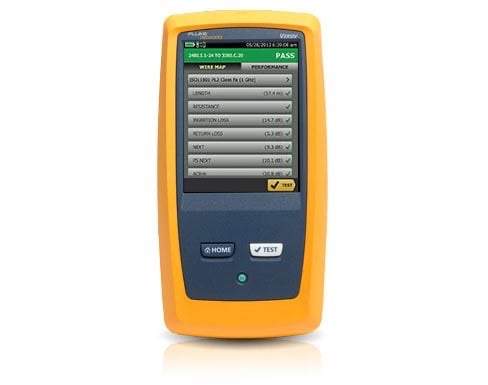
If you have ever shopped for a Fluke certifier, you have probably found yourself asking: do I want the Versiv or the DSX? The answer is yes, both. Versiv is the platform. DSX is the copper certifier capability that runs on the platform. You cannot buy a Versiv mainframe and use it to certify copper without a DSX module installed. You cannot buy a DSX module and use it without a Versiv mainframe to plug it into. They ship together as a system.
Fluke compounds the confusion by selling configurations under shorthand names. A "DSX2-5000" kit is a complete certification system: two Versiv 2 mainframes plus two DSX2-5000 modules plus accessories. A "Versiv 2 base unit" is just the mainframe with no test modules installed -- usually purchased to add a second test capability to an existing module set.
Once you understand the platform-and-module model, the rest of the Fluke certification line makes sense. The Versiv platform is the foundation; the modules are the test capabilities you add to make the platform do specific jobs.
The Versiv Platform Architecture
Think of Versiv as a smartphone analogy: the mainframe is the phone hardware (display, processor, battery, OS), and the modules are the apps that determine what the phone does for a given task. With a DSX module, the Versiv mainframe is a copper certifier. With a CertiFiber Pro module, the same mainframe is a fiber OLTS tester. With an OptiFiber Pro module, it is a fiber OTDR.
The Versiv 2 mainframe (introduced around 2018) provides:
- 5.7-inch color touchscreen for test setup and result review
- Lithium-ion battery with hot-swap capability and ~8 hours runtime
- Wi-Fi and Bluetooth radios for LinkWare Live cloud sync
- USB ports for offline result transfer and firmware updates
- Module bay that accepts swappable test modules
The available modules cover the full structured-cabling certification stack:
- DSX2-5000 module -- copper certification up to 1 GHz (Cat6A / Class EA)
- DSX2-8000 module -- copper certification up to 2 GHz (Cat8 / Class I/II)
- CertiFiber Pro module -- fiber OLTS for loss/length certification
- OptiFiber Pro module -- fiber OTDR for fault location and detailed fiber characterization
Versiv vs DSX: What You Actually Buy
| Component | Versiv 2 Mainframe | DSX2-5000 Module | DSX2-5000 Kit (Complete) |
|---|---|---|---|
| Standalone use | No (needs a module) | No (needs a mainframe) | Yes (complete system) |
| Performs copper certification | No | Yes (with mainframe) | Yes |
| Performs fiber certification | No | No | No (needs CertiFiber/OptiFiber) |
| Includes touchscreen | Yes | No | Yes |
| Includes battery | Yes | No | Yes |
| Includes link adapters | No | Yes (with module) | Yes |
| Pair count | Sold individually | Sold individually | Pair (main + remote) |
| Typical price (single) | $3,500 - $4,500 each | $5,000 - $6,500 each | $11,000 - $14,000 (pair) |
| Annual calibration | Yes (with module installed) | Yes | Yes |
| LinkWare Live | Included | N/A | Included |
Versiv 1 vs Versiv 2 (and Why It Matters)
Fluke shipped two generations of the Versiv platform. The original Versiv launched in 2014 with the DSX-5000 module. The Versiv 2 platform launched around 2018 with the DSX2-5000 and later the DSX2-8000 modules. The two generations are not cross-compatible: a DSX-5000 (no "2") module requires an original Versiv mainframe, and a DSX2-5000 module requires a Versiv 2 mainframe.
The differences between generations matter mostly for buyers shopping the used market. A used Versiv 1 system with DSX-5000 modules may sell for 30-40% less than an equivalent Versiv 2 / DSX2-5000 system. The Versiv 1 still performs Cat6A certification accurately and produces standards-compliant results. What you give up:
- No native Wi-Fi sync -- Versiv 1 syncs to LinkWare via USB and a desktop application; Versiv 2 syncs directly to LinkWare Live cloud
- Slower test speeds -- ~12-13 seconds per Cat6A test vs. ~10 seconds on Versiv 2
- Older display -- responsive but less crisp than Versiv 2's improved touchscreen
- Limited firmware roadmap -- Fluke continues to support Versiv 1 but new features ship to Versiv 2 first
For a contractor on a tight budget who needs basic Cat6A certification, a used Versiv 1 / DSX-5000 system can be a smart purchase. For anyone buying new or planning to use the certifier for 5+ years, Versiv 2 is the right choice.
Which Module(s) Do You Actually Need?
DSX2-5000 module (Cat6A / 500 MHz)
The DSX2-5000 certifies copper cable up to 500 MHz, covering Cat5e, Cat6, and Cat6A. For 95% of structured cabling work in commercial buildings, this is the right module. Most new construction specifies Cat6A as the standard cable type, and Cat6A testing requires 500 MHz capability.
DSX2-8000 module (Cat8 / 2 GHz)
The DSX2-8000 extends copper certification to 2 GHz, covering Cat8 cable used in data center top-of-rack switching. If you do not work in modern data centers, you do not need a DSX2-8000. The price premium over the DSX2-5000 is substantial (typically $4,000-$5,000 per pair), and Cat8 cable is not used in commercial office construction. For a deeper comparison, see our breakdown of the DSX-5000 vs DSX-8000.
CertiFiber Pro module (fiber OLTS)
The CertiFiber Pro module performs fiber optic loss testing (OLTS) for both single-mode and multimode fiber. If your work includes fiber backbone certification, this module turns your existing Versiv mainframe into a fiber OLTS without buying a separate fiber tester. It is the consolidation argument for the Versiv platform: one mainframe, multiple test capabilities.
OptiFiber Pro module (fiber OTDR)
The OptiFiber Pro module performs OTDR testing -- fault location, splice loss, and detailed fiber characterization. It is the most expensive module in the Versiv line and is typically purchased only by contractors doing serious fiber installation work. For light fiber loss certification, the CertiFiber Pro is sufficient.
The Decision Framework
Alternatives to the Versiv Platform
The Fluke Versiv platform is dominant but not the only option. The Softing WireXpert is the strongest direct competitor in the certifier category -- see our detailed comparison of the DSX vs WireXpert. For contractors who do not need formal TIA/ISO certification but do need gigabit throughput verification, a speed qualifier does that job at a fraction of the cost of a full certifier. We do not currently list one, so it is a rental or subcontract step.
For network analysis and qualification (not certification), see our breakdown of the Fluke LinkIQ vs NetAlly LinkRunner. These tools complement a certifier rather than replace it.
The Used Versiv Market
Used Versiv mainframes and DSX modules are widely available through equipment resellers and certified-pre-owned programs. For contractors entering the certifier market, used can save $4,000-$6,000 versus new. But used certifier purchases come with risks that are easy to underestimate.
What to verify before buying used
- Calibration date and certificate -- a Versiv outside calibration cannot produce valid certification reports until recalibrated. Factor in $300-$500 per unit for factory recalibration if the date is more than a year old.
- Original purchase records -- Fluke's authorized service depends on legitimate ownership history. Equipment with unclear provenance may have limited service options.
- Firmware version -- older firmware may not support current TIA/ISO standards. Verify the current firmware on Fluke's website before assuming the unit can certify to the latest standards.
- Module pairing -- DSX modules and Versiv mainframes must match generations. A DSX-5000 module will not work in a Versiv 2 mainframe and vice versa. Verify the seller is shipping a compatible pairing.
- Battery condition -- Versiv batteries degrade over years. Replacement batteries cost $200-$300 each.
- Adapter and accessory completeness -- a complete kit includes specific permanent link adapters, channel adapters, and patch cords. Missing accessories mean buying replacements.
Where used Versiv makes sense
For a contractor who needs basic Cat6A certification capability and is willing to handle the recalibration cost, a used Versiv 1 / DSX-5000 system can be acquired for $5,000-$7,000. The capability gap between Versiv 1 and Versiv 2 is meaningful but not crippling for routine certification work.
Where used Versiv does not make sense
For shops planning to use the certifier for 5+ years, growing into Cat8 work, or using the certifier for high-volume production where speed matters, new Versiv 2 / DSX2 is generally the right call. The faster test speeds, native Wi-Fi sync to LinkWare Live, and longer firmware roadmap pay back the higher upfront cost over the ownership period.
Annual Calibration: What It Costs and Why It Matters
The DSX certifier requires annual factory calibration to maintain Level V accuracy compliance. This is not optional for certification work -- a Versiv outside calibration cannot produce valid TIA/ISO compliance reports.
What calibration costs
Factory calibration through Fluke or an authorized service center runs $300-$500 per Versiv mainframe. The unit ships to the service center, gets calibrated against reference standards, and returns with a calibration certificate dated for one year. Total turnaround is typically 2-3 weeks, including shipping both ways. Plan for the unit to be unavailable during this window.
Why calibration matters
Cable certification is a measurement activity. The certifier compares the cable's electrical performance against TIA/ISO parameter limits at specific frequencies. If the certifier itself is out of spec, the measurements are not valid -- even if the cable would actually pass with a properly calibrated tester. Cable manufacturers will not honor warranty registrations from out-of-calibration certifiers. Inspectors and consultants will reject test reports from out-of-calibration testers.
Managing calibration cycles
For shops with multiple Versiv pairs, stagger the calibration schedules so that not all units are out of service at the same time. A shop with two DSX2 pairs can calibrate one pair every six months on alternating cycles, ensuring at least one pair is always available for certification work. Single-pair shops have no choice but to plan jobs around the calibration window.
Frequently Asked Questions
Is Versiv the same as DSX?
Not exactly. Versiv is the modular hardware platform. DSX is the copper certification module that runs on it. The same Versiv mainframe accepts CertiFiber Pro and OptiFiber Pro modules for fiber testing. When someone says they own a "DSX-5000," they own a Versiv mainframe with DSX-5000 modules installed.
What is the difference between Versiv and Versiv 2?
Versiv 2 is the second-generation mainframe with faster processor, improved touchscreen, longer battery life, and Wi-Fi for LinkWare Live cloud sync. Modules are not cross-compatible between generations -- DSX2-5000 modules require Versiv 2 mainframes, DSX-5000 (no "2") modules require original Versiv mainframes.
Can I add fiber testing to my existing DSX?
Yes. Buy CertiFiber Pro modules separately. Your existing Versiv 2 mainframes accept them. You swap modules for the test type rather than buying a separate fiber tester. This is the consolidation advantage of the Versiv platform.
What is included in a DSX-5000 kit?
Typically two Versiv mainframes (main + remote), two DSX-5000 modules, permanent link adapters, channel adapters, two batteries, two AC chargers, USB cable, and a hard carrying case. Configurations vary by reseller -- always verify the exact contents before purchase.
Module Compatibility Across the Versiv Generations
One of the strengths of the Versiv platform is module portability across mainframe generations. Here's what to know.
Versiv 1 vs Versiv 2 Mainframes
Versiv 2 mainframes accept all current-generation modules including DSX-8000 CableAnalyzer, CertiFiber Pro, and OptiFiber Pro. Older Versiv 1 mainframes accept DSX-5000 modules but cannot run DSX-8000. If you're inheriting older Versiv 1 hardware and want to add Cat 6A or Cat 8 certification, mainframe upgrade is required.
Mixing and Matching Modules
You can buy a single Versiv 2 mainframe and rotate DSX-8000 copper, CertiFiber Pro multimode/singlemode, and OptiFiber Pro OTDR modules through it depending on the day's job. This is particularly useful for contractors who do mixed copper-and-fiber jobs but don't want to staff multiple complete kits.
Remote Compatibility
Each module type uses its own paired remote. DSX-8000 main and remote are sold as a pair, as are CertiFiber Pro main and remote pairs. Remotes from one module type cannot be used with another — keep this in mind when planning multi-tester deployments.
LinkWare PC vs LinkWare Live: Reporting Software
Test data is only useful if you can produce clean, customer-ready reports. Here's how Fluke's software stack handles that.
LinkWare PC
The desktop application that downloads test results from any Versiv mainframe (DSX-5000, DSX-8000, CertiFiber, OptiFiber). It generates customer-ready PDF reports with cable IDs, headroom margins, and pass/fail summaries. Reports can be customized with company logos, project information, and signature lines for audit submission. LinkWare PC is the gold standard for cabling certification documentation.
LinkWare Live
The cloud companion to LinkWare PC. Project managers and supervisors can monitor test progress in real-time across multiple jobsites, push project setups to field testers, and pull results without waiting for technicians to return to the office. LinkWare Live subscriptions add ongoing cost but pay back fast on multi-tester deployments.
Report Audit Trails
For warranty manufacturers like Belden, Panduit, CommScope, and Leviton, certification data must be submitted in LinkWare format with full audit trail intact. The Versiv platform stamps each test with timestamp, tester serial, calibration date, and operator ID. This audit chain is what makes Versiv reports acceptable for 25-year warranty submissions.
Build the Right Certification System
Certifiers are quote-only here: not stocked, and not sold through the cart. Tell us which categories your contracts require and we will confirm availability, lead time and freight before anything is ordered.