Industrial Ethernet Is Not Office Ethernet
Industrial Ethernet uses the same IEEE 802.3 PHY as office Ethernet, but everything around it is different. The protocols on top (Profinet, EtherNet/IP, EtherCAT, Powerlink, Modbus TCP) carry deterministic traffic with cycle times below 1 ms. The cable jackets resist oil and chemicals. The connectors are circular instead of RJ-45. The topology is often line or ring instead of star.
Why this matters for testing: an industrial Ethernet link that performs at the office Ethernet test floor (for example, low NEXT margin) will be punished by the deterministic protocol layer. Packet loss that is invisible to a TCP application becomes a process control fault that stops a line. The cable plant has to deliver more headroom to the same TIA spec to support real-time industrial traffic reliably.
Industrial Cable Types and Where They Go
| Profinet Type | Typical Use | Movement | Bend Cycles |
|---|---|---|---|
| Type A | Fixed install in cable tray | None | N/A |
| Type B | Flexible install, occasional movement | Limited | 200,000 cycles typical |
| Type C (Special) | Cable carrier, robot torsion | High flex / torsion | 5+ million cycles |
| Type R (Robot) | Robot dress packs | Continuous flex | 10+ million cycles |
EtherNet/IP and EtherCAT use similar classifications under different names. The principle is the same: pick the cable for the motion environment. A Type A fixed-install cable run through a cable carrier will fail in months from conductor fatigue.
M12 Connectors and Why RJ-45 Is Wrong on the Plant Floor
RJ-45 is a fragile connector that depends on a small spring tab. It belongs in a wall plate, not on a machine. On the plant floor, vibration loosens it, dust contaminates it, and oil destroys it. Industrial Ethernet uses M8 and M12 circular connectors with screw-locking shells.
- M12 D-coded (4-pin). 100 Mbps Fast Ethernet. Older installs and lower-end devices.
- M12 X-coded (8-pin). 1 Gbps and above Gigabit Ethernet. Standard for new Profinet, EtherNet/IP, and EtherCAT installs.
- M8 D-coded (4-pin). Compact 100 Mbps for small sensors and IO blocks.
- HARTING / IP67 RJ-45. Hybrid solutions where an RJ-45 is sealed in an IP67 housing. Common in panel-to-machine transitions.
Test adapters from the certifier vendors (Fluke, Softing, NetAlly) support M12 X-coded and D-coded directly. The test limit applied is TIA Cat5e or Cat6A depending on the cable specified.
Line and Ring Topology Test Considerations
Office Ethernet is star: every device cables back to a central switch. Industrial Ethernet is often line (devices daisy-chained) or ring (line that closes back into a managed switch for redundancy). Cable testing follows the segments between devices, not full backbone runs.
- Test each segment. Each link between two devices is its own permanent link. Test it as such.
- Documentation by topology. The cable cert deliverable should match the topology drawing. A line of 12 devices means 11 segment cables documented in order.
- Total path budget. Standard Ethernet 100m max applies to each segment, not to the line as a whole. Long lines can extend kilometers if each segment is in spec.
- Ring redundancy verification. Beyond cable cert, verify the ring protocol (MRP, DLR, EAPS) recovers from a single break. This is a network-layer test.
Test Under Real Plant Conditions
An industrial Ethernet cable can pass certification on a Friday afternoon during a planned shutdown and fail in production on Monday morning. The difference is the plant being on. EMI from VFDs, welding, and motors is invisible until those systems are running.
- Test with adjacent equipment running. Especially VFDs and welders. Cable runs near a 200 hp drive in switching condition will pick up noise that quiet-condition tests miss.
- Document ambient temperature. Plant floor temperatures can swing 20+ C between idle and full production. Insertion loss varies with temperature; a borderline cable that passes at 22 C may fail at 55 C.
- Verify shield termination. Industrial cable is shielded by spec. The shield must be properly terminated at both ends (or one end, depending on the install standard) for the EMI rejection to work. Loose shields are common after machine vibration.
- Re-test after first month. Plant conditions accelerate cable issues. A re-test 30 days after commissioning catches early failures while warranty and contractor responsibility are still in scope.
Industrial Ethernet Test Workflow
1. Pre-Pull Verification
Before pulling cable through a tray or cable carrier, verify the cable reel meets the spec. Cable that has been damaged in shipping or storage will fail at install. Spot-check a few meters from the reel with a basic verification tester.
2. As-Installed Verification
After termination but before machine startup, run wiremap and continuity on every cable with the VDV MapMaster 3.0 using the appropriate M12 adapter. This catches obvious termination errors immediately.
3. Full Certification
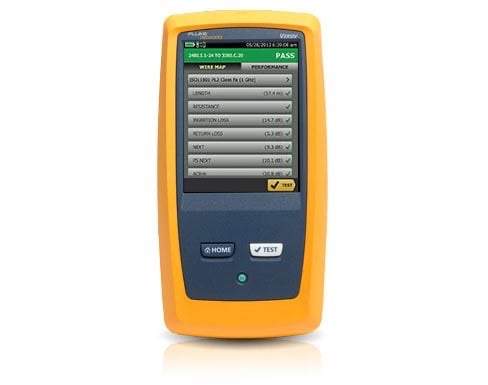
Run TIA-568.2-D permanent link cert on every cable using the certifier with M12 adapters. Document the cable ID, segment, and cell location.
4. Throughput Validation
Validate actual data throughput on each segment with a qualifier. This catches cable issues that pass TIA cert but cannot sustain real-world traffic load. CableTestShop does not list a qualifier, so budget this step as a rental or a subcontracted test.
5. Operational Verification
Once the line is running, monitor for protocol-layer errors (CRC, late collisions, dropped frames) at the switch ports. Persistent errors on a specific segment trace back to that cable. Use the LanSeeker at the device end to verify link speed, duplex, and PoE class match expected configuration.
Field Tools for Industrial Ethernet Verification
- Cat6A certifier with M12 X-coded and D-coded adapters
- VDV MapMaster 3.0 for wiremap and segment ID
- LanSeeker for split-pair and reversal detection with a reading at both ends of the run at once
- A rented qualifier for throughput validation per segment
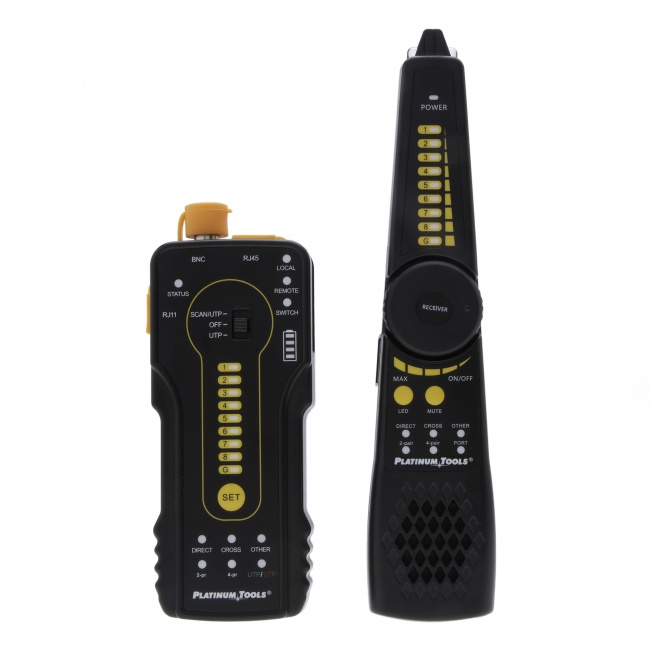
- Digital Tone & Probe for tracing through cable carriers and shared raceways
- Profinet/EtherNet/IP protocol analyzer for protocol-layer commissioning (separate from cable cert)
Background reading: our cable tester vs certifier comparison and guide to certification reports.
Frequently Asked Questions
What is industrial Ethernet and how does it differ from office Ethernet?
Industrial Ethernet is the family of protocols (Profinet, EtherNet/IP, EtherCAT, Modbus TCP) that run real-time deterministic traffic between PLCs, drives, robots, and field devices. The IEEE 802.3 PHY is the same as office Ethernet, but the cable, connectors, and topology are different.
Can a standard cable certifier test industrial Ethernet cables?
Yes for the electrical performance, with the right test adapters. Most major certifiers support M12 X-coded and D-coded adapters for industrial Ethernet. The test limits used are TIA-568.2-D Cat5e or Cat6A depending on the cable specified.
What is Profinet cabling certification?
Profinet certification is a separate program run by PI that tests the entire device and cable system against Profinet conformance requirements. Profinet cable types A, B, and C correspond to fixed install, flexible install, and torsion-rated cables.
How do I test M12 connector cables?
Use the M12 X-coded adapter for the certifier and the corresponding test cord on the remote end. M12 X-coded is the 8-pin connector used for Profinet, EtherNet/IP, and other 1G+ industrial Ethernet. Use the right adapter or you will get false fails.
What environmental factors affect industrial Ethernet cable performance?
Plant floor cables face higher temperatures, oil and chemical exposure, mechanical abrasion, and EMI from VFDs and welding equipment. Specify cables rated for the environment from the start: PUR jackets for oil resistance, high-flex cables for cable carriers, full shielded construction near VFDs.
Tools for Industrial Ethernet Work
Equip your plant floor cabling team with the right verification, qualification, and certification tools for industrial Ethernet.