What Crosstalk Actually Is
Inside a Cat5e, Cat6, or Cat6A cable, four twisted pairs run parallel to each other for the entire length of the run. Whenever a high-frequency signal moves through one pair, the changing electromagnetic field induces a smaller, unwanted signal in every neighboring pair. That unwanted signal is crosstalk, and it is the dominant noise source on copper twisted-pair networks.
The twist rate of each pair is the engineered defense. Each pair has a slightly different twist rate so the induced signals on adjacent pairs cancel themselves out over a short distance. The category of cable (5e, 6, 6A) is largely defined by how aggressively that cancellation has been engineered. Cat6 has tighter twist and an internal pair separator. Cat6A has all of that plus a larger overall diameter to physically separate the pairs further.
The Crosstalk Parameters You Will See on a Test Report
NEXT (Near-End Crosstalk)
The signal coupled into a victim pair at the same end where the disturbing pair is being driven. NEXT is the worst-case crosstalk because the disturbing signal is at full transmit strength and the victim has not been attenuated by traveling down the cable. Reported in dB, with larger negative values being better.
PS-NEXT (Power Sum NEXT)
The combined NEXT from all three other pairs onto one pair, summed together as if they were all transmitting simultaneously. PS-NEXT is more representative of real-world conditions where all four pairs carry data. PS-NEXT is always a few dB worse than individual NEXT.
FEXT (Far-End Crosstalk)
Coupling measured at the far end of the cable. The disturbing signal has been attenuated by the cable's insertion loss before producing FEXT, so raw FEXT looks much smaller than NEXT. The problem: the victim signal has also been attenuated. The relevant metric is therefore FEXT relative to victim signal level — see ACR-F.
ACR-F (Attenuation to Crosstalk Ratio, Far End)
FEXT minus insertion loss. Tells you whether the wanted signal at the far end is strong enough relative to the FEXT noise to be decoded. Formerly called ELFEXT (Equal Level FEXT). ACR-F failures usually mean either excessive cable length or sloppy termination at the receiver end.
PS-ACR-F
The power-sum equivalent of ACR-F — combined far-end crosstalk noise across all disturbing pairs versus signal level on the victim pair. The most realistic far-end crosstalk metric.
AXT / PS-AXT (Alien Crosstalk)
Crosstalk between cables, not within a single cable. AXT applies to bundles, conduit fills, and cable trays where multiple cables run parallel. Required for full Cat6A certification when the project demands it; rarely tested in routine field work.
How to Actually Run a Crosstalk Test
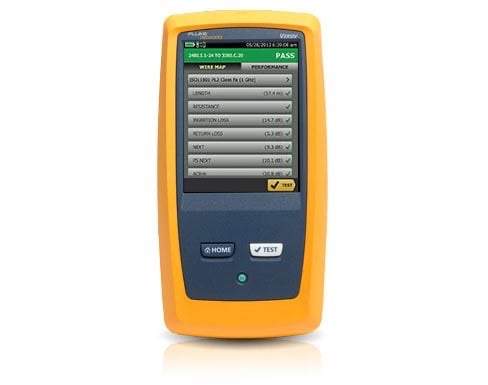
Crosstalk parameters are not measured by qualifiers. They are measured only by full TIA/ISO certifiers — Fluke DSX, Softing WireXpert, VIAVI CertiFiber, and equivalent Level III/IV instruments. Here is the process.
1. Calibrate the certifier
Run the daily reference and field calibration the manufacturer requires. Skipping this is the fastest way to get either a false fail or, worse, a false pass that is uploaded to the customer as proof.
2. Install permanent link adapters
Permanent link adapters terminate at a known reference plane that excludes the patch cords. For a final acceptance test against the TIA permanent link spec, this is the correct adapter. For a channel test that includes the actual patch cords in service, switch to channel adapters.
3. Select the correct test standard
Pick the spec that matches the cable category and topology — TIA-568.2-D Cat6A Permanent Link, for example. The wrong standard produces meaningless results. See how to test Cat6A for category-specific guidance.
4. Run autotest
The certifier sweeps every frequency point across the band and produces pass/fail for every parameter on every pair. Total time is usually 6-15 seconds per link.
5. Read the worst-case margin
A pass report is not enough. Look at the worst-case dB margin on NEXT and PS-NEXT. A pass with 1 dB of margin will likely fail in two years as connectors age. A pass with 6+ dB of margin will hold up for the life of the building.
TIA Crosstalk Limits at Reference Frequencies
| Parameter | Cat5e (100 MHz) | Cat6 (250 MHz) | Cat6A (500 MHz) |
|---|---|---|---|
| NEXT (worst pair) | 35.3 dB | 33.1 dB | 26.1 dB |
| PS-NEXT | 32.3 dB | 30.2 dB | 23.2 dB |
| ACR-F | 23.3 dB | 15.3 dB | 9.3 dB |
| PS-ACR-F | 20.3 dB | 12.3 dB | 6.3 dB |
| Return Loss | 10.0 dB | 8.0 dB | 6.0 dB |
Values shown as positive minimum margin in dB. Limits per TIA-568.2-D for permanent link channel.
Common Crosstalk Failure Modes
NEXT failure at the near end
Almost always termination quality. Untwist at the connector or jack exceeds spec, killing the engineered crosstalk cancellation. Re-terminate with minimal untwist (under 13 mm for Cat5e, less for Cat6/6A). Use the manufacturer's installation tool — punching down a Cat6A jack with the wrong tool gives consistently bad NEXT.
NEXT failure at the far end
Same root cause but at the opposite end. Re-terminate the far jack. Test again. If the failure persists, suspect cable damage somewhere in the run — sharp bends near a bracket, a staple driven through the jacket, or compression where the cable was pulled tight against a sharp edge.
PS-NEXT fail with NEXT pass
Individual pair-to-pair NEXT passes but the cumulative PS-NEXT fails. Indicates that the pair geometry inside the cable is degraded over a substantial length — pulled too hard, kinked at multiple points, or counterfeit cable that was never to spec. Recheck the cable run for damage; if none is found, replace the cable.
ACR-F failure
The cable is too long, the receiver-end termination is bad, or the receiver-end patch cord is poor quality. Check length first (TIA permanent link is 90 m, channel is 100 m). Then re-terminate the far end. Then swap the patch cord at the receiver end with a known-good Cat6A cord.
Marginal pass on multiple parameters
Every parameter passes but every parameter is within 1-2 dB of the limit across multiple links. The installation will degrade quickly. Investigate the highest-impact issue — usually termination quality on the worst link — and re-terminate. A solid pass should leave 4-6 dB of margin everywhere.
Tools for Crosstalk Testing
Full Certifier (required)
Fluke DSX-5000/8000, Softing WireXpert 4500/500, VIAVI CertiFiber. Only Level III/IV certifiers measure NEXT, PS-NEXT, ACR-F, and return loss across the full frequency band. Plan on $8,000 to $15,000+, or rent for short engagements.
Speed Qualifier (proxy)
A gigabit speed qualifier does not measure NEXT directly, but a bit error rate test at gigabit speed will surface most crosstalk-related performance issues. Useful for pre-cert troubleshooting and for installs that do not require formal certification. We do not currently list one: that tier is a rental or subcontract step.
Wiremap Tester (first step)
Always run wiremap before crosstalk. VDV MapMaster 3.0 rules out wiring faults that would invalidate any crosstalk measurement.
Frequently Asked Questions
What is crosstalk in network cabling?
Unwanted electromagnetic signal coupling between twisted pairs in a cable. The twist rate of each pair is engineered to cancel most coupling, but at higher frequencies and longer runs, residual crosstalk limits performance. It is the single biggest factor in how fast a copper cable can run.
What is the difference between NEXT and FEXT?
NEXT measures crosstalk at the same end where the disturbing signal is injected — the worst-case scenario because the disturbing signal is at full strength. FEXT measures crosstalk at the opposite end, where both signals have been attenuated. ACR-F normalizes FEXT against insertion loss to give a useful metric.
How is crosstalk measured?
In decibels (dB), with larger absolute values being better. A certifier sweeps the entire frequency band and compares measured NEXT and FEXT to TIA-568 limits at every frequency point. See our guide to reading certification reports for how to interpret the results.
What causes a NEXT failure?
Almost always excessive untwist at the termination. Other causes include damaged cable jacket, sharp bends, mismatched components (a Cat5e patch cord on a Cat6A run), and counterfeit cable. Re-terminate first; if the fault persists, inspect the cable for physical damage.
What is alien crosstalk?
Crosstalk between adjacent cables — not pairs within the same cable. AXT became a concern with 10GBASE-T. Cat6A is engineered to minimize it through tighter twist, larger diameter, and improved shielding. Field AXT testing is rare but is part of full Cat6A certification when required.
Verify Crosstalk With the Right Tools
From wiremap to full certification — the testers and certifiers you need to find and fix crosstalk failures.