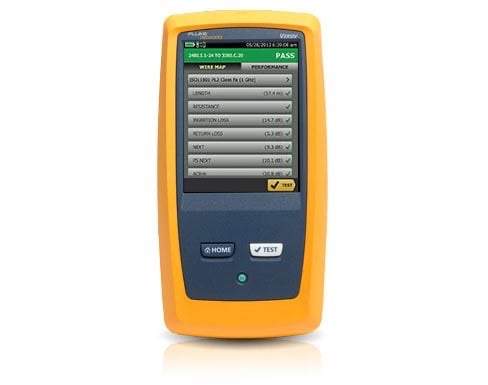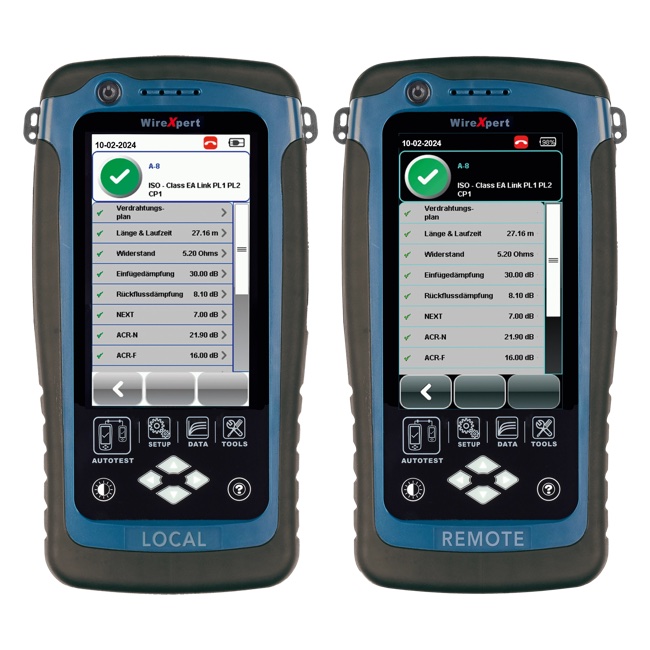
The Three Results and What They Mean
Why TIA Certifiers Report Three Results, Not Two
Every measurement has uncertainty. The certifier's stated accuracy (defined by its TIA-1152 level) is the manufacturer's specification of how close the measured value is to the actual value. A measurement that comes in just barely above the standard's limit is technically a pass, but it is also within the uncertainty band of being a fail.
The Pass* (Pass with asterisk) result exists to flag this ambiguity. When the certifier reports Pass*, it is saying: "this measurement met the threshold, but it is close enough to the limit that I cannot be statistically certain it is a true pass given my measurement accuracy."
Without Pass*, certifiers would have to either treat marginal measurements as clean Pass (overstating quality) or as Fail (rejecting cables that actually meet specification). The three-result system gives the technician and the project team enough information to make informed decisions.
Pass* is most common on Cat6A NEXT and return loss measurements at the upper frequency range, because the standard's limits are tight at 500 MHz and the certifier's measurement uncertainty is largest at the top of its range.
What Counts as a Real, Defensible Pass
A clean Pass on every parameter, with healthy headroom on the critical parameters (NEXT, return loss, insertion loss), is what you want for installation sign-off and warranty registration. "Healthy headroom" is project-dependent, but typical guidelines:
- NEXT headroom of 3 dB or more on Cat6A. Some installers and project specs target 5 dB. Below 2 dB indicates marginal termination quality even when the result is Pass.
- Return loss headroom of 3 dB or more. Return loss failures are common and the parameter is sensitive to many installation variables. Strong headroom indicates clean terminations and undamaged cable.
- Insertion loss headroom of 1-3 dB. Insertion loss is largely a function of length and cable quality. Even well-installed runs at the length limit will show 1-2 dB of headroom. More headroom means shorter or higher-quality cable.
- ACR-F headroom of 3 dB or more. ACR-F failures usually indicate cable quality issues. Strong ACR-F headroom suggests the cable design is well-matched to the installation.
- All wiremap and length parameters in the green -- these are pass/fail with no headroom concept.
A report showing every parameter at clean Pass with these headroom levels is a strong installation. Customers, consultants, and warranty programs accept it without question. This is the goal for every cable run.
Pass*: The Marginal Result Decision Matrix
Pass* tells you the measurement passed but the certifier is not statistically certain it would pass on a re-test or on a different certifier. What to do depends on which parameter triggered the Pass* and on the project context.
Pass* on NEXT or return loss
These parameters are termination-quality dependent. A Pass* on NEXT or return loss often converts to clean Pass after re-termination with proper technique. Action: re-terminate the closer-to-limit end and retest. If it converts to Pass, deliver the new report. If it stays Pass*, the cable's intrinsic crosstalk or impedance is the limiter and re-termination cannot improve it.
Pass* on insertion loss
Insertion loss is mostly determined by cable length and bulk cable quality. Re-termination rarely helps. Action: verify length (the certifier's TDR plot may show the cable is longer than estimated), check for cable damage along the run (kinks, crushes, crimps), and consider cable quality. If the cable was sourced from a non-major manufacturer, the insertion loss specification may be near the standard's edge by design.
Pass* on ACR-F
ACR-F is largely cable-design dependent. Re-termination rarely helps. Action: verify cable manufacturer and verify that the cable is genuine product (counterfeits and re-jacketed cables are common in the secondary market). For most projects, Pass* on ACR-F is acceptable as long as it is not on every cable -- a systemic ACR-F Pass* across the project may indicate substandard bulk cable.
Pass* on multiple parameters
If a single cable shows Pass* on three or more parameters, something systemic is wrong with that link. Possibilities: damaged cable, mixed component categories, end-of-life test cords, or a dirty test interface. Action: clean the test cord ends, retest. If still Pass* on multiple, replace test cords if they are near service-life end. If still Pass*, replace the cable.
Pass* across many cables in the project
If 20% or more of cables in the project show Pass* somewhere, the issue is not random. Possibilities: certifier needs calibration, technician technique is consistent but suboptimal, or the bulk cable batch is marginal. Action: send the certifier for calibration, retrain on termination technique, audit the cable batch certificates.
Headroom Decision Table: Real-World Reading
| Headroom Pattern | Quality Indicator | Recommended Action |
|---|---|---|
| All parameters >5 dB headroom | Excellent installation | Deliver report, register warranty |
| Critical parameters 3-5 dB, others >5 dB | Good installation | Deliver report, register warranty |
| Critical parameters 1-3 dB, others >3 dB | Acceptable, marginal on critical | Consider re-term on lowest parameter for headroom |
| One parameter <1 dB (Pass*) | Marginal | Re-terminate, retest; deliver clean Pass |
| Multiple parameters Pass* | Quality issue likely | Investigate cable, components, technique |
| Any parameter <0 dB (Fail) | Out of specification | Diagnose by parameter pattern, fix, retest |
Fail: A Decision Tree
When a certification fails, the failed parameter narrows the diagnosis. Work through the failure pattern systematically.
Step 1: Note which parameter failed and at which end
Most certifiers report parameters per end (near and far) and per pair combination. The pattern is the diagnostic clue.
Step 2: Apply the parameter-to-cause mapping
- Wiremap fail: miswiring. Re-terminate the failing end correctly.
- NEXT fail one end one pair: termination quality at the failing end on the failing pair. Re-terminate.
- NEXT fail both ends all pairs: wrong category components or systemic technique issue. Verify component category, retrain.
- Return loss fail: impedance discontinuity. Re-terminate; inspect cable for kinks near connectors.
- Insertion loss fail: cable too long, damaged, or substandard. Verify length, inspect cable, verify manufacturer.
- Length fail: over 90m permanent link or 100m channel. Re-route or add consolidation point.
- Delay skew fail: mixed cable batches or deformed cable. Replace cable.
- ACR-F fail: cable design or quality issue. Verify cable manufacturer.
Step 3: Implement the fix and retest
After the corrective action, run a new certification test. The fix is verified by a clean Pass on the previously failing parameter. If the retest still fails, the diagnosis was wrong -- work through the parameter pattern again.
Step 4: Document the failure and the fix
Internal documentation of failures and corrective actions is valuable for quality improvement. The deliverable report set should contain only the final passing test for each cable run, but keep the failure history for QA tracking and dispute defense.
Defending Certification Reports Against Challenge
Most certification reports are accepted at face value. Occasionally a customer or consultant disputes results, claiming the cable does not actually perform as the report indicates. Here is how to defend your work.
Preserve original native files
PDF reports are summaries. The certifier's native test files (.flw for Fluke, .tst for some others) contain the full waveform data and can be re-analyzed by anyone with the matching certifier software. If a dispute arises, the native file is the authoritative record. Always archive native files alongside PDFs.
Document the certifier's calibration status
The calibration certificate from the most recent factory calibration is your evidence that the certifier was operating to its rated TIA-1152 accuracy level on the test date. If a challenger claims the certifier was out of calibration, the certificate refutes them.
Maintain as-built records
The cable IDs in the reports must match physical cable labels and as-built drawings. This traces each report to a specific cable run. A report without a defensible cable ID cannot be tied to a physical cable and is hard to defend.
Be prepared to retest
If a customer demands re-test, agree -- and use a different certifier if possible. A fresh test of a properly installed cable should produce similar results regardless of which certifier is used. If the re-test results differ wildly from the original, investigate -- something has changed (cable damage, connector aging, or a problem with one of the certifiers).
Reference the standards
If the dispute is about whether the test methodology was correct, reference TIA-568 for the cable performance standard and TIA-1152 for the certifier accuracy requirement. Both standards are public and unambiguous on what constitutes a valid certification test.
For background on what each report parameter measures see How to Read a Cable Certification Report and Cat6A Test Parameters Explained.
Frequently Asked Questions
Is Pass* a passing result?
Technically yes, but it depends on the audience. Most cable manufacturers accept Pass* for warranty registration, though some require clean Pass on every parameter. Some general contractors flag every Pass* for explanation. Treat Pass* as a flag for investigation and aim for clean Pass.
Should I retest a Pass* result?
Often yes, especially on termination-sensitive parameters (NEXT, return loss). Re-terminate one or both ends with attention to pair twist preservation and retest. Many Pass* results convert to clean Pass after re-termination. If on insertion loss or ACR-F, re-termination usually does not help.
If a cable passes by 0.1 dB, is the install good or bad?
Depends on the parameter. 0.1 dB pass on insertion loss is fine. 0.1 dB pass on NEXT or return loss indicates marginal termination quality and should be re-terminated. Well-installed Cat6A links typically show 3-8 dB of headroom on NEXT and return loss. Consistent thin margins suggest a systemic issue.
What do I do when a critical link fails certification?
Identify the failed parameter and apply the diagnostic mapping: NEXT or return loss = re-terminate; insertion loss = check length and cable quality; wiremap = re-terminate correctly; length = re-route; delay skew = replace cable. Retest after the fix and verify clean pass.
How do I defend my certification reports if a customer disputes them?
Provide original native test files, calibration certificate from the test date, as-built drawings tying cable IDs to physical locations. Be prepared to retest with a different certifier as a sanity check. Most disputes resolve quickly when the original data is reproducible.
Certifiers That Produce Defensible Reports
A certifier earns its keep on the paperwork: native file export, full TIA-1152 documentation, and a current calibration certificate from the manufacturer's own service program. Confirm all three before you buy, on any platform and from any seller. The certifiers listed here are quote-only — send the configuration you are considering and we will confirm availability, lead time, and freight before anything is ordered.