The Quick Answer
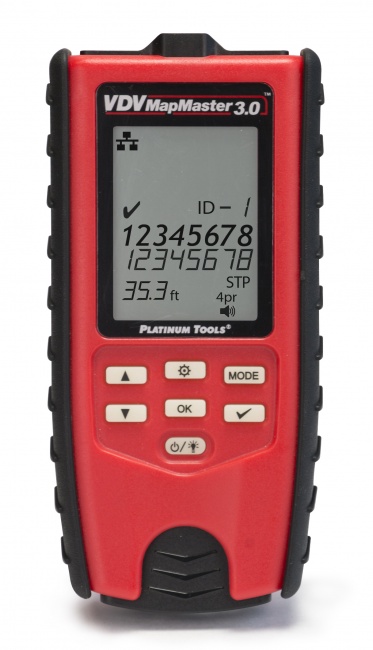
Still made: the VDV MapMaster 3.0, which is the one we list. It is the stronger tool for new-construction wiremap testing and large-scale cable mapping at patch panels. It does not do active-network detection.
Read on if: you own a Cable Prowler and are deciding what to do next, or you are weighing whether the MapMaster covers your work on its own.
Same Brand, Different Jobs
Platinum Tools built both the Cable Prowler and the VDV MapMaster 3.0. The strategy was to cover the structured cabling tester market with multiple options at different feature levels rather than a single hero product. The MapMaster 3.0 is the workhorse passive cable tester and is still made.
The Cable Prowler was the upgrade tier that added active-network detection. Platinum Tools has discontinued it, along with the rest of its network-aware and qualification line.
Because both tools share Platinum's design language and build philosophy, the choice is not about which brand to trust -- both are reliable, both have lifetime warranty backing, both have proven themselves in the field. The choice was about feature scope and price point. It is now also about what you can still get: only the MapMaster is in production.
Plenty of established structured-cabling shops own both tools. The MapMaster is the daily driver for cable verification on installations. The Cable Prowler comes out for active troubleshooting and customer-facing service calls. They are complementary rather than directly competitive, which is why owning both was common. A contractor buying a first or only field tester today has one of the two available to them.
Side-by-Side Comparison
| Feature | VDV MapMaster 3.0 | Cable Prowler |
|---|---|---|
| Availability | In production | Discontinued by Platinum Tools |
| Wiremap (opens/shorts/miswires) | Yes | Yes |
| Split pair detection | Yes | Yes |
| Cable length (TDR) | Yes | Yes |
| Distance to fault | Yes | Yes |
| Tone generator | Yes (4 modes) | Yes (4 modes) |
| Remote IDs supported | Up to 19 | Up to 20 |
| Active port detection | No | Yes |
| Link speed detection | No | Yes (10/100/1000) |
| PoE detection | No | Yes (presence + class) |
| Port flash / hub blink | Yes | Yes (enhanced) |
| Coax (F-connector) testing | Yes (with adapter) | Yes (with adapter) |
| Display | Color graphical LCD | Color graphical LCD |
| Battery | 9V alkaline | 4x AA alkaline / rechargeable |
| Warranty | Limited lifetime | Limited lifetime |
VDV MapMaster 3.0: Strengths
Mass cable mapping productivity
The MapMaster's numbered remote ID support is its standout feature. On a new-construction job with 100 unlabeled drops at a patch panel, the workflow is dramatic: drop remotes at 19 jacks, walk the panel identifying each port to its remote, swap out remotes, repeat. The total time to map 100 cables drops to roughly an hour. With a single-remote tester, the same job takes a full day. The MapMaster is purpose-built for this workflow.
Still in production
This used to be a cost comparison, and the MapMaster won it: the Cable Prowler carried a premium for its active-network features, and a shop outfitting five installers felt that gap.
The comparison has since been settled a different way. The Cable Prowler is discontinued, the MapMaster is in production, and for a crew that needs matching testers across five trucks and a replacement when one is dropped down a shaft, that is the difference that decides it.
Simpler interface
The MapMaster's interface is focused on the core passive-testing workflow: select test type, plug in, read result. There is no menu navigation through active-network options the user does not need. For installers who use the tester many times daily, the simplicity adds up to real time savings and fewer accidental menu changes.
Lighter and more pocketable
The MapMaster's smaller form factor and lighter weight (using a single 9V battery rather than the Cable Prowler's heavier battery configuration) make it easier to carry in a tool pouch all day. For installers who keep the tester at hand throughout a shift, the ergonomic difference compounds.
Cable Prowler: Strengths
Active port detection
The Cable Prowler detects whether a port is active and identifies the negotiated link speed (10/100/1000 Mbps). For service technicians doing customer-facing work -- "is this jack live?" -- the Cable Prowler answers the question directly without needing a separate tool. The MapMaster cannot do this; it tests passive cable only.
PoE detection
The Cable Prowler detects PoE presence and identifies basic PoE class. For installers verifying that a switch is supplying PoE to an IP camera or access point jack, this is genuinely useful. It is not a full load tester (it does not draw power to verify wattage), but for verification of PoE-on-this-port scenarios, it is the right level of capability.
Switch port discovery
When plugged into a live switch port, the Cable Prowler can identify the port by triggering a flash on the switch's port LED. This makes finding "which port is this cable plugged into?" a one-step operation rather than a guessing game. The feature exists in passive form on the MapMaster (hub blink generator) but the Cable Prowler integrates it more deeply with active port detection.
Remote ID support
The Cable Prowler supports numbered remote IDs as well. For mass cable mapping, the difference between the two is marginal but the Cable Prowler is at least competitive on this dimension while adding active features. For a shop doing both heavy cable mapping and active testing, the Cable Prowler covered both jobs in one unit.
Nothing Platinum Tools still makes does.
The Decision Framework
For shops doing pure new construction at scale, the MapMaster was and remains the better buy per installer equipped. For shops doing mixed install-and-service work, the Cable Prowler won on feature consolidation, and for shops large enough to specialize the sensible answer was both: MapMasters for the install crews, Cable Prowlers for the service techs. Only the MapMaster half of that plan can still be bought.
When Neither Tool Is the Right Answer
Both tools are strong field testers, but neither is a certifier or a deep network analyzer. For TIA/ISO certification work, you need a Fluke DSX or Softing WireXpert -- see our DSX vs WireXpert comparison.
For deeper network analysis (VLAN discovery, DHCP, traceroute, 10G validation), the Fluke LinkIQ or NetAlly LinkRunner 10G are stronger -- see our LinkIQ vs LinkRunner comparison. The Cable Prowler's PoE detection and link speed reading are useful but not in the same class as a dedicated network analyzer.
For gigabit qualification testing, a qualifier validates Ethernet up to 1 Gb/s with a report you can hand over; that tier is rented or subcontracted, as CableTestShop does not list one. For pure cable identification at a patch panel, the LanSeeker is a focused tool that beats both general-purpose testers on the specific task.
Related Reading
Workflow Walkthroughs
Specifications matter less than how the tools actually feel in daily use. Here are three common scenarios and which tool fits each.
New construction office build, 200 cable drops
The job: a new office tenant build-out, 200 Cat6A drops from a centralized telecom room to workstations and conference rooms. All cables are pulled and terminated; all jacks are unlabeled. The task is to map every cable to its corresponding jack, verify the wiring, and label both ends.
The right tool: VDV MapMaster 3.0. Drop remotes at jacks, walk the patch panel mapping each port to a remote. Move the remotes to the next batch of jacks, repeat. Total time for 200 drops: roughly 90-120 minutes of active mapping. With a single-remote tester, the same job would take 4-6 hours of constant walking back and forth.
Why not the Cable Prowler: its active features (link speed, PoE detection) are not relevant during new construction before the network goes live, so the premium it carried bought the crew nothing on this job. That was true when you could still buy one, and it is academic now that you cannot.
Service call: "the camera in the lobby went offline"
The job: a customer reports an IP camera dropped offline. The technician arrives and needs to isolate the problem -- is it the cable, the switch port, the PoE delivery, the camera itself, or a network configuration issue?
What this call needs: an active-network tester at the camera end. Verify link speed (the switch should be negotiating 100M or 1G), then verify PoE is present and at the expected class. If link is missing or PoE is absent, the issue is upstream: the cable, the patch panel, or the switch port. If link and PoE are present, the issue is the camera or its configuration.
The Cable Prowler did this in one plug-in, which is why it earned its place on service trucks. It is discontinued and we do not list a substitute, so this is the call that sends you to another brand.
Why not the VDV MapMaster: The MapMaster cannot detect active port status. It would tell you the cable is wired correctly, but cannot tell you whether the switch is providing service on the port. For a service call where "is this jack live?" is the first question, the MapMaster sends you back to the truck for a different tool.
Mixed install + service shop, equipping a 4-tech crew
The job: a contractor running four field technicians who do both new installation and service work. The shop wants to standardize on one field tester per tech.
The tool this called for: Cable Prowler for all four. The added active-network features paid off across the diverse work the crew does, and the premium per unit was meaningful but absorbable for the broader capability.
That answer is no longer available to buy. A crew in this position today runs MapMasters for the cable side and sources the active-network side separately, because CableTestShop does not list a network-aware tester and Platinum Tools no longer makes one.
The alternative used to be a mix: two MapMasters for the dedicated install crew, two Cable Prowlers for the service techs. Specialization by actual work pattern beats uniformity in shops large enough that techs have distinct roles, and that logic still holds. Only half of the kit it calls for can still be bought.
Other Considerations
Battery life and power
The MapMaster runs on a single 9V alkaline battery. Battery life is typically 10-15 hours of continuous use, and replacements are widely available at any hardware store. The Cable Prowler runs on 4 AA batteries (or rechargeable equivalents) with comparable runtime. Both designs prioritize long runtime over compact size; both work with off-the-shelf battery types.
Remote durability
Both testers' remote IDs are passive units that get tossed around job sites and occasionally lost. The MapMaster's remote IDs are designed to be inexpensive enough to replace without budget pain. The Cable Prowler's remotes are similarly designed. Treat them as consumables: budget for losing 1-2 per year on busy crews and order replacements proactively.
Adapter ecosystem
Both tools support coax (F-connector) testing with optional adapters. Both support various RJ45 jack adapters for testing different cable termination styles. The adapter ecosystems are similar; neither has a meaningful advantage on this dimension.
Display readability
Both tools use color graphical LCDs that read well in normal job-site conditions. Both struggle slightly in direct sunlight (typical for handheld testers in this price range). The Cable Prowler's display is slightly larger and slightly brighter, which marginally helps in outdoor work. The MapMaster's display is smaller but clearer for the focused passive-test workflow it supports.
Frequently Asked Questions
What is the difference between the Cable Prowler and the VDV MapMaster?
Both are Platinum Tools field testers. The Cable Prowler adds active port detection, link speed identification, and PoE detection. The VDV MapMaster 3.0 focuses on passive cable testing with strong support for numbered ID remotes. The MapMaster is better for mass wiremap work; the Cable Prowler is better for mixed install + active testing.
Is the Cable Prowler more expensive?
It was, while you could buy one. The Cable Prowler carried a premium over the VDV MapMaster 3.0 for its added active-network features. Platinum Tools has since discontinued the Cable Prowler, so there is no current price to compare; the MapMaster 3.0 is still in production and is the one CableTestShop lists.
Does the Cable Prowler test PoE?
The Cable Prowler detects PoE presence and identifies basic PoE class but is not a full load tester. For wattage verification under load (especially 802.3bt 60W/90W), you need a dedicated PoE tester or a network analyzer like the LinkRunner 10G.
Which tester is better for new construction?
The VDV MapMaster 3.0. Its numbered remote ID support dramatically speeds up cable mapping at patch panels. New-construction projects with hundreds of unlabeled drops are exactly the workflow the MapMaster is built for.
Brand History and Product Lineage
Both products have interesting backstories that explain their feature sets.
Cable Prowler Origins
The Cable Prowler survived a long run in the field because technicians genuinely liked its combination of active testing, length measurement, and PoE detection. Platinum Tools has now discontinued it, and we have not been able to establish a live source for an equivalent unit under any brand.
VDV MapMaster Origins
The VDV MapMaster line is a Platinum Tools product. The MapMaster 3.0 is the third major generation, with expanded remote support and an improved display over the units before it. Klein Tools makes a separate and competing line, the VDV Scout series, which is a different product from a different manufacturer.
Why Both Held Their Ground
Despite the proliferation of all-in-one network testers, both the Cable Prowler and the VDV MapMaster held loyal customer bases for years. They occupied different but adjacent niches, the Cable Prowler for active testing depth and the MapMaster for passive testing breadth, which is why contractors so often owned both. The MapMaster is still made. The Cable Prowler is not, and no unit in the Platinum Tools range has taken over the active-testing half of that pairing.
Accessory and Remote Ecosystem
Beyond the main tester, the surrounding accessory ecosystem affects daily usability.
VDV MapMaster Remote Set Options
The VDV MapMaster ships with a base set of remotes (typically 1-19 depending on kit configuration). Replacement remote sets and expansion packs are sold through Platinum Tools distribution. The numbered RJ45 remotes are the most common consumable, so plan on replacing damaged or lost ones annually in heavy-use shops.
Cable Prowler Probe and Adapter Options
The Cable Prowler supports tone probes for trace work, smart remotes for cable identification, and various RJ45/coax adapter options. The probe accessory typically ships with mid-tier and higher kits but can be added separately. For active testing, the network test cable assembly should be inspected periodically — connector wear affects link negotiation accuracy.
Replacement Battery and Charging
Both products use rechargeable lithium battery packs with multi-day field life. Replacement batteries are available from both manufacturers as units age. Keep at least one spare in the truck for multi-day deployments away from charging infrastructure.
Outfit the Right Tester for the Right Job
Of the two compared here we list the VDV MapMaster 3.0; the Cable Prowler is covered for comparison and is not one we carry. Where you need active testing rather than wiremap, we do not list one: Platinum Tools discontinued the qualifier that filled that slot and we have not replaced it, so that tier is a rent-or-subcontract step.
Our three-way comparison of the qualifier, analyzer and certifier tiers sets out what each one actually proves.