Why a Failing Cable Can Still Carry Traffic
Modern network protocols are remarkably resilient. They include forward error correction, packet retransmission, adaptive modulation, and link training that lets the equipment compensate for cable quality that falls short of the cable category specification. The cable does not need to be perfect for the link to work. It just needs to be good enough to support the modulation scheme the equipment chose to negotiate.
This is why a cable can fail certification at NEXT or return loss and still carry Gigabit traffic. The protocol does extra work to compensate: more retransmissions, more error correction, more conservative modulation. The link comes up. Traffic flows. The user does not notice that something is wrong because their applications complete successfully.
What they do not see is the cost. The link is operating without engineering margin. Every adverse change in the operating environment -- temperature, humidity, EMI, cable movement, connector wear -- pushes the cable closer to the failure point. A cable that just barely failed cert today may pass traffic today and fail unpredictably six months from now when conditions have shifted.
What Network Protocols Do to Compensate
Understanding why a failed cable can still work requires understanding what the network is doing under the hood.
Error correction and retransmission
Ethernet uses cyclic redundancy checks (CRCs) on every frame. Frames with CRC errors are dropped at the switch. TCP handles retransmission of lost packets. So a cable that introduces CRC errors at 0.1% rate still passes traffic -- the user sees correct data because TCP fills in the gaps, paying a small throughput cost in retransmissions.
If a switch is logging high CRC error counts on a port, that is your tip-off. The cable is operating but is silently consuming throughput in retransmissions. Switch port counters are an underused diagnostic for this exact problem.
Adaptive modulation in higher-speed Ethernet
10GBASE-T and 2.5/5GBASE-T use adaptive modulation that backs off to slower speeds when the channel cannot support the higher rate. A 10G-rated cable that fails cert may still link at 5G, 2.5G, or 1G depending on how bad the channel actually is. The user sees a working link at lower speed than they paid for.
Auto-negotiation falling back
Auto-negotiation between switch and device chooses the highest speed both ends support and the cable can sustain. A cable that fails Gigabit certification may still link at 100 Mbps, since 100BASE-TX uses only two pairs and tolerates much higher crosstalk. The user sees "internet works" but their Gigabit-rated drop is running at 100 Mbps without anyone noticing.
PoE works because DC is forgiving
Direct current power is much more tolerant of cable quality than high-frequency data. A cable with significant NEXT failures can still deliver PoE within voltage spec because the PoE protocols only need stable DC. So a cable carrying both data and PoE may show data degradation while PoE looks fine.
Failure Patterns and What They Mean for Reliability
The specific way a cable fails certification predicts how it will behave in service over time.
| Cert Failure | Network Symptom | Reliability Risk | Recommended Action |
|---|---|---|---|
| NEXT marginal fail | Works at full speed, occasional CRC errors | Will degrade as connectors age | Re-terminate |
| NEXT severe fail | Speed downshift, high CRC, slow throughput | Will fail under load or temperature changes | Re-terminate or replace |
| Return loss fail | Intermittent errors, more pronounced at higher speeds | Sensitive to cable movement | Inspect for damage, re-terminate |
| Insertion loss fail | Cable too long, signal too weak at far end | Will fail with any additional loss (patch cords, age) | Shorten run or replace cable |
| Length over spec | May work today, will fail at higher speeds | Cannot upgrade equipment | Add consolidation point or shorten |
| Wiremap fail | Working pairs only -- speed drops to next supported | Definite speed loss now, unstable later | Re-terminate immediately |
| Pass* (marginal pass) | Works fine, no obvious symptoms | One environmental change away from fail | Re-terminate to clean Pass if spec requires |
The Hidden Costs of Running on a Failing Cable
Lost throughput from retransmissions
A 0.5% CRC error rate may sound small but it consumes about 1-2% of effective throughput in TCP retransmissions on average and significantly more on high-loss flows. On a Gigabit drop running at-capacity backups, that is meaningful slowdown. The user notices "the backup got slower" without connecting it to the cable.
Equipment cannot upgrade
If your customer wants to upgrade from Gigabit to 2.5G or 10G in two years, the cable that just barely passed Gigabit traffic will not support the upgrade. Every cable that fails Cat6A certification but limps along at Gigabit is an upgrade you have committed the customer to redoing.
Intermittent failures are expensive to diagnose
A cable that works most of the time but flaps intermittently under specific conditions is one of the hardest network problems to diagnose. The user reports "it sometimes drops" but the IT team cannot reproduce. Many hours and dollars get spent on switch logs, packet captures, and equipment swaps before someone re-tests the cable. See our ethernet link flapping diagnosis guide for the full workflow.
Warranty exposure
Cable manufacturer warranties typically require certified test results. A cable that fails cert is not warranty-covered, even if it functions. If a failed-cert cable later causes damage to attached equipment (rare but possible with shielding faults), the contractor's liability is greater than it would be for a clean install.
What to Actually Do
Treat cert results as the truth
If the certifier reports a fail, the cable has failed. Do not argue with the equipment. Diagnose the failure parameter, identify the cause, fix it, and retest. See our cable failed certification guide for the workflow.
Use switch port counters as a sanity check
If the customer says "the network is fine," check the switch port error counters. CRC errors, alignment errors, and giant frames on a port are evidence the cable is working hard to compensate for marginal quality. High counter values prove the failed cable is not actually fine.
Validate with a qualification tester before committing
For non-certification installs (residential, small office), a qualification tester validates whether the cable can actually support its rated speed. This is faster and cheaper than running full certification on every drop. If qualification passes, the cable is genuinely usable for the rated application even without formal cert.
Document everything for the customer
If you and the customer agree to leave a non-passing cable in place (after the customer is informed of the risks), document that decision. Capture the failure result, your written explanation of the limitations, and the customer's written acceptance. This protects all parties if the cable causes problems later.
Tools for Diagnosing Working-but-Failing Cables
Wiremap with split-pair detection
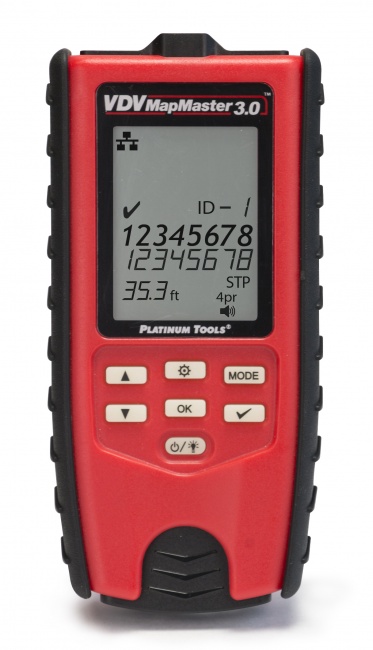
The VDV MapMaster 3.0 catches the wiremap-related causes of cables that work-but-fail, including split pairs that do not show on basic LED testers.
Network qualification tester
Reports pass or fail at the application level rather than against the parametric standard, which is exactly the gap this article is about: the cable fails cert and the network works anyway. CableTestShop does not list a qualifier; a throughput result on a specific job is a rent-or-subcontract step.
Cable certifier
For commercial work where cert is required, a full certifier is the only acceptable tool. Browse cable certifiers for the right unit for your work.
Frequently Asked Questions
Can a cable fail cert but still work for traffic?
Yes, frequently. Network protocols include error correction and adaptive modulation that compensate for marginal cable. The cable is operating outside its design margin, however, which means it may fail under future load or environmental changes.
Should I leave a cable that fails cert but passes traffic?
Generally no. Failed cert means the cable does not meet the standard. Even if it works today, there is no assurance it will work later. Re-terminate to fix, or document that the customer accepts a sub-spec installation.
Why does a working network suddenly fail later?
Cables on marginal cert results often fail when conditions change: temperature, adjacent cable load, equipment upgrades, connector aging. A cable with no certification headroom has no buffer for these inevitable changes.
What does it mean when wiremap fails but link is up?
Most commonly, only some pairs are functional. 10/100 Mbps uses only two pairs, so a cable with broken pairs can carry 100 Mbps traffic while failing wiremap. Verify the link speed -- it is probably running at 100 Mbps instead of Gigabit.
Stop Shipping Cables That Almost Work
Wiremap, qualification, and certification tools that catch failures before they become callbacks.