SDI Is Out, IP Is In
The broadcast industry has spent the last decade migrating from baseband SDI video and AES audio over coax and 110-ohm twisted pair to packetized video and audio over IP networks. SMPTE ST 2110 is the dominant standard for uncompressed video over IP. AES67 is the audio counterpart. PTP (IEEE 1588) synchronizes the network so video, audio, and timing align at sub-microsecond precision.
For the cable plant, this means three big shifts:
- Bandwidth. A single uncompressed 1080p59.94 video stream is roughly 3 Gbps. UHD 4K is 12 Gbps. A full studio fabric needs 25G or 100G aggregation. Copper is no longer the medium for primary signal paths.
- Synchronization. PTP requires every device to be on the same timing tree. Network jitter and asymmetric delay become certification concerns that did not exist on SDI.
- Documentation. Broadcast engineers expect IT-grade cable certification deliverables (TIA reports, fiber loss budgets, end-face inspection records) plus broadcast-specific records (PTP topology, latency budgets, signal flow diagrams).
The Modern Broadcast Cable Plant
A new IP broadcast facility has four parallel cable systems running through it. Each has its own test scope.
| System | Carries | Medium | Test Scope |
|---|---|---|---|
| IP Media Fabric | SMPTE 2110 video, AES67 audio | OM4/OS2 fiber, Cat8 short copper | OLTS + OTDR + end-face |
| Control Plane | NMOS, monitoring, KVM | Cat6A copper | TIA-568.2-D permanent link |
| PTP Sync Network | IEEE 1588 timing | Dedicated Cat6A or fiber | TIA cert + asymmetry test |
| Studio Talkback / IFB | Intercom, IFB feeds | Cat6A copper | TIA cert + PoE class |
| Legacy SDI (where present) | Baseband video | RG-6/RG-11 coax | Return loss + length |
Most new builds in 2026 are pure IP with legacy SDI gone or limited to a few interoperability paths. Renovations may carry both for years.
Fiber Certification for Broadcast IP Media
Broadcast IP media networks are predominantly fiber. Multimode OM4 covers most intra-facility runs, with OS2 single-mode for inter-building or longer remote camera runs. Both require tier-1 and tier-2 testing.
Tier 1: Optical Loss Test Set (OLTS)
The OLTS measures end-to-end insertion loss at the wavelengths the application uses (850/1300 nm for OM4, 1310/1550 nm for OS2). The result is a loss number per link compared against the loss budget calculated from connector count, splice count, and cable length. Tier 1 produces the contractual acceptance number.
Tier 2: OTDR
The OTDR (Optical Time Domain Reflectometer) characterizes the link event by event: each connector loss, each splice loss, each bend or stress point along the fiber. Tier 2 is the diagnostic record. When a link develops trouble in service two years from now, the original OTDR trace tells you what changed.
End-Face Inspection
For 25G/100G applications, mandatory before every mate. A fiberscope (typically 200x or 400x) inspects the polished end face for scratches, pits, and contamination. IEC 61300-3-35 defines the pass/fail zones. A contaminated end face will introduce loss that destroys the budget.
Copper Certification for Control and Sync
Even in an all-IP studio, copper carries the control plane, KVM, intercom, and many PTP timing endpoints. Copper certification follows the same rules as a data center plant.
- Cat6A minimum for new installs
- TIA-568.2-D permanent link as the contractual deliverable
- MPTL test limit for cables that terminate directly into a transceiver or device plug
- PoE class verification for any cable powering an intercom panel, monitor, or wall-mounted controller
For pre-cert qualification of installed copper runs, a gigabit speed qualifier validates throughput and reports PoE presence in one test. We do not currently list one, so that step is a rental or subcontract. For cable identification across studio and control room patch fields, the VDV MapMaster 3.0 with multiple remotes streamlines verification.
PTP and Network Asymmetry
PTP synchronizes broadcast devices by exchanging timestamped messages and assuming the path delay is symmetric in both directions. When the cable plant introduces asymmetric delay (different distance, different transceiver type, different switch path going one way vs the other), PTP accuracy degrades.
Cable certification cannot directly measure PTP performance, but it can prevent the obvious sources of asymmetry:
- Matched cable lengths within a sync domain. Document the length of every PTP-bearing link. Designers compensate in software when lengths differ.
- No cable shortcuts. Pull every PTP cable through the planned pathway, not the shortest physical route. Asymmetry comes from the difference between modeled and actual path length.
- No bend-induced loss imbalance. Tight bends in fiber introduce direction-dependent loss. The certification process catches this on the OTDR trace.
Documentation Broadcast Engineers Want
Broadcast engineers come from a video engineering tradition that values traceable signal paths and consistent documentation. The cable certification deliverable for a broadcast facility looks different from a generic IT cert deliverable.
- Signal flow diagram. Source devices, switches, destination devices, and the specific cable IDs used for each path. Living document maintained alongside the cert package.
- Patch field map. Each patch panel rendered as a grid with port numbers, cable IDs, and signal types. The broadcast engineer uses this to plan changes without going to the field.
- Loss budget table. For fiber links, the calculated budget vs the measured loss for every link, with margin highlighted.
- End-face inspection log. Pass/fail and a captured image for every fiber connector at acceptance.
- Grounding test results. Single-point ground continuity for every rack and equipment frame.
Refer to our guide to network certification test reports and cable tester vs certifier comparison for foundational concepts.
Test Tools for Broadcast Cable Verification
A broadcast cable test kit covers fiber and copper plus the workflow tools that make a dense studio install manageable.
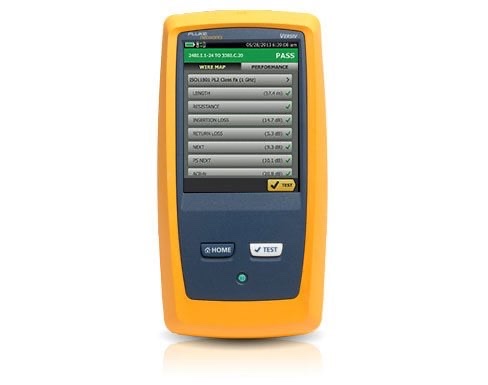
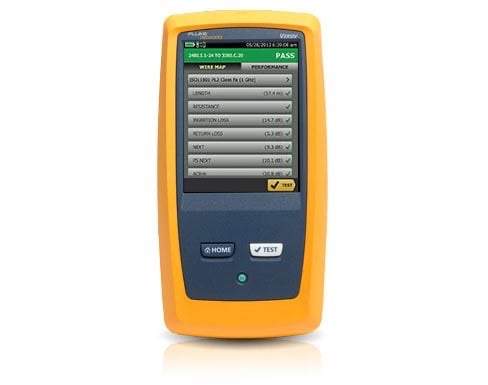
- Cat6A/Cat8 certifier (Fluke DSX, Softing WireXpert)
- OLTS and OTDR for fiber tier-1 and tier-2 testing
- Fiberscope for end-face inspection
- A rented qualifier for copper gigabit throughput validation
- VDV MapMaster 3.0 for cable ID and verification across the patch field
- LanSeeker for switch port verification at the IDF without CLI access
- Digital Tone & Probe for tracing through multi-conduit pathways and overhead trays
Frequently Asked Questions
What cable category is required for SMPTE 2110 broadcast IP networks?
SMPTE ST 2110 carries uncompressed video over IP at bandwidths that demand 25 GbE or higher. That means top-of-rack to camera or switch links are typically OM4 multimode fiber or single-mode fiber, not copper. Copper is used for control plane (PTP, monitoring, KVM) and shorter device-to-device links.
Do broadcast cable certifications include latency measurements?
Standard TIA-568.2-D copper certification does not measure latency, but propagation delay and delay skew are part of the parameter set. For PTP-synchronized broadcast networks, additional one-way delay measurements with calibrated equipment may be required as part of network commissioning.
How do you test fiber for broadcast IP video applications?
Fiber for broadcast SMPTE 2110 networks is tested with both a tier-1 OLTS (optical loss test set) for insertion loss and a tier-2 OTDR for event-by-event characterization. End-face inspection with a fiberscope is mandatory before every connection.
What labeling scheme is used in broadcast studios?
Broadcast studios use a position-based scheme keyed to studio, position, and signal type. A typical format is STUDIO-POSITION-SIGNAL-INSTANCE, for example STA-CAM03-VID-A. Cable certification reports must use the same scheme as the as-built drawings and patch field labels.
How is grounding tested in a broadcast facility cable plant?
Broadcast facilities require single-point grounding of the technical infrastructure. The grounding system is tested with a low-resistance ohmmeter (typically requiring less than 0.1 ohm to the technical ground bus from any rack ground point) and a clamp-on ground resistance tester for the building ground bond.
Tools for Broadcast Cable Verification
From copper qualification to cable identification across complex studio patch fields, equip your broadcast install team with the right tools.