Quick Recommendations
For TDR on active networks: nothing current at a contractor price. The Platinum Tools Net Prowler filled this slot and the manufacturer has discontinued it; CableTestShop does not list a replacement.
Best dedicated TDR: Megger CFL535G ($2,500-$3,500). For power cable, coax broadcast, and underground locating where structured-cable TDRs run out of range.
What a TDR Actually Does
Time Domain Reflectometry is older than the internet — it was used to find faults in transatlantic telegraph cables in the 1850s. The principle is the same today. The tester sends a fast electrical pulse down the cable. Whenever the pulse hits an impedance change, part of the energy reflects back. The tester times the round trip and converts time into distance using the cable's nominal velocity of propagation (NVP).
Different impedance changes produce different reflections:
- Open circuit reflects positive — large bump in the trace. The cable is cut or disconnected.
- Short circuit reflects negative — large dip. The conductors are touching each other or shield.
- Connector or splice reflects small positive — minor bump. Normal but locatable.
- Sharp bend or kink reflects small bump or dip depending on geometry.
For structured cabling work, you don't need to read the trace. Modern testers parse it for you and just display "Open on pair 1-2 at 47 ft." That's the magic.
Comparison Table: TDR Tools by Use Case
| Tool | Price | Best For | Standout Feature |
|---|---|---|---|
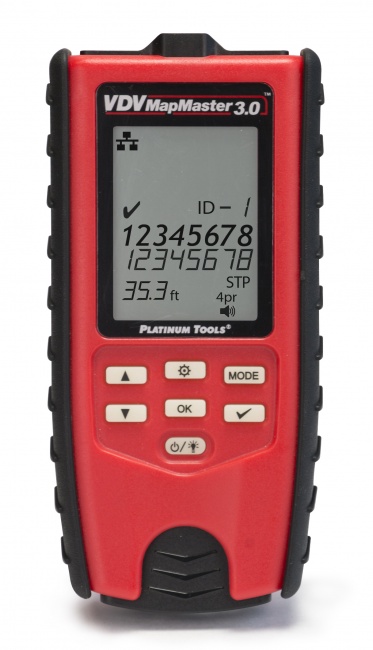
| VDV MapMaster 3.0 | $168.14 | Structured cabling techs | TDR + wiremap + numbered ID remotes |
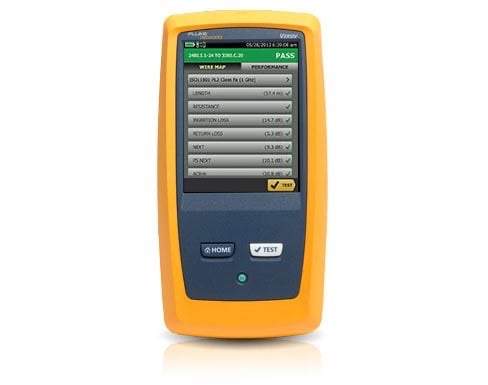
| Fluke MicroScanner PoE | $500 | Fluke shops | TDR + IntelliTone + PoE |
| Megger CFL535G | $2,500-$3,500 | Power and broadcast cable | 4 km range, high-energy pulses |
| AEMC CA7028 | $3,000-$4,000 | Underground cable locating | Combined TDR + locator |
Best TDR for Structured Cabling: Platinum Tools VDV MapMaster 3.0
For 90% of low-voltage and IT contractors, the VDV MapMaster 3.0 at $168.14 is the right TDR. It tests Cat5e, Cat6, and Cat6A copper cabling, identifies opens and shorts by pin and distance, measures cable length with NVP calibration, and includes numbered ID remotes for cable identification on multi-drop installs.
Why it's the value pick
Distance-to-fault is the killer feature. When a cable fails, the MapMaster doesn't just say "fail" — it says "open on pair 4-5 at 31 feet." On a 50-foot run from the patch panel to a wall jack, you walk to the 31-foot mark and find the staple driven through the cable, the bent corner where the drywaller smashed it, or the damaged termination at a previous interim splice.
Without TDR, that troubleshooting takes hours. With it, you find the fault in a minute and bill for the fix. The tester pays for itself on the first wall demo it saves you.
For a deeper look at how distance-to-fault changes the troubleshooting workflow, see our guide on cable tester vs. certifier.
TDR Plus Active Networks: The Platinum Tools Net Prowler, and What Happened to It
When TDR work overlaps with active network troubleshooting, the Net Prowler was the step up most contractors took. Platinum Tools has discontinued it and CableTestShop does not list a replacement, so read this as the capability line rather than a buying recommendation. Over the MapMaster it added:
- PoE detection and voltage measurement on each pair
- Link speed verification (10/100/1000)
- DHCP and DNS verification
- Internet connectivity check
- Color screen with stored test results
That combination suits IT shops, MSPs, and contractors whose customers don't separate "the cable is bad" from "the network isn't working." Plug into the wall jack, run one test, and you know whether the problem is the cable, the switch port, the PoE budget, or the network configuration.
When You Need a Dedicated TDR
Cable-tester-with-TDR products like the MapMaster max out around 1,500 feet of CAT cable and don't work on shielded, coaxial, or power conductors. For specialty work, you need a dedicated TDR.
Megger CFL535G ($2,500-$3,500)
The pick for utility work, broadcast coax, and any twisted-pair fault location beyond 1,500 feet. 4 km range, high-energy pulses that propagate through low-quality jacketing, and a graphical trace display that lets you read complex faults the auto-decoders can't handle. If you locate faults on outside-plant copper or broadcast distribution, this is the tool.
AEMC CA7028 / Riser Bond models ($3,000-$4,500)
Combined TDR + cable locating units used by utility crews to find buried cables and locate faults in underground runs. Overkill for a structured-cabling contractor; essential for a utility tech.
Tektronix lab-grade TDRs ($8,000-$25,000)
Used in cable manufacturing QA, RF system commissioning, and signal integrity engineering. Resolution down to inches. Not a field tool.
NVP Calibration: Why Your Length Reading Might Be Off
Every TDR uses Nominal Velocity of Propagation to convert reflection time to distance. NVP varies by cable construction — typical Cat6 is around 0.69, but specific brands range from 0.65 to 0.72.
If your TDR is set to a default NVP and you're testing a cable with a different actual NVP, your length readings will be off by the same percentage. A 100-foot cable might read 95 feet or 105 feet depending on the cable.
How to calibrate: take a known-length spool of the cable you typically install (a fresh box has the length stamped on the carton). Measure that cable with the tester, adjust NVP up or down until the displayed length matches the actual length. Save that NVP value as the default for that cable type. Now your distance-to-fault readings are accurate to within 1%.
The MapMaster 3.0 lets you save multiple NVP profiles per cable type. Use this feature.
What CableTestShop Carries
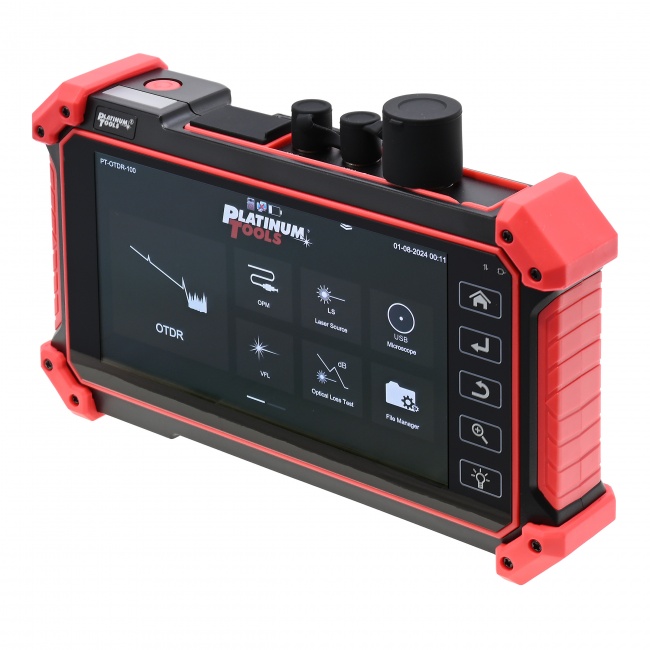
Distance-to-fault is built into our cable testers, and the PT-OTDR-100 covers both copper TDR and fiber in one instrument. Certification-grade instruments are quote-only. We do not sell a network analyzer or a bundled kit, so a TDR paired with PoE and link diagnostics is a purchase you will make elsewhere.
What to Avoid
"TDR" features on $30 testers
The cheap multifunction Chinese testers claim TDR but use simple capacitance measurement instead. Capacitance gives you a length but won't pinpoint a fault — it just gives you "this cable is somewhere between 0 and 200 feet." Real TDR uses pulse reflection.
Untrusted NVP defaults
If your tester reports lengths that are consistently 5-10% off from the actual run, it's an NVP problem, not a tester problem. Calibrate before deciding the tester is broken.
TDRs without distance-to-fault interpretation
Lab-grade TDRs show you the raw reflection trace and expect you to read it. For field work, you want a tester that interprets the trace and tells you "open at 47 feet" — that's all the contractor models. Buy interpretive, not raw.
Frequently Asked Questions
What is a TDR and how is it different from a regular cable tester?
A TDR sends a pulse down the cable and measures reflections to locate faults by distance. A regular continuity tester just tells you whether a cable is connected. A TDR tells you "the cable is open at 73.5 feet."
How accurate is a TDR for finding cable faults?
Modern TDR-based testers locate faults to within 1-3% of cable length on copper structured cabling — about 1 foot for a 100-foot run. Accuracy depends on calibrating NVP for your specific cable type.
Do I need a dedicated TDR or is a cable tester with TDR enough?
For most contractors, a cable tester with built-in TDR is plenty. The MapMaster 3.0 at $168.14 includes TDR-based length and fault location. Dedicated TDRs are needed for power cable, coax broadcast, and underground locating.
Can a TDR find a break inside a wall?
Yes — that's exactly what TDR does best. The reading "open at 47 feet" tells you to walk 47 feet from the tester end and find the fault. Typically a staple, a bend, or damage from another trade.
Find Your TDR Tester
From $150 handhelds to dedicated 4 km TDRs. Free shipping on orders of $100 or more.