Quick Recommendations
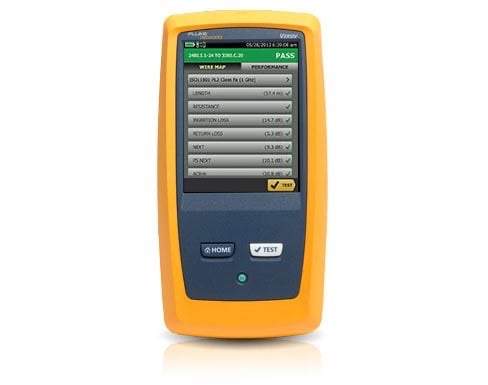
Best load tester: Fluke MicroScanner PoE. Draws actual current to verify sustained delivery under load.
If all you need is the reading: a pocket PoE tester that does nothing but negotiate with the port and report class, voltage, wattage, and powered pairs is the cheapest way to stop guessing on a camera drop. We do not list one, so that tier is a purchase from another supplier.
Why IP Camera PoE Is Different
Most PoE devices are simple: a phone, a basic AP, a small access controller. They draw a few watts and never push the budget. IP cameras are not most devices. A modern IP camera can need:
- Sustained 5-15W for the imager and processor
- Bursting to 25-30W when IR illuminators kick on at night
- Bursting to 50-60W when integrated heaters cycle in cold weather
- PTZ peak draw when motors move (often the highest single peak)
A camera that runs fine in benchtop testing may reboot at 2 AM when the heater cycles, the IR is on, and the PTZ is panning — drawing more than the switch port's actual deliverable wattage at that moment, hitting the camera at end-of-cable voltage that's lower still.
Your PoE tester's job isn't just "is there power?" It's "is there enough power, sustained, with margin, at the far end of this cable?"
Comparison Table: Best PoE Testers for IP Camera Installers
| Tester | Best For | Standout Feature |
|---|---|---|
| Fluke MicroScanner PoE | Sustained-load verification | Draws real current under load |
| Fluke LinkIQ | Multi-camera install troubleshooting | LLDP/CDP shows switch's PoE config |
| NetAlly LinkRunner AT 4000 | Premium security integrators | Full PoE + active link verification |
Best for Sustained-Load Testing: Fluke MicroScanner PoE
The Fluke MicroScanner PoE earns its premium with one feature most PoE testers don't have: a real load. It can draw actual current at the negotiated wattage and verify the switch maintains the voltage under sustained load.
When this matters for cameras
The diagnostic case: a 4K PTZ camera with heater on a 250-foot run, intermittently rebooting in cold weather. A detection-only tester reads "PoE+ class 4, 30W advertised" — looks fine. The MicroScanner PoE drawing actual 30W reveals the voltage at the camera end is 42V instead of the expected 50V — out of spec, exactly the cause of the reboots. Cable resistance over the long run plus a slightly underspec switch power supply.
You won't need it on every install. You will be glad you have it on the troubleshooting calls.
Best for Switch-Side Diagnostics: Fluke LinkIQ
For larger installs — multiple cameras on a single PoE switch, a budget that's getting tight, or chronic intermittent problems across multiple devices — the Fluke LinkIQ ($1,200) is the right step up. The killer feature is LLDP and CDP support, which means the tester talks to the switch and asks "what's your PoE budget, what's allocated, what's available, what's this port's class configuration?"
That answer tells you whether the switch is correctly provisioned before you start chasing cable issues. For the head-to-head with the NetAlly competitor, see our LinkIQ vs. LinkRunner comparison.
Best for Premium Security Integrators: NetAlly LinkRunner AT 4000
Large-scale security integrators commissioning hundreds of cameras across a campus need the deepest tester in the handheld category. The NetAlly LinkRunner AT 4000 ($2,000-$3,000) adds:
- Active iPerf3 throughput testing alongside PoE verification
- VLAN-aware testing for camera VLANs separated from data
- Cloud reporting via Link-Live for fleet-wide commissioning records
- 10G link testing for high-resolution camera aggregation switches
For a single-truck operator, this is too much tester. For an integrator with a fleet of trucks doing enterprise security work, it's the right standardization.
Common PoE Camera Problems and What Catches Them
| Problem | Symptom | Tester That Finds It |
|---|---|---|
| Switch port misconfigured (af instead of at) | Camera boots, runs short on IR/heater | Any PoE tester that reports class |
| Switch PoE budget exhausted | Camera negotiates lower wattage | LinkIQ (shows switch budget) |
| Bad termination, voltage sag | Random reboots under peak load | MicroScanner PoE (draws load) |
| Cable too long for wattage | Camera works in summer, not winter | Any tester that reads length and PoE |
| Split pair on Cat5e/6 | Camera flickers, drops connection | Any qualification tester |
What CableTestShop Carries
We do not sell a PoE tester, a network analyzer, or a bundled kit. What we list for camera work is the cable side: see our cable testers for wiremap, length, and distance to fault, and our tone generators for finding the run in the first place. The PoE instrument itself you will buy from a supplier who stocks one.
For a deeper PoE primer, read our best PoE testers of 2026 and how to test PoE guides.
What to Avoid
Generic "PoE injectors with LCD" sold as testers
The cheap units that look like PoE injectors with a small LCD aren't testers — they're injectors with a voltmeter. They show you what they're putting out, not what the switch is delivering. Buy a purpose-built PoE tester.
PoE testers that don't support 802.3bt
PoE++ (802.3bt) is increasingly the default for modern outdoor cameras with heaters and IR. Any tester you buy in 2026 should support bt Type 3 and Type 4 up to 90W. Older detect-only testers that max at 802.3at miss the upper half of the modern PoE deployment.
Multimeter-only PoE checks
Reading PoE voltage with a multimeter "works" but doesn't tell you the class, doesn't load the source, and doesn't verify the standard. Use a PoE-specific tester.
Frequently Asked Questions
What's the best PoE tester for IP camera installs?
For most camera installers, a dedicated pocket PoE tester covers the job: it reads class, voltage, wattage, and powered pairs at the camera end, which is where the answer is. For shops also doing their own cabling, a combined unit that adds wiremap and length saves a second trip to the truck. We list neither, so both are a purchase from another supplier.
Do I need a load tester or just a PoE detector?
A detector confirms the switch is providing power. A load tester (like the Fluke MicroScanner PoE) draws actual current and verifies sustained delivery. For high-wattage cameras with heaters or PTZ, load testing catches problems detection misses.
Why does my PoE camera randomly reboot?
Common causes: wrong PoE class on the switch port, exhausted switch PoE budget, bad termination causing voltage drop, or cable too long for the wattage. A PoE tester at the camera end isolates the problem.
What's the difference between PoE, PoE+, and PoE++?
PoE (802.3af) delivers up to 15.4W. PoE+ (802.3at) delivers up to 30W. PoE++ (802.3bt) delivers up to 60W (Type 3) or 90W (Type 4). Modern outdoor cameras with heaters often need PoE++.
Equip Your Camera Install Truck
We do not sell a PoE tester. The units above are covered on their merits and you will buy them elsewhere. What we sell for a camera install is the cable proof: wiremap, continuity, length, and distance to fault. Free shipping on orders of $100 or more.