The Premise: Fluke Is Not the Only Option
Fluke earned its reputation. Their cable testers are accurate, well-supported, and produce documentation accepted everywhere. But "Fluke or nothing" is a habit, not a fact. Several manufacturers produce testers that compete directly with specific Fluke models -- sometimes at lower price, sometimes with workflow advantages, sometimes with feature sets Fluke does not offer.
The right way to think about it is by tier and use case. At the certification tier, Softing WireXpert is a peer competitor to Fluke DSX. At the qualification tier, gigabit BERT is available at a fraction of certification cost, though the Platinum Tools unit that anchored this tier has been discontinued. At the network analysis tier, NetAlly's LinkRunner family goes deeper into network-side diagnostics than Fluke's offerings. Below the professional tier, NOYAFA and others provide functional verification testers at consumer prices.
This guide walks the alternatives by tier, so you can match the tool to the job without paying for capability you do not need.
Top Picks by Tier
Qualifier tier: no current alternative we stock -- gigabit BERT, full wiremap, TDR length and PoE detection are a rental line item right now.
Best network analyzer alternative: NetAlly LinkRunner 10G / AT 4000 -- Deeper network diagnostics than Fluke LinkIQ, Android-based interface, 10G validation.
Best multi-cable verifier alternative: Platinum Tools VDV MapMaster 3.0 -- Data, voice, coax, with cable mapping and tone, at a fraction of comparable Fluke verifier pricing.
Fluke Models and Their Closest Alternatives
Match Fluke models to their closest functional competitors at each tier.
| Fluke Model | Tier | Closest Alternative | Why Consider Alternative |
|---|---|---|---|
| DSX2-5000 / DSX-8000 | Certifier | Softing WireXpert 500/4500 | Lower price for similar Cat6A/Cat8 capability, accepted by major warranty programs |
| LinkIQ | Network analyzer | NetAlly LinkRunner AT/10G | Deeper VLAN/DHCP/CDP discovery, 10G validation |
| MicroScanner Cable Verifier | Verifier | Platinum Tools VDV MapMaster 3.0 | Multi-cable types, more remotes, lower cost |
| CableIQ Qualification Tester | Qualifier | No current alternative | The Platinum Tools qualifier that filled this tier is discontinued |
| CertiFiber Pro | Fiber certifier | Softing WireXpert OLTS module / EXFO MaxTester | Direct OLTS competition, comparable accuracy |
| OptiFiber Pro | OTDR | EXFO MaxTester / AFL FlexScan | Comparable performance, often lower price |
| IntelliTone Pro | Tone generator | Digital Tone Probe | Strong digital tone immune to PoE, lower cost |
| MicroScanner PoE | PoE + verifier | Klein Scout Pro 3 PoE | Multi-cable type; the full-BERT alternative is discontinued |
Certifier Tier: Softing WireXpert
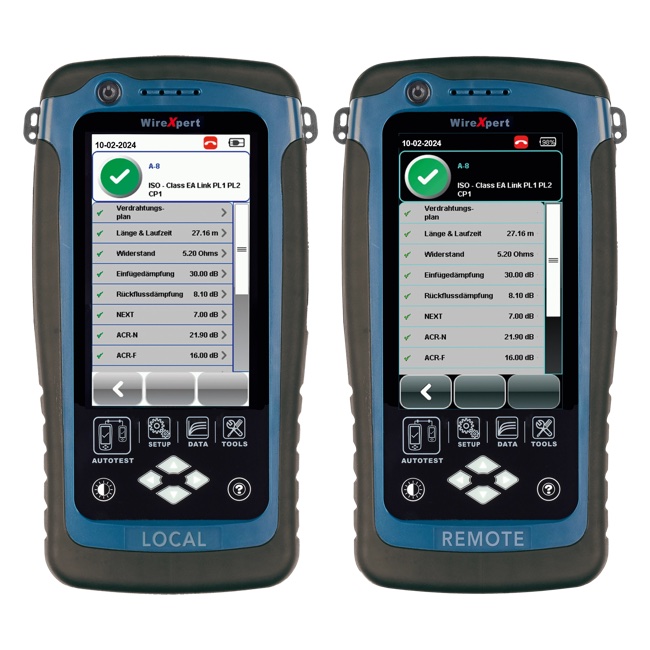
For TIA-568 certification work -- the formal cable testing that produces warranty-grade reports for installed structured cabling -- the Softing WireXpert is the most credible alternative to Fluke DSX. WireXpert tests Cat5e through Cat8, performs alien crosstalk on Cat6A and above, supports MPTL (modular plug terminated link) testing, and is on the approved tester list for major cable manufacturers' extended warranty programs.
The differences from DSX are workflow-oriented. WireXpert uses a tablet-style touch interface that some installers prefer for its modern UI; the DSX uses physical buttons and a smaller display that others prefer for ruggedness. Reports come out of Softing's eXport software, which is competent but unfamiliar to long-time LinkWare users. Test times are comparable. Battery life is comparable. Calibration intervals are comparable.
The two reasons to pick WireXpert over DSX: lower acquisition cost for equivalent Cat6A/Cat8 certification capability, and a touch UI for crews who find tablet interaction faster than button navigation. The two reasons to stick with DSX: existing LinkWare report archives that you do not want to migrate, and shop standardization with subcontractors who use Fluke.
For a deeper head-to-head, see our Fluke DSX vs Softing WireXpert comparison.
Qualifier Tier: The Gap in Every Catalog Including Ours
Qualification testing means proving the cable will support the intended Ethernet speed without going to full certification. A qualifier delivers gigabit BERT (bit-error-rate testing) at 10/100/1000 Mbps, full wiremap with split-pair detection, TDR cable length, distance to fault, and PoE detection. It is the tier most contractors actually need and the tier hardest to buy right now.
The BERT result -- a measured count of bit errors at line rate -- is the gold standard for proving a cable will run gigabit reliably, and it costs a fraction of what full parameter certification costs whichever way you get it. CableTestShop does not currently stock a qualifier: the Platinum Tools Net Chaser that filled this tier has been discontinued by the manufacturer and is not orderable at any price. For commercial installers who deliver gigabit drops and need more proof than continuity, budget this as a rental or a subcontracted test until the tier restocks.
For more on choosing between qualifier and certifier, read our Cable Tester vs Certifier guide.
Network Analyzer Tier: NetAlly LinkRunner
For network-side diagnostics -- speed validation, VLAN discovery, DHCP analysis, switch port identification -- the NetAlly LinkRunner family (LinkRunner AT, LinkRunner G2, LinkRunner 10G) is generally regarded as deeper than Fluke's network analyzers in the same price tier. NetAlly was spun out of Fluke Networks and inherited the network analysis IP, then continued to develop it independently.
What you get over a Fluke LinkIQ: Android-based interface, deeper VLAN and CDP/LLDP neighbor discovery, network path tracing, more granular DHCP analysis, and 10G speed validation on the LinkRunner 10G. What you give up: the LinkIQ does cable performance testing (frequency response up to 500 MHz) that the LinkRunner does not -- so for installers who want cable and network in one tool, the LinkIQ is still the better fit.
The choice is workflow-driven: if you spend most of your day diagnosing network connectivity issues at client sites, NetAlly is deeper. If you split time between cable testing and network validation in one tool, Fluke LinkIQ has a feature combination NetAlly does not match.
Our full Fluke LinkIQ vs NetAlly LinkRunner 10G head-to-head goes deeper.
Verifier Tier: Platinum Tools VDV MapMaster 3.0
For basic verification -- continuity, wiremap, length, cable identification on multi-cable installations -- the Platinum Tools VDV MapMaster 3.0 is the strongest alternative to the Fluke MicroScanner family. It tests data, voice, and coax (Fluke verifiers split this across multiple models), supports numbered ID remotes for cable mapping, includes TDR length and distance to fault, and runs ~$330 in kit form.
The MapMaster does not produce certification reports -- neither does the Fluke MicroScanner. Both are verification tools. The MapMaster simply offers more cable types and more cable mapping capacity at a lower price point. For low-voltage installers in residential and light commercial work, this is the daily-driver tool.
Tone Generator Tier: Digital Probes
For cable tracing in noisy environments -- around live PoE, fluorescent ballasts, motor controllers -- digital tone generators are dramatically more reliable than analog tone. Fluke's IntelliTone uses a digital signal that filters out interference. The same approach is available from other manufacturers at lower price points.
Our Digital Tone Probe uses digital signaling to maintain signal lock through PoE, fluorescent noise, and dense cable bundles where analog tone fails. For shops that already own Fluke verifiers and just want better cable tracing without the IntelliTone price, this is a direct functional alternative.
For more on tone tracing, see our Tone Generator Guide.
Budget Tier: NOYAFA and Generic Brands
Below the professional tier sit testers from NOYAFA, Lanseeker, and similar brands that retail at consumer prices. These are not competitive with Fluke at the certification or warranty-grade qualification level -- their accuracy and documentation are not designed for it. But for verification (continuity, wiremap, basic length), they work fine.
The honest assessment: a $50-$120 NOYAFA tester verifies a cable terminates correctly. It does not certify. It does not produce defensible documentation. It does not match Fluke build quality. But for a homeowner, a hobbyist, an apprentice learning the trade, or a professional buying a backup tester, it serves the purpose. Know what you are buying.
When Fluke Is Still the Right Answer
This guide is about alternatives, but it would be dishonest not to acknowledge where Fluke remains the best choice.
Existing Fluke ecosystem. If your shop already runs DSX certifiers, OptiFiber Pro OTDRs, and LinkWare report archives, the cost of switching is high. Standardize on what you have.
Subcontractor compatibility. If you frequently subcontract cable testing or work alongside crews who use Fluke, sharing the same brand simplifies report consolidation and crew interchangeability.
Specific Fluke-only features. Some Fluke models include capabilities (specific OTDR features, IntelliTone digital cable ID, certain reporting formats) that competitors do not match feature-for-feature. If a particular Fluke capability is core to your workflow, no alternative will fully replace it.
Resale value. Fluke equipment retains used value better than alternatives. If you frequently rotate or sell test equipment, the resale curve helps offset the higher initial cost.
Verifying Approved Tester Status for Warranty Programs
Before buying a Fluke alternative for warranty-grade certification work, confirm the specific model is on the cable manufacturer's current approved tester list. This is the single most important verification step -- and the one most often skipped.
Where to find the approved lists
Major cable manufacturers publish approved tester lists on their warranty program pages. Panduit, CommScope (SYSTIMAX, Uniprise), Belden, Hubbell, Siemon, and Leviton all maintain current lists with the specific certifier model numbers and required adapter sets. The lists update periodically as new testers are evaluated and older models phase out.
What to verify on the list
Three things: the specific tester model number (DSX-8000 vs DSX-602 are different; WireXpert 4500 vs WireXpert 500 are different), the required test adapters or accessories (some warranty programs require specific link adapters), and the report format requirements (some programs accept LinkWare native, eXport native, or specific export formats).
What if the tester is on the list but the firmware is old?
Some cable manufacturer warranty programs require minimum firmware versions on the certifier. An approved tester running outdated firmware may not produce reports the warranty program will accept. Always update certifier firmware to the most recent stable release before starting a warranty-eligible project.
What if you have an older model not on the current list?
Older Fluke DTX, older WireXpert models, and older LANTEK models may have been removed from current approved lists as cable manufacturers update their programs. The tester still works for verification and customer-facing certification, but reports may not satisfy current warranty programs. Confirm with the cable manufacturer before assuming continued acceptance.
Migrating From Fluke to an Alternative
If you decide an alternative makes sense for your shop, the migration is not always one-and-done. Here is what experienced shops report about transitioning -- the realistic friction points, not the marketing version.
Historical reports stay where they are
Do not try to migrate years of LinkWare reports into eXport or other software. Keep LinkWare PC installed on a workstation for legacy report access. Start the new software with new projects only. The cost of trying to convert old reports exceeds the value of consolidating archives.
Run parallel for the first project
Take both old and new testers to the first project on the new platform. Run a few cables on each, compare results, get the team comfortable. The point is not to verify accuracy (both tools certify accurately) -- it is to give crews confidence in the new workflow before fully committing.
Train on reporting, not testing
Crews pick up new tester operation in a day. The reporting software is where the friction lives. Schedule a half-day training session focused on the project setup, result organization, and report generation workflow. This is where productivity gains or losses actually accumulate.
Update your subcontractor coordination
If you frequently subcontract test work or hire test crews, communicate the new platform clearly. Subcontractors often have a brand preference and may need accessory loans or report format coordination. Address this upfront, not at job handover.
Replace, do not retire, the Fluke
Keep the old Fluke as a backup tester for the first six months on the new platform. If the new tester goes in for calibration or has an issue, you have continuity. After six months of confident use on the new platform, sell or repurpose the Fluke -- it has resale value, especially the DSX line.
Subcontractor and Multi-Crew Considerations
Tool brand decisions have ripple effects beyond your own crew. Subcontractor relationships, joint ventures, and multi-crew projects all benefit from brand consistency.
If you frequently subcontract test work
The subcontractor's reports come out of their certifier brand's software. If they use Fluke and you use Softing, consolidating the project handover documentation requires extra work -- exporting from one platform, importing to the other, reconciling formatting differences. For shops that subcontract regularly, matching the most common subcontractor brand simplifies operations.
If you serve as a subcontractor
The general contractor who hires you may specify the certifier brand. Read the contract carefully. Some specifications call out specific brands (Fluke is most common), and using a different brand can void the warranty program eligibility regardless of accuracy.
Multi-crew projects
When multiple crews work on a single project, brand consistency simplifies result aggregation. All reports come out of one software platform with one format and one project structure. Mixing brands across crews on the same project is workable but adds friction at every report milestone.
Project manager preferences
The person who reviews and submits reports has preferences. Long-time LinkWare users find eXport workflow unfamiliar; long-time eXport users find LinkWare verbose. The PM's preference matters because they spend more time in the reporting software than the field crew does.
Common Mistakes When Buying a Fluke Alternative
Every season we see the same mistakes. Avoid these and you will get the right tool for your work.
Buying a verifier expecting it to certify
The most expensive mistake. A qualifier is a genuinely useful instrument, but it does not produce TIA-568 certification reports. If your customer hands you a contract that requires "TIA-568 certification" or "Cat6A certification report," a qualifier is not enough -- regardless of brand or price. Read the spec before you buy or rent.
Optimizing on price over workflow fit
The lowest-priced alternative is not always the best alternative. A NOYAFA tester at $100 saves money relative to a Klein Scout Pro 3 at $200 -- until the NOYAFA breaks halfway through a project and you lose a day. For tools that work hard every day, build quality and accessory ecosystem matter as much as initial price.
Ignoring the calibration / accessory total cost
Acquisition cost is one input. Annual calibration, replacement test cords (the standard wear item), software subscriptions, and training time all add up over the tool's life. Ask the dealer for the typical annual ownership cost before committing.
Switching mid-project
Never introduce a new tester partway through a project. Reports come out of brand-specific software, and consolidating mid-project handover docs across two brands is a real headache. Finish projects on the platform you started.
A Decision Framework
Apply this five-question framework when evaluating any Fluke alternative. The answers either justify the alternative or send you back to Fluke.
1. What tier do I actually need? Verifier, qualifier, validator, certifier, network analyzer. Get this right first. Buying a verifier when you need a certifier is a costly mistake regardless of brand.
2. Is the alternative on my warranty programs' approved lists? If certification is in scope, this question is binary. Either the tester is approved or it is not. No-go if not.
3. Does my crew know the brand? Familiarity has real productivity value. New brands require training time. Factor this into the cost calculation.
4. What does the total ownership cost look like? Acquisition, calibration, accessories, software, training, end-of-life resale. Spread across the tool's expected life. Compare apples to apples.
5. What do my subcontractors and partners use? Cross-shop coordination is easier when brands match. Match the dominant brand in your network unless a clear advantage justifies departing.
Frequently Asked Questions
Are Fluke alternatives as accurate as Fluke?
At the professional tier (Softing for certification, NetAlly for analysis, Platinum Tools for verification/qualification), yes -- they meet the same TIA-1152-A and ISO standards and are accepted by the same warranty programs. Below the professional tier, no -- but those tools are not competing with Fluke certifiers anyway.
Why buy a Fluke alternative instead of Fluke?
Lower price for equivalent capability, better workflow fit (touch UI, Android, multi-cable types), or features Fluke does not match. The decision is rarely about whether Fluke is good -- it is whether the alternative fits your work better at a better price.
Will alternative testers' reports be accepted for warranty?
Yes, for testers on the cable manufacturer's approved list. Major manufacturers list Fluke DSX, Softing WireXpert, and others. Always verify the current approved-tester list before buying for a specific warranty program.
What is the closest alternative to Fluke DSX?
Softing WireXpert. It tests the same cable categories, produces TIA/ISO certification reports, supports the same warranty programs, and competes at lower price points. The differences are workflow (touch UI, Softing eXport software) rather than capability.
Is it OK to mix tester brands across one project?
For verification and qualification, yes. For certification, prefer one brand per project so reports come out of one software platform without consolidation overhead. Standardize on one certifier brand and use whatever verification tool is convenient otherwise.
Find Your Fluke Alternative
Verifiers, qualifiers, certifiers, network analyzers, and tone generators from Platinum Tools, NetAlly, Klein, Softing, and more. Expert support to match the tester to your work.