Quick Verdict
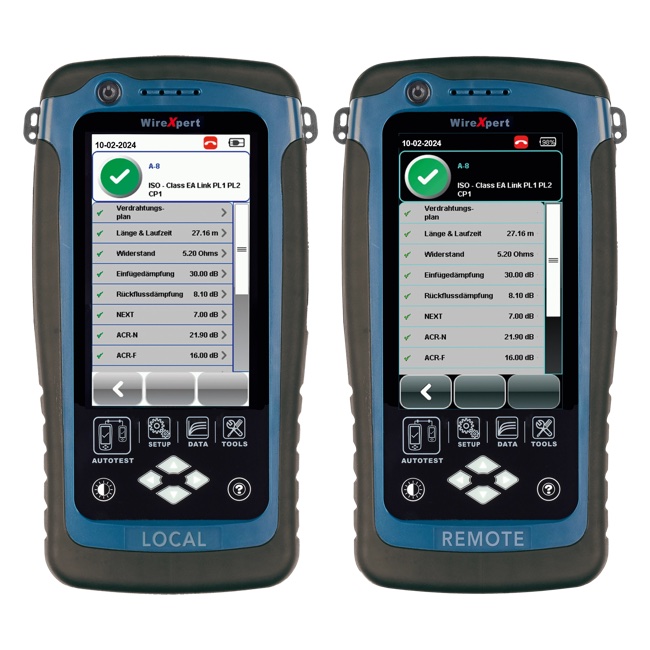
Pick Softing WireXpert if: You are starting fresh or adding capacity, want lower upfront cost for equivalent Cat6A/Cat8 capability, prefer a tablet-style touch interface, or value Softing's eXport software workflow.
Both are equally capable at certification accuracy for Cat5e through Cat8 and accepted by the major cable manufacturer warranty programs. The decision is workflow and ecosystem, not raw capability.
Side-by-Side Comparison
| Feature | Fluke DSX-8000 | Softing WireXpert 4500 |
|---|---|---|
| Top cable category | Cat8 / ISO Class II | Cat8 / ISO Class II |
| Frequency range | Up to 2000 MHz | Up to 2500 MHz |
| TIA Level accuracy | Level VI / IIIe (Cat8) | Level VI / IIIe (Cat8) |
| Cat6A certification | Yes | Yes |
| Alien crosstalk (Cat6A+) | Yes | Yes |
| MPTL support | Yes | Yes |
| Permanent link test time | ~8-12s (Cat6A) | ~10-15s (Cat6A) |
| Interface | Touch + buttons | Tablet-style touch |
| Display | 5.7" color | 5.7" color touch |
| Reporting software | LinkWare PC / Live | eXport PC |
| Cloud platform | LinkWare Live | eXport Cloud (limited) |
| Fiber capability | Modular (Versiv) | Modular (WireXpert) |
| Major warranty programs | All major (Panduit, CommScope, Belden, Hubbell, Siemon) | All major (Panduit, CommScope, Belden, Hubbell, Siemon) |
| Battery life | ~10 hrs typical | ~9 hrs typical |
| Calibration interval | Annual | Annual |
| Price tier | $$$$$ | $$$$ |
Certification Capability: Effectively Tied
The certification capability comparison is less interesting than people expect. Both testers measure the same TIA-568 and ISO 11801 parameters -- insertion loss, NEXT, PSNEXT, ACR-F, return loss, propagation delay, delay skew -- to the same Level VI accuracy required for Cat6A and Cat8 certification. Both produce reports accepted by the major cable manufacturers' extended warranty programs. Both perform alien crosstalk testing for Cat6A and Cat8. Both support MPTL for direct-attach scenarios.
The Softing WireXpert 4500 actually extends its measurement range to 2500 MHz versus the DSX-8000's 2000 MHz, providing some headroom for emerging post-Cat8 specifications. In practical Cat8 certification, this matters not at all -- both testers measure to and beyond the 2000 MHz Cat8 requirement.
Test times differ marginally: a DSX-8000 Cat6A permanent link test runs approximately 8-12 seconds; a WireXpert 4500 runs approximately 10-15 seconds. Multiplied across thousands of links, the DSX has a small throughput advantage. For most jobs, the difference is unnoticeable -- crews are limited by patching speed and travel between drops, not by tester computation.
What this means for the buying decision: do not pick based on certification specs. Both tools certify. Pick on workflow, software, and price.
Interface: Touch vs Hybrid
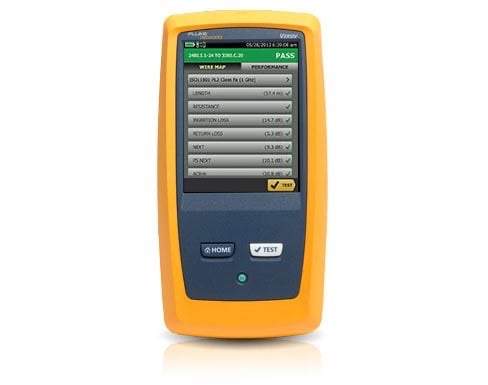
The Softing WireXpert uses a tablet-style touch interface with on-screen menus and touch-optimized result navigation. The Fluke DSX uses a hybrid: touch-capable display combined with hard buttons for primary navigation and test initiation. This is the most divisive workflow difference between the two platforms.
Touch advantages (WireXpert): Easier menu navigation for setup. More information visible at once. Familiar gesture controls (swipe, pinch-zoom on detail screens). Cleaner for review of saved results.
Hard-button advantages (DSX): Faster initiation under glove conditions. More reliable in cold or wet field environments. Tactile feedback for test start without looking at the display. Less risk of accidental touches in tight cabinet spaces.
Crews migrating from the older Fluke DTX or earlier DSX models prefer the button-based workflow because muscle memory transfers. Crews coming from tablet-driven workflows or those who prefer modern touch UI prefer the WireXpert. Neither is objectively better; both work well once familiar.
Reporting Software: LinkWare vs eXport
This is where the platforms genuinely diverge. The reporting software is what your customers, project managers, and warranty programs interact with. The differences matter.
Fluke LinkWare PC and LinkWare Live
LinkWare is the longest-tenured cable certification reporting platform on the market. LinkWare PC runs on Windows, organizes test results by project and customer, generates the standard PDF certification reports the industry expects, and exports to formats accepted by manufacturer warranty programs. LinkWare Live adds cloud sync: results upload from the DSX during the day, project managers see them centrally, and reports generate from any browser without local PC software.
The cloud workflow is the killer feature for shops with multiple crews and project managers who want real-time visibility into testing progress. LinkWare Live also handles asset and tester management, calibration tracking, and team-wide standards configuration.
Softing eXport
eXport is Softing's PC reporting software for the WireXpert. It produces the same TIA-568 and ISO 11801 standard reports, organizes by project, and exports to the formats warranty programs accept. The reports are cosmetically different from LinkWare but contain the same regulatory data. eXport is competent and clean, but lacks the equivalent of LinkWare Live's deep cloud-based project management.
For shops where the project manager opens a folder of test files and produces reports at handover, eXport is fully sufficient. For shops where multiple project managers want simultaneous, real-time visibility into testing across geographically distributed crews, LinkWare Live remains differentiated.
Accessories and Ecosystem
The Fluke DSX runs on the broader Versiv platform, which means the same chassis hosts copper certification (DSX), fiber loss certification (CertiFiber Pro), fiber OTDR (OptiFiber Pro), and fiber inspection (FI-1000/FI-3000). For shops standardizing on a single ecosystem, this modularity is valuable: one tester body, several test heads, unified reporting through LinkWare.
The Softing WireXpert similarly supports modular fiber test heads -- light source, power meter, OLTS, and OTDR options -- though the catalog is somewhat narrower than Versiv. For shops that primarily certify copper and only occasionally test fiber, this is non-blocking. For fiber-heavy shops, the broader Fluke catalog often tilts the decision toward Versiv.
Accessory pricing is generally lower on the Softing side. Test cords, MPTL adapters, and link adapters cost less per unit. For shops adding multiple test cords or replacing accessories at scale, this adds up.
Total Cost of Ownership
Acquisition cost is one input; the full TCO includes calibration, accessories, software subscriptions, training, and replacement parts. Both platforms carry annual calibration requirements at comparable prices. Both require periodic test cord replacement (the standard wear item in cable certification).
Where the platforms diverge:
Initial purchase. Softing WireXpert is generally less expensive for equivalent Cat6A/Cat8 capability. The price gap varies by configuration but typically runs 15-30% lower than the comparable DSX setup.
Cloud subscription. LinkWare Live carries a subscription cost that LinkWare PC alone does not. eXport's cloud features are more limited but typically less or no additional cost.
Resale value. Used Fluke DSX equipment retains value better than used Softing WireXpert. For shops that rotate equipment every 3-5 years, this offsets some of the higher initial Fluke cost.
Training. Both platforms require training. Fluke's documentation and training materials are more extensive given the longer market presence. Softing's documentation is solid but less voluminous.
How to Choose: By Shop Profile
Established Fluke shop with LinkWare archive
Stay with DSX. The cost of switching -- migrating historical reports, retraining crews on eXport, replacing accessory inventory, breaking subcontractor compatibility -- usually exceeds the savings on new equipment purchase. Add DSX capacity as needed.
New shop or first certifier purchase
Compare on price and interface preference. Both will produce equivalent results. The WireXpert's lower acquisition cost is meaningful when you do not have legacy investment to protect. Touch-comfortable crews adapt to WireXpert quickly; button-preference crews adapt to DSX quickly.
Shop adding capacity to existing fleet
Add the same brand. Mixing certifier brands across one project complicates reporting and consolidating handover documentation. Shop consistency on certifier brand simplifies operations even if a competing brand offers a price advantage on the marginal unit.
Shop primarily doing copper, occasional fiber
Either works. Both support modular fiber test heads. Decision driven by other factors (interface, software preference, price).
Shop heavily fiber-focused
Lean Fluke. The Versiv ecosystem's fiber catalog (CertiFiber Pro, OptiFiber Pro, FI-1000/FI-3000 scopes) is broader and more deeply integrated than Softing's fiber options. For fiber-heavy work, the unified Versiv platform pays back the higher acquisition cost.
Shop with distributed crews and central project management
Lean Fluke. LinkWare Live's cloud-based project management and real-time test visibility across multiple crews remains the most mature implementation in the market. eXport's cloud features are catching up but are not yet at parity for distributed workflows.
Related Reading
- Fluke DSX vs Softing WireXpert (alternate angle) -- another take on the same comparison.
- Best Cable Testers for 2026 -- the broader cable testing landscape.
- How to Read Certification Reports -- understanding what your customers see.
Calibration, Service, and Long-Term Ownership
Both platforms require annual calibration to maintain certified accuracy. This is not optional -- TIA-1152-A specifies that certifiers must be calibrated within their manufacturer's recommended interval (typically 12 months) for results to be considered valid for warranty programs.
Calibration cost and turnaround
Fluke and Softing both offer factory calibration through their respective service networks. Pricing is broadly comparable, with Fluke typically running slightly higher per unit. Turnaround is typically 2-4 weeks for either brand. Plan calibration around your seasonal workload -- send testers during slower months, not during peak project execution.
Loaner availability
Fluke offers loaner units during calibration through some service centers and select dealers. Softing's loaner availability is less established in the US market. For shops that cannot afford to lose tester capacity for two weeks, this is a meaningful consideration.
Test cord replacement
Test cords (the patch-cord-style cables that connect the certifier to the cable under test) are the standard wear item on both platforms. Fluke and Softing both sell replacement cords; Softing's tend to be modestly less expensive per cord. Budget for cord replacement every 6-12 months on heavily-used certifiers.
Software updates
Both platforms release periodic firmware and software updates. Fluke's LinkWare PC and LinkWare Live update on a regular cadence; Softing's eXport similarly. Keep both tester firmware and reporting software current to maintain compatibility with newest cable manufacturer standards and warranty program requirements.
End-of-life and resale
Fluke equipment retains used value better than Softing in the US market. A 5-year-old DSX-8000 in working condition retains a meaningful percentage of its purchase price; Softing equipment depreciates faster. For shops that rotate test equipment every 3-5 years, this offsets some of the higher Fluke acquisition cost.
Real-World Workflow Differences
Beyond features and price, several workflow differences affect day-to-day satisfaction with each platform.
Project setup and configuration
Fluke DSX project setup is button-driven and follows the linear flow installers know from earlier DTX and DSX models. Softing WireXpert project setup is touch-driven with more on-screen guidance. New installers generally find WireXpert's setup easier to learn; experienced installers transitioning from older Fluke tools find DSX's flow more familiar.
Mid-project adjustments
Both platforms allow you to adjust the test standard, cable type, or limits mid-project. Fluke's hard buttons make this faster for experienced users; WireXpert's touch interface makes it more discoverable for new users. The right answer depends on crew composition and turnover.
Result review at the cable end
WireXpert's larger touch interface makes it easier to review detailed test results in the field -- expanding individual parameter views, scrolling through frequency response charts, comparing multiple links. DSX result review requires more button navigation but produces the same data.
Handover documentation
This is where shops should test the platforms before committing. Generate a sample 50-link project report from each platform and walk through it with your project manager and customer. The report style, organization, and clarity matter -- and the difference between LinkWare and eXport reports is meaningful enough that it should drive the decision.
Frequently Asked Questions
Is the Softing WireXpert as good as the Fluke DSX?
Yes, at the certification capability that matters. Both meet TIA Level VI accuracy, both certify Cat5e through Cat8, both produce reports accepted by major warranty programs. The differences are workflow and ecosystem, not raw capability.
Which is approved for Panduit, CommScope, Belden warranties?
Both. Specific approved models vary, so verify the current list with the cable manufacturer. The major warranty programs all accept both DSX and WireXpert at appropriate model levels.
Which is faster?
DSX has a marginal speed advantage on Cat6A permanent link tests (~8-12s vs ~10-15s). At scale this matters less than crew patching speed and travel between drops.
Does WireXpert support MPTL?
Yes. Both WireXpert and DSX-8000 support MPTL (modular plug terminated link) testing for direct-attach PoE devices. Each requires a specific MPTL adapter.
Should I switch from DSX to WireXpert?
Generally no, unless you have a specific reason. Switching costs include accessory inventory, software training, report migration, and subcontractor compatibility. New shops have a clean choice; established shops should stick with their platform absent a clear driver.
Find Your Certifier
Fluke and Softing certifiers are quote-only here: not stocked, and not sold through the cart. Send the configuration you are considering and we will confirm availability, lead time, and freight before anything is ordered.