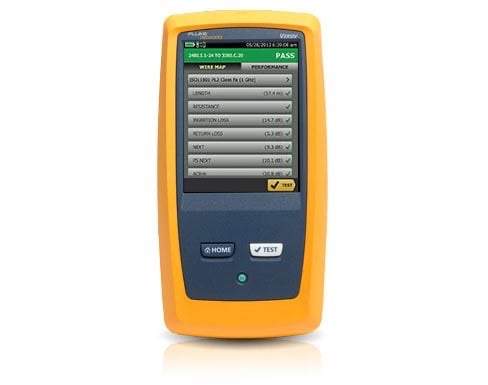
Why Test Documentation Matters as Much as the Test
An installation that performed perfectly during testing but is undocumented is treated by every future technician as suspect. They have no baseline to compare against, no record of what was originally tested, no way to know whether the problem they are diagnosing is new or old. The test report is what makes the installation auditable for the rest of its life.
Documentation also resolves payment disputes. If the contract says "all links shall be certified to TIA-568 Cat6A permanent link," the test report is the evidence that this requirement was met. Without the report, the contractor has no defense against a customer who claims work was incomplete.
The Labeling Discipline That Makes Reports Usable
Labels link the test report to the patch panel to the as-built drawings to the wall outlet. If any of those labels disagree, the report is unusable. Establish a labeling convention at project kickoff and enforce it ruthlessly.
Hierarchical labels
Build labels from the largest unit (building) down to the smallest (port). Examples:
B1-F2-IDF1-PP1-J17— Building 1, Floor 2, IDF 1, Patch Panel 1, Jack 17HQ-3-RM325-A04— Headquarters, Floor 3, Room 325, Outlet A, Position 4IDF1-J17— Smaller scope, just IDF and jack number
Pick one format and use it everywhere. The label on the test report, the label on the patch panel, and the label on the as-built must be identical character-for-character.
Match the certifier label to the printed label
Every certifier lets you enter a label before each test. Type the same label that is printed on the patch panel. Do not use shortened versions, do not improvise. Consistency wins.
Pre-create labels in the certifier
Most modern certifiers let you upload a list of labels in advance. Generate the list from the as-built drawings before mobilizing. The tester just selects the next label from the list, which guarantees no skipped or duplicated labels and dramatically speeds up testing.
What Every Cable Test Report Must Include
Project Identification
- Project name and street address
- General contractor name
- Owner name
- Cabling contractor (your company) with license number
- Project number / contract reference
Test Scope
- Cable category tested (Cat5e / Cat6 / Cat6A)
- Topology (permanent link / channel)
- Test standard (TIA-568.2-D, ISO/IEC 11801, manufacturer-specific)
- Cable manufacturer and part number
- Connector manufacturer and part number
- Total number of links tested
Tester Identification
- Certifier make, model, and serial number
- Firmware version
- Calibration date and certificate reference
- Permanent link adapter serial number
Per-Link Result
For every cable tested, the report must show:
- Link label (matching patch panel and as-built)
- Date and time of test
- Pass / Fail summary
- Length per pair (with worst-case noted)
- Insertion loss with margin to limit at worst frequency
- NEXT (worst pair-pair, with margin)
- PS-NEXT (worst pair, with margin)
- Return loss (worst pair, with margin)
- ACR-F / PS-ACR-F (worst pair, with margin)
- Propagation delay and delay skew
Summary Statistics
- Total links tested
- Pass count
- Fail count (should be 0 in final accepted report)
- Worst-case parameter margins across the entire installation
Sign-off
- Tester name and signature
- Date of completion
- Customer acceptance signature line
Deliverable File Formats
| Format | Audience | Use | Required? |
|---|---|---|---|
| PDF report | Owner, GC, AHJ | Reading, archive, project closeout binder | Always |
| Native certifier file (.flw, .lwm) | Future cable technicians | Re-analysis, troubleshooting decades later | Almost always |
| CSV summary | Facilities managers | Spreadsheet sorting, quick lookups | Often |
| Manufacturer warranty certificate | Owner, future warranty claims | 25-year warranty registration | If contract requires warranty |
| As-built drawings | All future trades | Locating cables in walls and ceilings | Always (separate deliverable) |
Most modern certifiers (Fluke LinkWare, Softing eXport, VIAVI ReportXpert) generate all three formats from a single test set. Confirm the customer's preferred format up front.
The Project Closeout Package
The complete package handed to the owner at project close should include:
Hard copy binder
- Cover sheet with project info and contractor details
- Acceptance letter with customer signature
- Test report (PDF, printed)
- Manufacturer warranty certificate
- As-built drawings (printed at usable scale, typically 11x17 or 24x36)
- NEC compliance certificates for cable and connectors
- Bill of materials with manufacturer part numbers
Digital archive
- All hard-copy documents as PDFs
- Native certifier files
- CSV summaries
- CAD as-built drawings (.dwg or .pdf)
- Photographs of patch panels, IDF rooms, and any unusual installation details
Delivery
Deliver the digital archive on a USB drive in the closeout binder, AND email a download link, AND store on your own cloud archive. Triple redundancy is appropriate for documents the customer will want in 15 years.
Customer training
Spend 30 minutes walking the facilities team through the closeout package. Show them the report, the file types, the warranty certificate, the as-built. They are the people who will reference this in five years; familiarize them with the structure now.
What AHJs Actually Care About
Authorities Having Jurisdiction — typically local building or electrical inspectors — care about code compliance, not data performance. They are looking for:
NEC 800 compliance
Cable type marking (CMR for risers, CMP for plenums, CM for general use), distance from line voltage, support spacing, fire stopping at penetrations, proper labeling. Provide manufacturer NEC ratings and a list of fire stop products used.
Listing labels
Cable jackets must have visible UL or ETL listing marks. Patch panels and termination hardware should similarly be listed. AHJs may pull cable from boxes to verify the marking.
Bonding and grounding
Where shielded cabling is used, the shield must be bonded per NEC 800.100. AHJs check the equipment grounding conductor connection at the equipment racks.
Fire protection
Penetrations through fire-rated assemblies must be sealed with listed fire stop products. AHJs inspect these visually and may require documentation of the fire stop product used and the rating.
None of this requires the data performance test report. Keep that report in the owner's closeout package; do not bundle it with AHJ submittals unless asked.
Frequently Asked Questions
What should a cable test report include?
Project identification, test scope (category, topology, standard), tester ID with calibration date, per-link results (label, length, NEXT, return loss, insertion loss, ACR-F, pass/fail), summary statistics, and signed sign-off. See network certification reports for the full anatomy.
What file format do customers want for test results?
PDF for reading, native certifier file (.flw, .lwm) for future re-analysis, and CSV summary for facilities managers. Provide all three even if only one is contractually required.
How should I label cable test results?
Hierarchical labels matching the patch panel labels and as-built drawings exactly. BUILDING-FLOOR-IDF-PANEL-PORT works for large projects; IDF-JACK works for smaller. Consistency matters more than the specific format.
How long should I keep test result records?
25 years for warranty-registered installations; 15-20 years for general work. Archive in cloud storage with backup, not just on the certifier's internal memory. Customers come back asking for original data years later.
Does the AHJ inspect cable test results?
Generally no. AHJs inspect NEC code compliance — cable type marking, fire stopping, separation from line voltage. Performance test reports are commercial documents between contractor and owner, not part of the AHJ submittal.
Get Certifiers That Make Reporting Easy
Modern certifiers automate report generation in PDF, native, and CSV formats — saving hours per project.