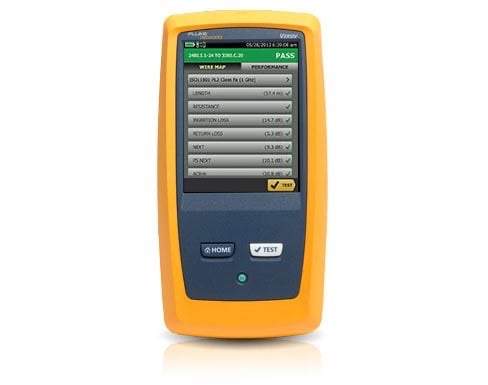
What a Validator Is (and Is Not)
The cable testing market splits into three tiers: verifiers (continuity, wiremap, basic length), validators (practical performance testing including BERT, length, and Ethernet standard validation), and certifiers (full TIA-568 frequency-domain measurement for warranty reports). The validator tier is where Byte Brothers and Fluke compete most directly.
Validators answer a specific question: "Will this cable reliably carry the Ethernet standard I intend to run on it?" They do this by running bit-error-rate tests at relevant speeds, measuring length and quality, and producing a clear pass/fail relative to gigabit, 10G, or higher Ethernet standards. They are faster than certifiers, less expensive than certifiers, and more informative than basic verifiers.
What validators do not do: produce TIA-1152-A frequency-domain measurements, generate certification reports accepted by warranty programs, or substitute for a certifier when contracts require formal certification. The "Real World Certifier" name on the Byte Brothers RWC1000 is somewhat marketing-driven -- the device is a validator by industry definition, not a TIA certifier.
Quick Verdict
Pick Fluke CableIQ Qualification Tester if: You want network-side analysis (switch port discovery, link speed and duplex) alongside cable validation. You are already in the Fluke ecosystem (LinkWare, MicroScanner, DSX) and want consistency.
Pick Fluke LinkIQ if: You need 10G validation, deeper network analysis, and modern touch-screen UI. The LinkIQ is a step up from CableIQ in capability and price.
Pick neither -- step up to a certifier -- if: Your contracts ever require TIA-568 certification or warranty-program reports. The validator tier does not produce these.
Side-by-Side Comparison
| Feature | Byte Brothers RWC1000 | Fluke CableIQ | Fluke LinkIQ |
|---|---|---|---|
| Tier | Validator | Validator + qualifier | Network analyzer + cable performance |
| Wiremap | Yes | Yes | Yes |
| TDR cable length | Yes | Yes | Yes |
| Distance to fault | Yes | Yes | Yes |
| Bit-error-rate (BERT) | Yes (10/100/1000) | Yes (10/100/1000) | Yes (to 10G) |
| Ethernet standard validation | Yes (clear pass/fail) | Yes | Yes (cable category) |
| Cable performance (frequency) | No | Limited | Yes (to 500 MHz) |
| PoE detection | Yes | No | Yes |
| Network analysis (VLAN/DHCP) | Limited | Limited | Yes |
| Switch port discovery | No | Yes | Yes |
| Reporting / documentation | Built-in | LinkWare | LinkWare / LinkWare Live |
| TIA-568 certification | No | No | No |
| Interface | Buttons + LCD | Buttons + LCD | Touch + buttons |
| Price tier | $$$ | $$$ | $$$$ |
Byte Brothers Real World Certifier (RWC1000)
The Real World Certifier is a focused validator. It runs a battery of practical tests -- wiremap, TDR length, bit-error-rate at 10/100/1000 Mbps, and PoE detection -- and produces a clear answer to the question "what Ethernet standard will this cable support reliably?" The output is unusually direct: instead of a list of measurements, it tells you "this cable passes for Gigabit Ethernet" or "this cable will not reliably carry Gigabit -- it is rated for Fast Ethernet only."
This kind of unambiguous output is genuinely useful for installer-customer conversations. When the customer asks "is this cable good for Gigabit?" you have a crisp answer -- not a wall of measurements they cannot interpret. For installers who validate on every job and want fast, clear results, the RWC1000 workflow is a strength.
The PoE detection adds value: most validators in this tier skip PoE, requiring a separate PoE tester. The RWC1000 includes it, simplifying the daily kit.
The tradeoffs: no network analysis (you cannot use it to discover VLANs or DHCP behavior), no switch port discovery, less polished reporting software than the Fluke ecosystem, and the cable performance measurement is BERT-based rather than frequency-domain so it does not characterize cable quality the way a true certifier does.
Best for: Installers who want fast, clear cable validation. Shops that prioritize crisp customer-facing output over deep network analysis. Crews looking for one tool that handles both cable validation and PoE detection.
Byte Brothers TVR Series
Byte Brothers also offers the TVR cable test series at a lower price tier than the RWC1000. The TVR40 and TVR400 focus on cable-side validation -- length, distance to fault, wiremap -- without the BERT-based Ethernet standard validation that defines the RWC1000. Think of the TVR series as the verifier-tier offering from Byte Brothers, complementing rather than competing with the RWC1000 validator.
For shops that want Byte Brothers tools at a verifier price point (rather than Klein VDV Scout Pro 3 or Platinum Tools VDV MapMaster), the TVR series is worth evaluating. For pure validator work, the RWC1000 is the right Byte Brothers product.
Fluke CableIQ Qualification Tester
The CableIQ is Fluke's qualification-tier tool, sitting between the MicroScanner verifier and the LinkIQ network analyzer. It performs wiremap, length, distance-to-fault, BERT-based Ethernet qualification at 10/100/1000 Mbps, and switch port discovery. Results integrate with LinkWare for organized documentation -- a meaningful workflow advantage over the RWC1000's standalone reporting.
The CableIQ's strength is its position in the Fluke ecosystem. Shops that own MicroScanner verifiers and DSX certifiers benefit from a qualifier that uses the same software (LinkWare) and the same accessory style. Test result organization stays consistent across the entire Fluke fleet.
The tradeoffs: no PoE detection (you need a separate PoE tester or step up to LinkIQ), more menu navigation than the RWC1000's focused workflow, and pricing typically a notch higher than the RWC1000.
Best for: Shops standardized on Fluke for verification and certification who want a qualifier in the same ecosystem. Crews who value LinkWare integration. Workflows where qualification fits between MicroScanner and LinkIQ tier needs.
Fluke LinkIQ (Step Up From Validators)
The LinkIQ is technically a step above the validator tier but worth mentioning here because many buyers cross-shop CableIQ and LinkIQ. The LinkIQ adds 10G Ethernet validation, deeper network analysis (VLAN, DHCP, switch port discovery, CDP/LLDP), cable performance testing up to 500 MHz, PoE detection, and a touch-based interface. Pricing is meaningfully higher than CableIQ or RWC1000.
For installers and MSPs who want one tool that does cable validation, network analysis, and PoE testing -- and who can justify the price -- the LinkIQ is more capable than either pure validator. For shops that only need cable validation and have separate tools for PoE and network analysis, the LinkIQ overshoots the actual need.
For more on this tier, see our Fluke LinkIQ vs NetAlly LinkRunner 10G head-to-head.
How to Choose: By Workflow
Installer who validates every cable on every job
The Byte Brothers RWC1000 is the focused choice. Fast, clear output, PoE included, low menu friction. Validation throughput is the priority and the RWC1000 optimizes for it.
Fluke shop adding qualification capability
Fluke CableIQ for ecosystem consistency. LinkWare reporting, MicroScanner-compatible accessories, and unified Fluke training for the crew. The price-to-value relative to RWC1000 is close enough that ecosystem consistency tilts the decision.
Installer who also needs network analysis
Step up to Fluke LinkIQ or NetAlly LinkRunner. Pure validators do not handle deep network-side diagnostics. If you find yourself reaching for a separate network tool on every job, consolidate into a network analyzer that includes validation.
Installer who needs certification reports
Step up to a certifier (Fluke DSX, Softing WireXpert, Ideal LANTEK). Validators do not produce TIA-568 certification reports regardless of brand. Buying a validator and hoping it will satisfy customers who require certification is a recipe for return visits and lost revenue.
Related Reading
- Cable Tester vs Certifier -- understanding the verifier/validator/certifier tiers in depth.
- Best Cable Testers for 2026 -- the broader landscape.
- Fluke LinkIQ vs NetAlly LinkRunner -- the next tier up from validators.
Who Actually Buys Validators
Understanding who fits the validator tier helps you decide whether you fit too. Below are the typical buyer profiles where validators excel.
Mid-tier installer with quality customers
Installers serving customers who care about quality but do not require formal TIA-568 certification. The cable will run gigabit reliably, the customer wants proof, but no contract clause demands a warranty-grade certifier. Validators serve this profile perfectly -- defensible results, fast workflow, lower cost than a certifier.
MSP with cable installation as a service line
MSPs that primarily troubleshoot networks but occasionally pull and terminate new cables benefit from a validator that adds proof-of-quality without the certifier price. Pair the validator with a network analyzer for the full kit.
Internal IT for a single facility
In-house IT teams supporting one or two large buildings often want better than verifier-tier confirmation but cannot justify a certifier. A validator gives them confidence that the cable will support the application without the warranty-grade documentation overhead they do not need.
Backup tester for cert shops
Some shops own a primary certifier (Fluke DSX, Softing WireXpert) and a validator as backup or for non-warranty work. Validators run faster than certifiers and produce results good enough for routine validation, freeing the certifier for warranty-eligible projects only.
BERT vs Frequency-Domain Testing
Validators and certifiers approach the same fundamental question -- "is this cable good enough?" -- from opposite directions. Understanding the difference helps you decide which tier matches your work.
The validator approach: BERT
Bit-error-rate testing transmits actual Ethernet frames at the target speed and counts errors. The Byte Brothers RWC1000 sends a stream of frames at 1000 Mbps and reports how many were received with errors. If the error rate is below the standard's threshold, the cable passes. The logic is direct: the test condition matches the use condition. This is appealing because the cable is being tested under the conditions it will actually experience.
BERT's limitation: it tests the cable at the transmission speed, in the moment, with the test patterns the tester generates. It does not characterize the cable's frequency response across the full spectrum the standard requires. A cable that passes BERT today might be marginal under temperature stress, near interference sources, or with different transmission patterns. BERT validates fitness for use; it does not characterize quality.
The certifier approach: frequency-domain
True certifiers (Fluke DSX, Softing WireXpert, Ideal LANTEK) sweep the cable across a defined frequency range and measure parameters like NEXT, return loss, and insertion loss across the spectrum. The cable is then graded against the TIA-568 mask for the target category. The logic is indirect: instead of running Ethernet frames, the tester characterizes the cable's electrical properties and infers fitness for the standard.
Frequency-domain testing's strength: it characterizes the cable thoroughly, producing measurements that catch problems BERT might miss, and the results are reproducible by any other certifier on the same cable. This is why warranty programs require certification reports rather than BERT results -- the data is consistent and characterizes the cable, not just the moment of test.
What this means for your buying decision
If your work is "make sure the cable will run gigabit reliably," BERT-based validators are appropriate and faster. If your work includes "produce defensible documentation that the cable meets Cat6A standards," only frequency-domain certifiers produce the right output.
Buying a Validator: What to Verify
Before pulling the trigger on a validator, confirm the specifics. Vendor product pages and datasheet headlines do not always match the tool's actual capabilities.
What Ethernet standards does it actually validate?
"Tests gigabit" can mean BERT at 1000 Mbps (the actual standard) or just "tests cables that should support gigabit" (less rigorous). Confirm the tool runs actual BERT against the speed standard you care about, with industry-standard test patterns and pass/fail thresholds.
Does it test at the cable's intended length?
Some validators test at fixed lengths and infer performance for longer runs. The right validator tests the actual installed length and reports based on real measurement, not extrapolation. Ask the vendor how their tool handles your typical cable length range.
What is the documentation output?
Some validators produce simple LCD output -- you write down the result. Others save results internally and export to PC software. For installer work where any kind of documentation matters, software-backed validators (Fluke CableIQ with LinkWare) win over LCD-only tools.
Calibration interval and cost
Validators are not held to certifier calibration standards but still benefit from periodic calibration to maintain accuracy. Ask about the recommended interval and cost. Tools that drift without calibration produce results that erode trust over time.
Test cord wear and replacement
Test cords are the standard wear item on every cable tester. They flex, get crimped against panels, and degrade over time. Ask about replacement cord cost and availability before buying. A tool with hard-to-source replacement cords is an expensive maintenance problem waiting to happen.
Frequently Asked Questions
What is a cable validator?
A tool that sits between a verifier and a certifier. It runs practical tests including BERT, length, and Ethernet standard validation to confirm a cable will support its intended application. Byte Brothers RWC1000 and Fluke CableIQ are the canonical examples.
Is Byte Brothers Real World Certifier actually a certifier?
Despite the name, no -- not in the TIA-568 sense. It is a validator. It does not produce TIA-1152-A frequency-domain measurements required for warranty-grade certification. For warranty work, you need a Fluke DSX, Softing WireXpert, or Ideal LANTEK.
Byte Brothers RWC1000 vs Fluke CableIQ: which validator wins?
Both are credible. RWC1000 has a more focused, clearer-output workflow and includes PoE. CableIQ has better Fluke-ecosystem integration with LinkWare and adds switch port discovery. Pick on workflow fit and ecosystem alignment.
Do these validators handle PoE?
The Byte Brothers RWC1000 includes PoE detection. The Fluke CableIQ does not -- you need a separate PoE tester or step up to LinkIQ. Always verify PoE capability against the specific model before purchase.
Validator or certifier?
Validator if customers do not require TIA-568 certification reports. Certifier if your contracts require certification, you participate in cable manufacturer warranty programs, or you need defensible documentation. The price gap from top validator to entry certifier is meaningful but not enormous.
Find Your Validator
Validators, qualifiers, and network analyzers from Byte Brothers, Fluke, NetAlly, and Platinum Tools. Expert support to right-size the tier to your work.