Quick Recommendations
Best multi-media (data + coax + phone): Klein Scout Pro 3 ($80). One tester, three jacks, durable enough for a tool pouch.
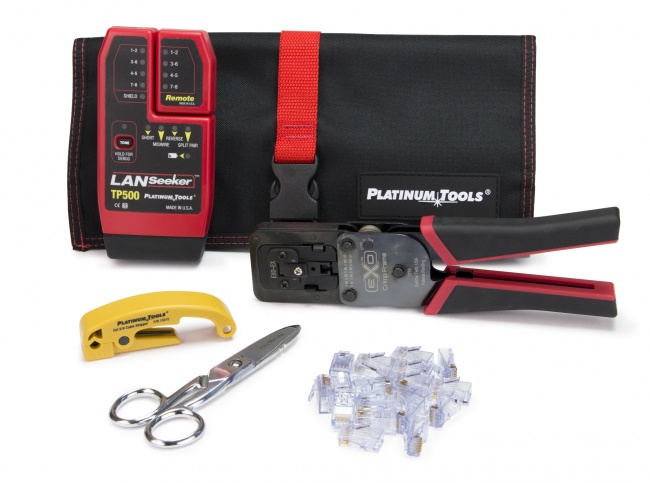
Best pocket verifier: Platinum Tools LanSeeker ($80.08). One-button pass/fail with a built-in toner.
What Electricians Actually Need a Cable Tester to Do
Electricians don't run cable the way data contractors do. You're typically pulling four to twelve drops in a residential rough-in, terminating data along with phone and coax in the same low-voltage box, and getting in and out fast. Your tester has to be quick, durable, and capable of catching the faults that matter.
The four things you actually use a cable tester for on a typical job:
- Verify wiremap. Did the wires land on the right pins? This is 80% of cable testing.
- Find the fault. When something fails, where is the break? Distance-to-fault tells you whether the problem is at the patch panel, in the wall, or at the keystone.
- Identify cables. Which run goes where? Tone tracing in an unmarked bundle is half the workday.
- Catch split pairs. The fault basic LED testers miss. Cables with split pairs pass continuity but fail under load.
If your tester does those four things, you're covered for 95% of the work. Everything beyond that is for jobs where you're billing certification or troubleshooting active networks.
Comparison Table: Top Picks for Electricians
| Tester | Price | Best For | Standout Feature |
|---|---|---|---|
| Platinum LanSeeker | $80.08 | Pocket verification | One-button operation, built-in tone |
| Klein Scout Pro 3 | $80 | Multi-media electricians | Tests RJ45, coax, and RJ11/12 in one unit |
| VDV MapMaster 3.0 | $168.14 | Daily structured cabling | Distance-to-fault + numbered remote ID mapping |
| Digital Tone & Probe | $202.66 | Tracing existing runs | Digital tone rejects power-line noise |
Best Overall: Platinum Tools VDV MapMaster 3.0
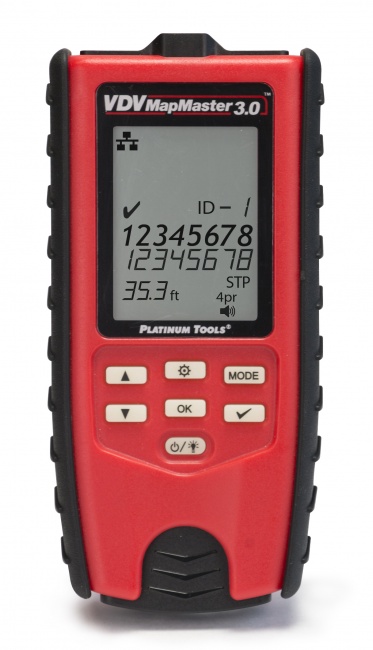
If you're an electrician who pulls data more than occasionally, this is the tester to buy. At $168.14 it sits at the price floor of professional qualification testing, meaning it actually does the things a cheap LED tester pretends to do.
Why it works for electricians
The MapMaster gives you a pin-by-pin wiremap on the screen, not just LEDs. When a cable fails, you see exactly which pin is open, shorted, or miswired. Distance-to-fault tells you the cable is broken at 47 feet, which on a 60-foot run usually means it's in the wall, not at either end. That alone has saved enough callback time to pay for the tester many times over.
The numbered ID remotes are the secret weapon. Drop them at every keystone in a multi-room install, then walk back to the patch panel and ID every cable in one pass. You're not guessing which RJ45 is the kitchen anymore.
For deeper detail on what qualification testing covers, see our cable tester vs. certifier guide. Buy the MapMaster 3.0.
Best for Multi-Media Electricians: Klein Scout Pro 3
The Klein Scout Pro 3 (model VDV501-851) is the tester for electricians whose tickets hop between data, coax, and phone in the same box. It tests RJ45 (Cat5e/6/6A), F-connector coax, and RJ11/RJ12 phone lines with built-in jacks: no adapters to lose.
What it does well
The included remote kit covers all three cable types, so you can verify installed runs without dragging a separate tester for each medium. Backlit display, pass/fail with fault identification, and Klein durability, the same brand whose hand tools are already in your pouch. At $80 it's the value pick when you genuinely work all three media.
Where it falls short
No length measurement, no distance-to-fault, no split-pair detection. If you're doing structured cabling as a regular part of your work, you'll outgrow the Scout Pro 3. For electricians who touch data once a week, it's perfect.
Best Pocket Verifier: Platinum Tools LanSeeker
Some testers need to fit in a shirt pocket and run on a 9V battery for a year. The LanSeeker is that tester. Push the button, get pass/fail. Built-in tone generator works with any analog probe. $80.08.
This is the right tool for electricians who carry a "real" tester in the truck but want something on their person to verify a quick patch cable, check a jumper, or trace a single run without hauling out the kit. We sell more LanSeekers as second testers than as primary ones.
When to Step Up to a Speed Certifier
Most electricians never need a certifier. The exceptions are predictable:
- You're bidding commercial structured cabling work where the spec calls out gigabit performance
- The general contractor requires PDF reports with each drop documented
- You're a low-voltage subcontractor whose competitors all show up with certifiers
In those cases, the entry to speed certification is a gigabit speed qualifier: it tests actual Ethernet throughput and generates PDF reports, which is what most clients actually want, even when they say "certified." Platinum Tools discontinued the unit that filled that tier for us, so it is a rental or subcontract step. For full TIA-568 certification with NEXT, return loss, and insertion loss measured, you're looking at a Fluke DSX or Softing WireXpert, both quote-only here. See our DSX vs. WireXpert breakdown for that decision.
Don't Forget the Toner
Cable identification is half the job in any building older than five years. Crews show up to find a punch-down with no labels, a 24-port patch panel where six ports actually go somewhere, and a homeowner who insists "the contractor labeled them, I don't know what happened."
A dedicated Digital Tone & Probe at $202.66 is the right answer. Digital tone rejects the noise from fluorescent ballasts and power wiring that confuses cheap analog probes, exactly the environments electricians work in.
What to Avoid
Sub-$25 LED testers
The Amazon-special LED testers under $25 will tell a split pair is fine. They check for continuity per pin but not the physical pair routing. A cable can light all 8 LEDs in sequence and still fail a real network test. Skip them.
Multifunction "do-everything" cheap testers
The $80 Chinese imports that claim wiremap, length, PoE, and tone are universally bad at all four. Their length measurement is wrong by 30%, their PoE detection is unreliable, and their tone output is too quiet to trace through a wall. Buy purpose-built tools from established brands.
Used Fluke MicroScanners on eBay
The original MicroScanner is a great tool but the calibration drifts and there's no service support left for older units. If you want Fluke quality, buy current.
Frequently Asked Questions
What cable tester do most electricians actually use?
Most working electricians who do data work carry the Platinum Tools VDV MapMaster 3.0 ($168.14) or the Klein Scout Pro 3 ($80). The MapMaster is better for structured cabling because it adds length, distance-to-fault, and split-pair detection. The Klein wins if you hop between RJ45, coax, and phone on the same job.
Do electricians need a certifier?
Almost never. Certifiers like the Fluke DSX are for jobs where the contract requires TIA-568 or ISO 11801 certified results. For everyday electrical work, residential data drops, and small commercial jobs, a qualification tester gives you everything you need.
Can a cable tester check coax and phone lines too?
Some can. The Klein Scout Pro 3 tests RJ45, coax, and RJ11/RJ12 in one unit. The MapMaster 3.0 tests data, voice, and video with appropriate adapters. If you regularly work all three media, look for a multi-function VDV tester.
What's the cheapest cable tester worth buying?
The Platinum Tools LanSeeker at $80.08 is the floor for a tool worth carrying. Pass/fail wiremap, built-in tone, runs on a 9V battery. Below that, you're looking at unbranded LED testers that lie about split pairs.
Find the Right Tester for Your Truck
The testers we list are sourced per order and shipped within 3 to 5 business days. Free shipping on orders of $100 or more.